Tempura
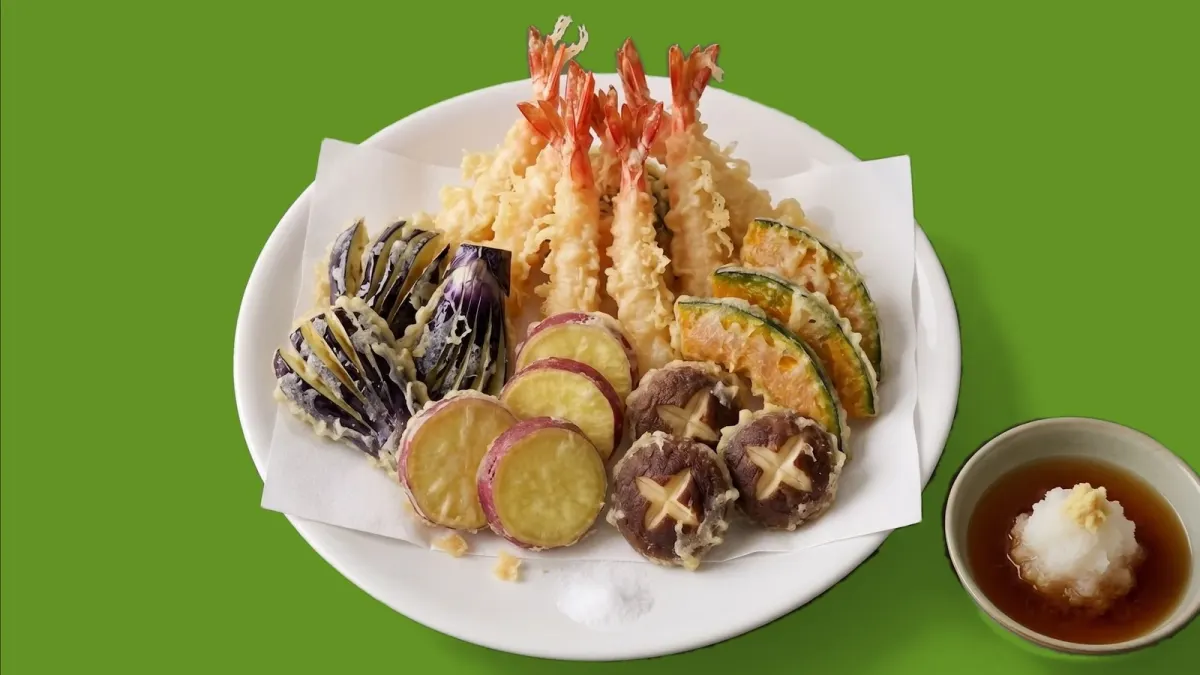
Prawns and vegetables in a cold, barely stirred batter, fried in batches: home frying for the days that are a little bit special.
- In all
- 53min
- Hands-on
- 53min
- No waiting
- 0
- You save With the steps in parallel, instead of one at a time.
- −6min
Difficulty: 4 of 5. 450 kcal each (estimate) With the steps in parallel, instead of one at a time.
The median
The quantities are the median of the versions that give them, not one person’s opinion.
The time
The sources 40min
The plan 53min
3 of 12 sources state a time: 20min to 40min, median 40min.
Ingredients · 4 people
- Raw peeled prawns 160 g
- Aubergine 160 g
- Sweet potato 100 g
- Pumpkin (kabocha squash) 110 g
- Fresh shiitake mushrooms 4
- 00 flour 120 g
- Eggs 1
- Vegetable oil 720 g
- Sesame oil 6 tablespoons
- Dashi 200 ml
- Soya sauce 3 tablespoons
- Mirin 3 tablespoons
- Daikon (mooli) 150 g
- Fresh ginger to taste
- Salt to taste
The plan
53min, all hands-on.
for 4 · one cook · one pan and two pots
- 01 Clean and straighten the prawns hands-on, minutes 0–8
- 02 Cut the vegetables hands-on, minutes 8–16
- 03 Make the tentsuyu and grate the daikon hands-on, minutes 16–22
- 04 Heat the oil watching, minutes 21–27
- 05 Make the batter at the last minute hands-on, minutes 22–27
- 06 Fry the vegetables in batches hands-on, minutes 27–45
- 07 Fry the prawns hands-on, minutes 45–51
- 08 Serve straight away hands-on, minutes 51–53
- hands-on
- watching
- waiting
The plan is for one cook, with one pan and two pots: PREP lines the steps up side by side.
In the app this plan guides you step by step, and rings when a pot is ready. Notify me
The steps
-
01 Clean and straighten the prawns
Peel them leaving the tail on, pull out the black vein, trim the tip of the tail, score the belly and straighten.
- Take off the shell leaving the last segment and the tail, and pull out the dark vein along the back with a cocktail stick: left in, the prawn curls up as it cooks and takes on a muddy smell. Fourteen recipes out of seventeen prepare the whole prawn this way, and all fourteen pull the vein out.
- Trim the tip of the tail and the pointed blade in the middle of it, and with the back of the knife squeeze out the water that collects in there: that's what makes the oil spit. Twelve recipes trim the tail, eleven also write down why.
- Make four or five shallow diagonal cuts across the belly, then lay the prawn on the chopping board and press down from above until you feel a small crack: the sinews snap and the prawn stays straight instead of curling in the oil. Twelve recipes out of seventeen either score it or straighten it by hand.
- Dry only the surface with kitchen paper, without pressing on: take too much water out of the prawn and the flavour goes with it, warns the flour mill's cookbook. Then into the fridge until it's time for the batter.
- Prawns are among the nine allergens Japanese law requires you to declare, and in Europe crustaceans are on the same list: if you're cooking for guests, say so before you fry. And while they're raw they stay in the fridge below four degrees and out of it for no more than two hours: that's the rule the Japanese food safety authority gives for raw fish and shellfish, where the bacterium of the hot summers lives.
IT’S READY WHEN Prawns straight and dry, tails trimmed clean, the dark vein gone.
-
02 Cut the vegetables
Sweet potato and squash in thin slices with the skin on, aubergine fanned out, shiitake with the stalk off.
- Sweet potato in rounds a little over half a centimetre thick with the skin on, straight into cold water so it doesn't darken; squash in wedges of the same thickness, seeds and strings out, skin left on. The sources sit between half a centimetre and one: any thicker and they stay raw inside, and the flour mill's cookbook warns that then you have to fry them for a long time.
- Aubergine: cut off the stalk, quarter it lengthways and on each quarter make close parallel cuts leaving the tip attached, then open it out into a fan with your fingers. The cuts let the heat into a vegetable full of water, and they make the slice look good.
- Shiitake with the stalk off and a cross scored in the cap; if you can't find them, big button mushrooms. Small sweet green peppers — in Japan they're shishito, and they turn up in six recipes out of seventeen — get one cut lengthways or two holes with a cocktail stick, or they burst in the oil.
- Dry everything with kitchen paper before flouring: it's the water on the surface that makes the oil spit and lifts the batter off. The sweet potato comes out of the water last and is dried straight away.
- Shiso leaves, which eight recipes out of seventeen add, are fried with batter on one side only and for a few seconds: if you can find them, they're the lightest thing on the plate.
IT’S READY WHEN Slices all the same thickness, aubergines opened into fans, everything dry on the kitchen paper.
-
03 Make the tentsuyu and grate the daikon
Dashi, soya sauce and mirin in a small pan, one boil, then left to cool; daikon grated and squeezed to one side.
- Four parts dashi, one of soya sauce, one of mirin: it's the median ratio of seven recipes, from the Ministry's cookbook to the soya sauce company's. Bring it to the boil, let it simmer for a minute so most of the alcohol in the mirin goes, and turn off the heat: it's served warm or cold.
- If you haven't got dashi ready, water with soya sauce and mirin and, off the heat, a handful of katsuobushi left to infuse for a few minutes and then strained: it's the route of two company cookbooks. Three recipes out of seven also add a teaspoon of sugar, and then the tentsuyu comes close to the tendon one.
- Grate the daikon finely, squeeze it lightly in a sieve and set it aside: it goes into the tentsuyu at the last moment, with a little grated ginger. A Ginza cook makes his much lighter, six parts dashi to one of mirin and half a part of each of the two soya sauces.
- The tentsuyu is made first because it has to cool, and because once the oil is on the heat there's no time left for anything: two sources say so, and one writes it as the first line of the recipe.
IT’S READY WHEN The tentsuyu has boiled for a moment and is resting off the heat; the daikon is a damp snow in the sieve.
-
04 Heat the oil
Three centimetres of oil in a wide, heavy frying pan, a tenth of it sesame oil and no more, at 170-180 degrees.
- Three centimetres of oil, actually measured with a chopstick held upright: the most thorough cookbook warns that two and a half centimetres always look like more than they are. With too little oil the temperature collapses at the first piece and the batter drinks instead of frying: «plenty of oil» is the iron rule of a cookery publisher.
- A frying pan or saucepan of 22-24 centimetres, wide and heavy, that holds its heat; a Ginza master at home uses a thick frying pan of 26-28. Neutral vegetable oil with a tenth of toasted sesame oil, no more: it gives the scent of Tokyo tempura without covering the vegetables. The Edo street stalls fried in pure sesame, and the Ministry's cookbook still puts in three parts out of ten.
- You can see the right temperature without a thermometer, and seven sources explain how: a drop of batter should sink halfway down and come straight back up. If it reaches the bottom and rises slowly you're under 160, if it stays on the surface and spreads you're over 180.
- Start at the top of the range, towards 175-180: every batch takes the oil down a few degrees, and in a home frying pan the drop is sharper than in a restaurant's big pot. Roots want a few degrees less, seafood a few degrees more.
- If the oil smokes, turn the heat down at once: above 200 degrees it spoils, and higher still it catches fire on its own without anyone bringing a flame near it. If it does catch fire, turn off the hob and cover the whole pan with a lid to cut off its air; never water, which boils all at once and scatters burning oil, and vegetables thrown in do the same. And a pan on the heat is never left on its own.
IT’S READY WHEN A drop of batter sinks halfway and comes back up sizzling; not a wisp of smoke.
-
05 Make the batter at the last minute
Egg beaten into iced water, then the sifted flour: a few stirs, lumps and all.
- Water and egg first, then the flour: beat the egg into the iced water until it makes a white froth, and lift the froth off with a spoon, because that's what weighs the batter down and burns. Only then pour in the sifted flour and stir with chopsticks a few times, just until you can no longer see dry flour: the lumps stay, and that's how they should be.
- The water is one and a half times the weight of the flour and the egg one for every hundred grams: those are the medians of sixteen recipes. Cold, because gluten forms between 25 and 30 degrees, explains the flour mill's cookbook: water from the fridge, or water with ice cubes taken out before you measure. Anyone who wants a lighter crust uses half an egg, as the most thorough cookbook does; three sources use the yolk alone, and that's the cooks' choice.
- A few stirs is the rule of fifteen sources out of sixteen: a smooth, even batter is a batter with the gluten developed, which fries chewy and holds on to the oil. One flour mill measures it out as ten beating strokes and twenty quick cuts. The dissenting voice is a cook on public television who beats it until it turns smooth, so as not to taste the flour: one against fifteen, and you can try it knowing it isn't the majority's route.
- It's made at the last minute, with the oil already on the heat: the Ministry's cookbook writes it down as a rule, and the others warn that standing still, or warming up, the batter turns tough. If any is left over, into the fridge: the next day it's fine for vegetable fritters, no longer for tempura.
- A trick that goes round in the comments on the cookbooks: sparkling water in place of still, for a lighter crust. In the Kansai the batter is made without egg and comes out white and soft, and anyone who wants it crisp for longer can put in a tablespoon of potato starch in place of the same amount of flour.
IT’S READY WHEN A runny batter that drips straight off the chopsticks, with visible lumps of flour and no froth on the surface.
-
06 Fry the vegetables in batches
Flour them, dip them in the batter, fry a few pieces at a time: roots first, then aubergines and mushrooms.
- Vegetables first and prawns after: seafood dirties the oil, and the vegetables want a few degrees less. Five sources say so, two of them cookbooks from flour companies; the Ministry's cookbook does the opposite and stays in the minority, one against five.
- A veil of flour on every piece, shaken off, then the dip in the batter: the flour acts as glue, seals the water in and keeps the crust attached. Eleven sources do it; the flour mill warns that on roots it isn't needed, and that on squash and sweet potato it's better skipped so their colour shows through.
- A few pieces at a time, never more than half the surface of the oil and never touching each other: every piece lowers the temperature, and crowded tempura comes out limp. Sweet potato and squash first, three or four minutes, turning them once when the crust has set; the aubergine skin side down, three minutes; the shiitake with the batter on the cap, two or three.
- With roots the acrylamide rule applies: the Japanese ministry and the European food safety authority ask for sweet potato and fried vegetables to be barely golden in colour, never brown, and the threshold the European authority gives for frying is 175 degrees. A proper tempura is pale.
- Between one batch and the next lift out the crumbs of batter with a slotted spoon, because they burn and dirty the oil, and let the temperature climb back. Drain the pieces standing up on a rack, not piled up and not straight onto kitchen paper: steam would form underneath and the crust would go soft.
IT’S READY WHEN The big bubbles around the piece turn small and the sound rises in pitch; the piece floats to the surface; a cocktail stick goes into the sweet potato meeting just a little resistance. Crust pale, barely golden.
-
07 Fry the prawns
Hotter oil, prawns floured and dipped in the batter held by the tail, two and a half minutes.
- Turn the heat up for a moment: the prawns want the oil at 175-180, a few degrees above the vegetables, and the flour mill explains that seafood is fried hotter and faster. Hold them by the tail, take them through the flour and the batter leaving the tail bare, and lower them in waving them back and forth across the surface of the oil: that way they don't bend.
- As soon as it's in, let a few drops of batter fall from the chopsticks over the prawn: those are the fringes that make the tempura of the street stalls. Turn it once when the crust has set.
- Two and a half minutes in all, the median of the sources for the large prawn: the tail turns red, the bubbles get small, the prawn comes to the surface. Inside it has to be opaque and firm right to the centre. The Japanese food safety authority's report says that at 65 degrees the shellfish bacterium falls to a tenth in a minute: in a frying pan at 180 degrees the prawn goes well beyond that.
- The «rare» prawn that a Ginza cook fries for twenty seconds in scorching oil is another dish, and it needs prawns sold to be eaten raw: at home, cook it right through.
IT’S READY WHEN Red tail, pale crust with its fringes, small bubbles; the prawn floats and, cut open, is white and opaque right to the centre.
-
08 Serve straight away
Onto the plate straight from the pan, tentsuyu with daikon and ginger in a small bowl, salt on the side.
- Tempura is eaten within a few minutes: the crust soaks up the moisture from the piece and goes soft. In restaurants they fry one piece at a time in front of the diner for exactly this reason; at home, whoever fries eats last.
- The tentsuyu in the small bowl with a little heap of grated daikon and a bit of ginger: you dip for a moment, you don't leave it to soak. Or else a pinch of salt, which is the Kansai custom for vegetables and which plenty of Tokyo stalls have taken up; some people mix it with Japanese Sichuan pepper.
- The grated daikon isn't an affectation: at the Edo street stalls the tempura dripped with oil and was eaten off a skewer, with the daikon alongside to cut the grease.
- At dinner on 31 December the tempura prawn ends up on top of the year-end soba, and it's no accident: a Japanese survey puts tempura eighth among New Year's Eve dinners, and some people set aside the ingredients they've bought for the osechi and fry them this way.
- With the tentsuyu sweeter and reduced, tempura becomes the tendon of the Edo street stalls: the frying doesn't change, what changes is that it goes onto hot rice with its sauce.
IT’S READY WHEN Pieces standing up on the plate, still sizzling, warm tentsuyu alongside.
Where the sources disagree
- 1
Whole egg, yolk or none
Fourteen recipes out of sixteen put the whole egg in the batter and two only the yolk, the Japanese Ministry of Agriculture's among them, while in the Kansai region the egg is left out. Here it's the whole egg, like the majority. If you want a thin, crisp, flavourful coating, a Ginza chef recommends the yolk alone; without egg and with vegetable oil, the tempura comes out white and soft.
- 2
Lumpy or smooth batter
Fifteen sources out of sixteen stir the batter only a few times and leave the lumps in; just one beats it until smooth: a recipe by Tamura, a Tsukiji chef, for NHK. Here the lumps stay, like the majority: overmix it and the batter turns heavy and the coating won't crisp up. Tamura argues that a smooth batter doesn't taste of flour, comes out dry and holds less oil.
- 3
What to fry first
Five sources fry the vegetables first and then the prawns; only the Japanese Ministry of Agriculture's recipe does the opposite. Here it's vegetables first, like the majority: seafood dirties the oil, warns Delish Kitchen, and once oil is hot it's hard to cool down, explains the flour miller Nisshin, so you start with what needs less heat. Start with the prawns and you'll have to turn the heat down afterwards, frying the vegetables in oil that's already dirty.
Where the numbers come from
This recipe compares 12 sources. The quantities are the median of the versions, not one person’s opinion: where the sources disagree, the majority wins. Here they all are.
- 白ごはん.com — 天ぷらの基本のレシピ~衣・油・揚げ方まで~ 40min
- デリッシュキッチン — 具材ごとにポイントを解説!サクサクおいしい天ぷら 40min
- オレンジページnet — 基本の「天ぷら」のレシピ —
- NHK みんなのきょうの料理 — えびの天ぷら(髙城順子) —
- NHK みんなのきょうの料理 — 野菜の天ぷら(髙城順子) —
- NHK みんなのきょうの料理 — えびと野菜の天ぷら(野﨑洋光) 20min
- 日清製粉グループ — こむぎ粉料理の基礎とコツ:天ぷら —
- キッコーマン ホームクッキング — 基本のえび天ぷら —
- 農林水産省 うちの郷土料理 — てんぷら(東京都) —
- 農林水産省 — アクリルアミド:家庭調理でできること —
- 食品安全委員会 — リスクプロファイル:生鮮魚介類における腸炎ビブリオ(2012) —
- 文部科学省 食品成分データベース — バナメイえび 養殖 天ぷら(10416) —
- With PREP’s plan 53min
Published .
Allergens
- Crustaceans
- Gluten
- Eggs
- Sesame
- Fish
- Milk
- Soya
They come from the recipe's list. The label on what you buy is what counts.
More recipes
- Okonomiyaki 24min
- Karaage 41min
- Churros with hot chocolate 1h
Coming to the App Store.
This recipe is all hands-on: 53min with no waiting. PREP keeps the time, step by step, and at the end makes you a postcard.
Leave your email: we’ll write once, when it’s out.
We count visits to the website without cookies and without knowing who you are.
One step left.