Karaage
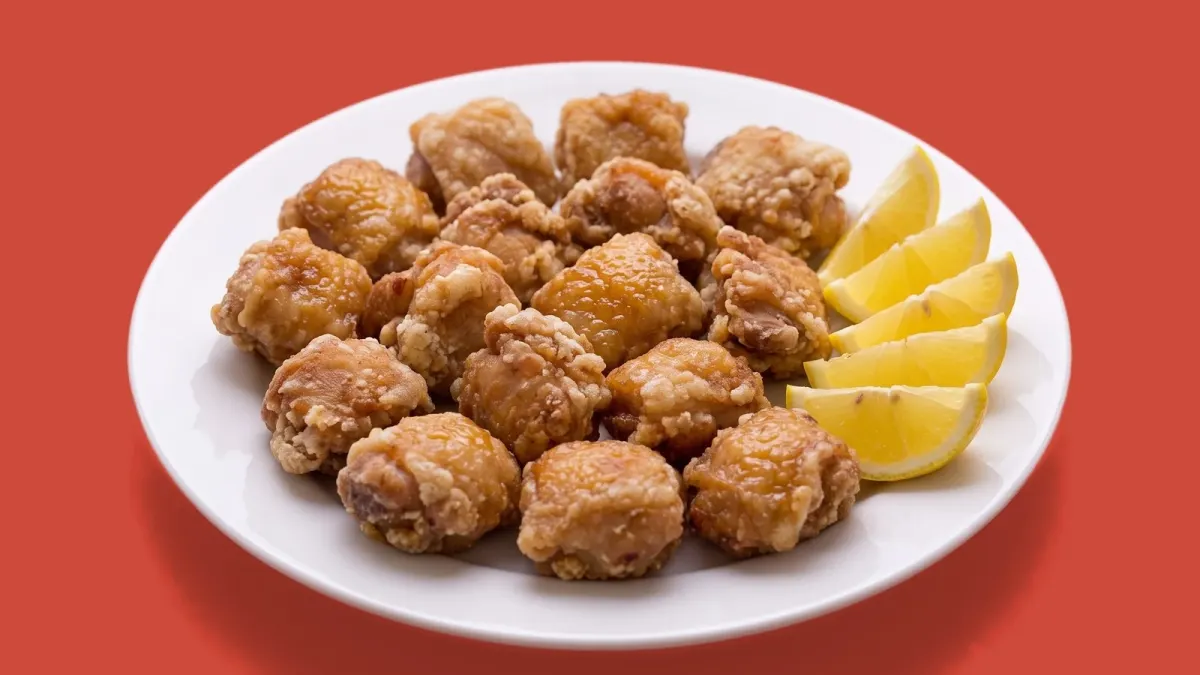
Bite-sized pieces of chicken thigh marinated in soya sauce, sake and ginger, coated in potato starch and fried: Japan's best-loved okazu, for dinner, bento and parties
- In all
- 41min
- Hands-on
- 26min
- Waiting
- 15min
- You saveWith the steps in parallel, instead of one at a time.
- −6min
Difficulty : 2 of 5340 kcal each (estimate)With the steps in parallel, instead of one at a time.
The median
The quantities are the median of the versions that give them, not one person’s opinion.
The time
The sources50min
The plan41min
3 of 13 sources state a time: 30min to 50min, median 50min.
Ingredients · 4 people
- Boneless chicken thighs600 g
- Soya sauce2 tablespoons
- Cooking sake1.5 tablespoons
- Fresh ginger12 g
- Potato starch5 tablespoons
- Vegetable oil720 g
- Lemon1
The plan
41min, 26min of it hands-on.
for 4 · one cook · one pan and two pots
- 01Cut the thighs into pieces hands-on, minutes 0–6
- 02Massage with soya sauce, sake and ginger hands-on, minutes 6–8
- 03Leave to rest in the marinade waiting, minutes 8–23
- 04Heat the oil to 170 degrees watching, minutes 21–27
- 05Coat in the potato starch hands-on, minutes 23–27
- 06Fry in batches, first at 170 then at 185 degrees hands-on, minutes 27–39
- 07Drain, rest a moment and serve with lemon hands-on, minutes 39–41
- hands-on
- watching
- waiting
The plan is for one cook, with one pan and two pots: PREP lines the steps up side by side.
In the app this plan guides you step by step, and rings when a pot is ready. Notify me
The steps
-
01Cut the thighs into pieces
Trim off the yellow fat, keep the skin, pieces of three to four centimetres, all the same size.
- Boneless thigh with the skin on: it's the cut in seventeen recipes out of eighteen, because the fat in the skin keeps the piece juicy in the hot oil. Breast works just as well, and two cookbooks allow it, but it comes out drier.
- Scrape off the soft yellow fat with the blade and cut through the white tendons: five recipes out of eighteen say so, and it's so you don't find it in your mouth.
- Pieces of three to four centimetres, eight to ten per thigh, with the knife held at an angle so the thickness comes out even and they all cook in the same time. Bigger, they stay juicier; smaller, they make more crust: the Tokyo eatery that taught Kikkoman the recipe cuts them two bites big.
- Don't wash the chicken: the Ministry of Agriculture lists it among its five points, because the water spreads bacteria around the sink. One recipe out of eighteen does the opposite and rinses it: it's the only one, and it's wrong. If there's liquid on it, pat it dry with kitchen paper.
- If the chicken is coming out of the fridge right now, that's fine: the quarter of an hour in the marinade brings it back to room temperature, and a piece that's cold inside cooks badly.
IT’S READY WHEN Pieces all the same size, skin still on, no yellow fat on the chopping board.
-
02Massage with soya sauce, sake and ginger
In the bowl with the soya sauce, sake and grated ginger, a good minute with your hands.
- Soya sauce and sake four to three, with the ginger grated skin and all: the soya sauce is the median of eighteen recipes, the sake of fourteen, the ginger of sixteen. The soya sauce here is a little generous compared with other Japanese marinades, and that's no accident: it has to stand up to the frying and go alongside plain rice.
- With your hands, a good minute, until the liquid has almost disappeared into the meat: two cookbooks time it exactly like that. Without squeezing, or the skin comes away from the piece.
- Just the ginger juice, squeezed out of the grated ginger, if you want the version of the reference recipe and of the Tokyo eatery: the fibres burn in the hot oil and get stuck between your teeth. Seven recipes out of sixteen do it that way; the other nine leave it in whole.
- There's no garlic in the list because ten recipes out of eighteen leave it out, the reference recipe included: if you want it, one clove finely grated for every half kilo of chicken, and that's the Nakatsu version, where the collective trademark demands it alongside the ginger.
- No salt or pepper: the soya sauce salts it already, and the Tokyo eatery says pepper muddles the taste of the soya sauce instead of helping it.
IT’S READY WHEN The bottom of the bowl is almost dry and the pieces are glossy and dark.
-
03Leave to rest in the marinade
A quarter of an hour on the worktop, turning them once halfway through.
- Fifteen minutes is the median of eighteen recipes: two don't wait at all, the Tokyo eatery wants two hours in the fridge. In a quarter of an hour the soya sauce gets into the surface and the chicken comes back to room temperature, which is what frying needs.
- Turn the pieces once halfway through, so the marinade wets all of them: the reference recipe does it two or three times.
- If you have time, half an hour in the fridge gives more flavour and more juice: a long marinade makes the meat take on water, which then comes out as juice when you bite. Two hours is the eatery's time, and beyond that there's no point.
- It isn't the majority's route, but anyone who wants the softer version adds a tablespoon of mayonnaise for every three hundred grams of chicken at this point, as two cookbooks out of eighteen do: the fat and the vinegar it brings with it tenderise the meat.
- In place of the sake, two recipes out of eighteen use mirin, another two put it alongside, and two also add sugar, a couple of teaspoons: it comes out sweeter and darkens sooner in the pan, so keep the heat a touch lower.
IT’S READY WHEN The pieces have drunk up almost all the marinade and the meat is at room temperature.
-
04Heat the oil to 170 degrees
Three fingers of vegetable oil in a small saucepan, over a medium heat, up to 170 degrees.
- Three fingers of oil: it's the median of eight recipes, which run from one finger to five. The chicken has to float without touching the bottom, and the more oil there is, the less the temperature drops when you lower it in.
- One hundred and seventy degrees is the median of eighteen recipes and the exact figure given by nine: eleven out of eighteen start between 160 and 170, four go straight up towards 170-180 and three start from 180. It's a start low enough to cook the centre before the crust darkens.
- A frying thermometer is the most useful thing you have; without one, the chopstick trick: stand a dry wooden chopstick upright in the oil and watch the bubbles, fine and steady means 170, furious means 185. A pinch of potato starch dropped into oil at the right temperature spreads across the surface at once, sizzling: that's the eatery's signal.
- You don't need a special oil: vegetable oil in every recipe that names one, although a food-industry researcher prefers rice bran oil, which colours well and oxidises less. Don't reuse it too many times.
- Heating oil is never left alone. If it catches fire, turn off the heat first, and never water: Japan's Fire and Disaster Management Agency says so for frying oil, water makes it boil up all at once, and vegetables or anything else wet thrown in to cool it down scatter boiling oil all around.
IT’S READY WHEN 170 degrees on the thermometer; a dry chopstick dipped in gives off fine, steady bubbles all along the wood.
-
05Coat in the potato starch
Drain off almost all the marinade, add the potato starch to the same bowl and mix until the chicken is coated and sticky.
- Press the pieces with your hand and throw away the marinade, leaving a film of it on the bottom: that little bit of soya sauce worked into the starch gives the crust colour and aroma. If too much is left, the starch dissolves and the crust comes out hard instead of crisp.
- Just under a tablespoon of potato starch for every hundred grams of chicken, mixed in the bowl until every piece is covered in a thick paste: it's the reference recipe's method and the median of the starch-only recipes. The tray of starch to roll the pieces in makes a whiter, more irregular crust, and it's what the eateries do; if you use it, shake off the excess starch without knocking it about.
- No flour in the list: starch alone in nine recipes out of eighteen, and since 1932 at the Ginza restaurant that invented the dish, because it makes a thin, glassy, crisp crust. Seven recipes mix it with flour, which makes a softer, thicker crust that drinks more oil: if you want it that way, flour first and starch after, on the outside.
- There are no eggs in the list: four recipes out of eighteen put them in the coating, and the crust clings better and comes out thicker. A food-industry researcher whisks the white until almost stiff and passes the pieces through it before the starch, for an airy crust that spits less.
- Coat at the last moment, with the oil already at temperature: wet starch left waiting dissolves. The eatery does the opposite, an hour in the fridge after the starch so the crust sets: it only works with the dry starch bath, not with the paste in the bowl.
- Before you lower them in, stretch the skin of each piece around the meat: it cooks better and the piece comes out round instead of flapping like a flag.
IT’S READY WHEN Every piece is wrapped in a thick, opaque paste, with no dry starch on the bottom and no liquid.
-
06Fry in batches, first at 170 then at 185 degrees
Half the pieces at a time: four to five minutes at 170 without touching them for the first two, then the heat up high for a minute, towards 185 degrees, until they sizzle hard.
- Lower in half the pieces, skin side up, one at a time and quickly: the temperature drops and has to climb back. Half at a time in a home saucepan; with more chicken the oil collapses and what comes out is limp and greasy, with less it cooks through before it colours.
- Don't touch them for the first two minutes, until the crust has hardened: move them straight away and you lose it. Then turn them once with chopsticks or tongs and finish: four to five minutes in all at 170 degrees is the median of the recipes for a piece of three to four centimetres.
- For the last minute turn the heat up, high but not full, towards 185 degrees, lifting the pieces out of the oil now and then to let them take in air: it's the choice of five recipes out of eighteen, and it's what makes the crust dry. The Ginza restaurant has been giving the pieces air since 1932, but at a medium temperature: turning the heat up isn't theirs, it belongs to those five, and the other ten that fry only once stay at a constant temperature.
- Double frying is the route of three recipes, the reference one included, and another two offer it as a variation: three to four minutes at 170, out onto the rack for four to five minutes while the residual heat finishes the centre and the oil climbs to 185, then back in for one to two minutes for the crust. It comes out juicier inside and crisper outside, and the rest is cooking time, not time wasted. With two batches it dovetails on its own: while the first rests, the second fries.
- It's ready when the bubbles go from fine to big and the sound from a rustle to a dry crackle, the pieces float and are golden brown. Picked up with chopsticks, a cooked piece passes on a fine vibration; if in doubt, cut open the biggest piece.
- The chicken is cooked when the juice runs clear and the meat in the centre is white, not pink: the two Japanese ministries ask for 75 degrees at the core for one minute, because raw chicken often carries Campylobacter, which in Europe is the leading declared cause of food-borne infection. If a piece is pink inside, five minutes in a small oven on a rack with a sheet of foil finish it off and dry out the crust.
- Between one batch and the next let the oil climb back to 170 and lift out the crumbs of starch with the slotted spoon: they burn and turn the second batch bitter.
IT’S READY WHEN An even golden brown, a dry crackle, pieces floating; cut open, clear juice and white meat right to the centre, 75 degrees on the thermometer.
-
07Drain, rest a moment and serve with lemon
On the rack in a single layer, one minute; then onto the plate with the lemon wedges.
- Drain them on a rack or in a slotted spoon, keeping them up in the air: kitchen paper makes them sweat from underneath. Never piled up, says the cook who sells them: the steam softens the crust of the ones at the bottom.
- A minute's rest lets them finish cooking and makes them easy to handle; then they need eating: the starch crust stays crisp for only a few minutes, and if you're letting them cool, do it quickly and in the open air, so the moisture doesn't have time to get in.
- The lemon wedges aren't to be squeezed over everyone's plate: they sit on the side, and whoever wants it squeezes it over their own. That's how it is in seven recipes out of eighteen and at the restaurant that invented the dish, which puts Japanese mustard and sesame salt alongside them as well.
- For the bento, the cookbooks' rule: cool them completely before closing the box, and in summer keep it somewhere cool. In the fridge they keep until the next day.
IT’S READY WHEN Still sizzling on the plate, crust dry to the touch, lemon wedges on the side.
Where the sources disagree
- 1
Garlic or no garlic
Ten recipes out of eighteen marinate with soya sauce, sake and ginger and nothing else; eight add garlic. Here there's no garlic, like the majority and the reference recipe; if you want it, that's the Nakatsu version, where the collective trademark demands it alongside the ginger.
- 2
Fry once or twice
Fifteen recipes out of eighteen fry once; three fry twice with a rest in between, the reference recipe included. Here it's a single fry, turning the heat up at the end as five of those fifteen do, for a dry crust; double frying comes out juicier inside.
- 3
Starch alone or with flour
Nine recipes out of eighteen coat with potato starch alone, seven mix it with flour, one uses flour alone and one rice flour and starch. Here it's starch alone, which makes a thin, glassy, crisp crust; with flour it comes out softer and thicker, and drinks more oil.
Where the numbers come from
This recipe compares 13 sources. The quantities are the median of the versions, not one person’s opinion: where the sources disagree, the majority wins. Here they all are.
- 白ごはん.com — 定番の味!鶏の唐揚げのレシピ作り方30min
- クラシル — 【基本の味】ジューシー!鶏の唐揚げ50min
- デリッシュキッチン — 下味しっかり! 基本の唐揚げ50min
- オレンジページ — 鶏のから揚げ (今泉久美)—
- ゆとりの空間 — 鶏のから揚げ (栗原はるみ)—
- キッコーマン ホームクッキング通信 — プロに教わる鶏の唐揚げ【菱田屋さん直伝】—
- 日本食糧新聞 — 近代メニューのルーツ(8)若鶏の唐揚げ編 東京・銀座「三笠会館」—
- 中津商工会議所 — 地域団体商標「中津からあげ」 (2016)—
- 厚生労働省 — お肉はよく焼いて食べよう—
- 農林水産省 — カンピロバクターによる食中毒—
- EFSA — Campylobacter—
- 文部科学省 食品成分データベース — 若どり もも 皮つき から揚げ (11289), 307 kcal—
- 消防庁 消防研究センター — 天ぷら油火災(消火器具)—
- With PREP’s plan41min
Allergens
- Soya
- Gluten
They come from the recipe's list. The label on what you buy is what counts.
More recipes
- Spaghetti alla carbonara22min
- Tagliatelle al ragù2h37min
- Soupe à l'oignon gratinée1h52min
Coming to the App Store.
For 15min of this recipe’s 41min your hands are free: PREP tells you what to do meanwhile, and when to go back to the stove.
Leave your email: we’ll write once, when it’s out.
We count visits to the website without cookies and without knowing who you are.
One step left.