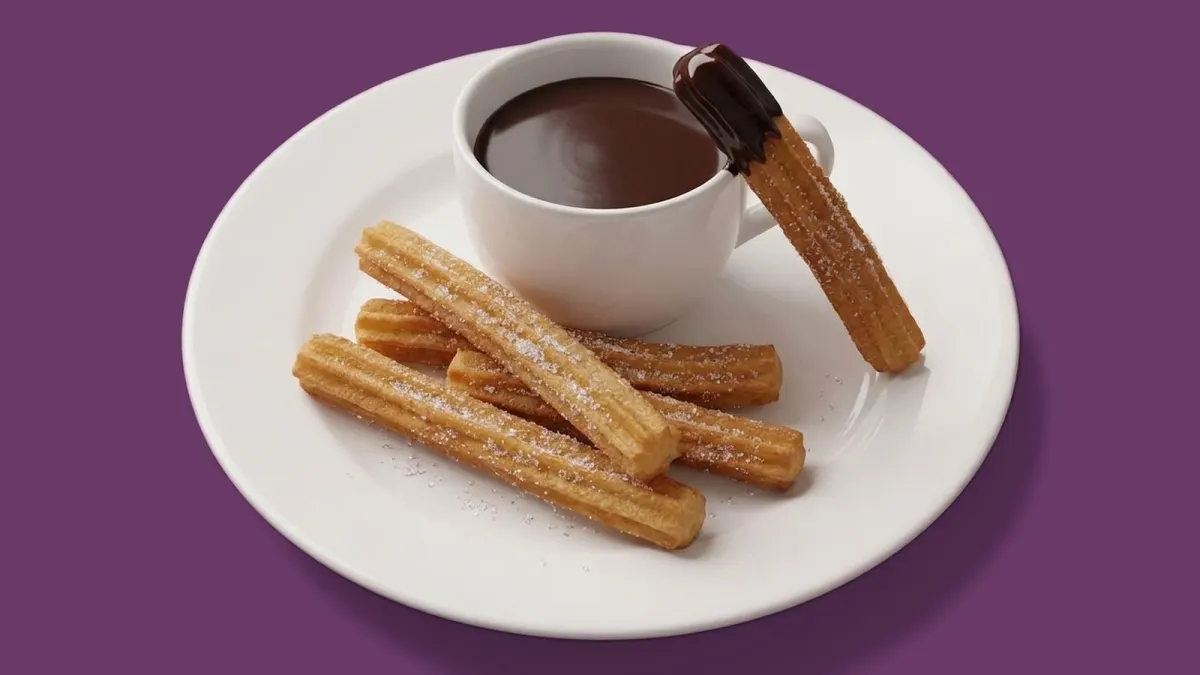
Churros with hot chocolate
Freshly fried and dunked in thick hot chocolate: Sunday morning in Madrid.
- In all
- 1h
- Hands-on
- 45min
- Waiting
- 15min
- You save With the steps in parallel, instead of one at a time.
- −14min
Difficulty: 3 of 5. 1155 kcal each (estimate) With the steps in parallel, instead of one at a time.
The median
The quantities are the median of the versions that give them, not one person’s opinion.
The time
The plan 1h
Only 2 of 33 sources state a time for the whole recipe, 30min and 45min: not enough for a comparison, so here there’s only the plan.
Ingredients · 4 people
- 00 flour 250 g
- Salt to taste
- Extra-virgin olive oil 720 g
- Sugar 80 g
- Whole milk 1 litre
- Dark chocolate 380 g
- Cornflour 25 g
The plan
1h, 45min of it hands-on.
for 4 · one cook · one pan and two pots
- 01 Bring the salted water to the boil waiting, minutes 0–5
- 02 Add the flour and work the dough hands-on, minutes 5–10
- 03 Leave the dough to cool waiting, minutes 10–20
- 04 Fill the piping bag hands-on, minutes 20–23
- 05 Heat the oil watching, minutes 21–29
- 06 Pipe the churros onto baking paper hands-on, minutes 23–29
- 07 Fry the churros in batches hands-on, minutes 29–49
- 08 Heat the milk watching, minutes 46–52
- 09 Break up the chocolate, slake the cornflour hands-on, minutes 49–52
- 10 Melt the chocolate and thicken hands-on, minutes 52–58
- 11 Sugar them and serve hands-on, minutes 58–60
- hands-on
- watching
- waiting
The plan is for one cook, with one pan and two pots: PREP lines the steps up side by side.
In the app this plan guides you step by step, and rings when a pot is ready. Notify me
The steps
-
01 Bring the salted water to the boil
In the small saucepan, water at one and a half times the weight of the flour, with the salt: over a high heat until it's at a rolling boil.
- One and a half times the flour's weight in water is the median of fifteen recipes that weigh both. The sources split between two rules: equal weights of water and flour (Consumer, Cocina Casera, and the ratio of the churrerías, the churro shops, as reported by ¡Hola!) and a glass of water to a glass of flour (Directo al Paladar, El Cocinero Casero), which by weight is nearly twice as much water. With a home piping bag, the softer dough is easier to squeeze out.
- The salt: a level teaspoon for every three hundred grams of flour, the median of the ten recipes that measure it. A churro is only lightly salted; the sweetness comes from the sugar on top.
- No butter, no eggs, no raising agent: water, flour and salt, Bon Viveur's three ingredients, and nine recipes out of eighteen add nothing else. Seven add a fat, Eva Arguiñano egg whites, Consumer baking powder. If you want to add something, a tablespoon of oil in the water: Divina Cocina writes that the dough then spits less in the pan.
- Don't let it boil for long: the water evaporates, and the dough comes out stiffer than you want it (2 Mandarinas en mi cocina).
IT’S READY WHEN Big bubbles across the whole surface and the salt dissolved.
-
02 Add the flour and work the dough
Off the heat, all the flour in one go; beat hard with a wooden spoon until the dough comes away from the sides of the pan.
- All at once and off the heat, as in twelve recipes out of seventeen that say what to do with the heat. Six do the opposite and pour the boiling water over the flour in a bowl (Recetas de ¡Escándalo!, PequeRecetas and Mi Querida Cocinera among them): it works just as well. Consumer and Eva Arguiñano put the pan back over a low heat for a minute, to dry the dough out.
- Beat hard for five minutes, pressing the dough against the sides as El Cocinero Casero does, until there are no lumps and no free water left. It isn't fussiness: Lolita la Pastelera warns that droplets of water left inside make the churros burst in the oil, and Eva Arguiñano that lumps make it spit.
- Strong bread flour is what seven recipes out of eighteen ask for: it has more gluten, takes more water and holds its shape, writes Bon Viveur. With 00 flour it works just the same, a touch softer.
- Eva Arguiñano uses half milk and half water and adds two egg whites, and recipes from Italy add butter and eggs: that gives you choux pastry, softer, and not a Madrid churro.
IT’S READY WHEN A smooth, matt ball that comes away from the sides and from the spoon, with no white lumps of flour.
-
03 Leave the dough to cool
Covered with a tea towel, in the pan, away from the heat, until you can touch it without burning yourself.
- Ten recipes out of eighteen rest it before it goes into the piping bag: ten minutes sits between PequeRecetas's few minutes and the quarter of an hour in Recetas de ¡Escándalo!. No longer than that: as it cools it stiffens and is hard to pipe, warns PequeRecetas.
- Covered, so the surface doesn't dry out and form a crust.
- This is when to make the hot chocolate: Recetas de ¡Escándalo! makes it right here, so it's ready when the churros are frying.
IT’S READY WHEN The dough is warm to the touch, soft, and no longer steaming.
-
04 Fill the piping bag
Large star nozzle, the dough pressed in a spoonful at a time right down to the tip, leaving no air.
- A star nozzle, the fluted kind, is what twelve recipes out of fourteen that name one ask for, and PequeRecetas calls it essential: the ridges let the churro cook right through to the centre and make it crisp. Without them, warns Cocina Casera, the churro puffs up and can burst.
- Air is the danger, and nine of them say so: a bubble left in the dough bursts in the oil and makes it spit. Push the dough down towards the tip with every spoonful and close the bag by twisting it.
- A sturdy piping bag, cloth or thick plastic: the dough is stiff and thin ones split (Recetas de ¡Escándalo!, Consumer).
- If you have a churrera, the plunger cylinder of the churrerías, use it: it pushes the dough out with no bubbles, and it's the safest choice for Bon Viveur and the only one for Mi Querida Cocinera.
IT’S READY WHEN The piping bag is full and firm, and the dough reaches the tip with no gaps.
-
05 Heat the oil
At least three fingers of oil in a deep frying pan, over a medium heat, up to 170-175 degrees: hot, never smoking.
- The recipes fry hotter, from 170 (Recetas de ¡Escándalo!) to 195-200 (PequeRecetas) and as high as 225 (Canal Cocina). Here 175 at most, following AESAN, the Spanish food safety agency: for home cooking it asks you not to fry breaded foods above 170 degrees or past the point where the oil smokes, and potatoes not above 175. It doesn't name churros there, but its technical sheet on acrylamide lists them among the foods that can contain a lot of it. A thin stick at 175 cooks well in three to four minutes.
- Olive oil, and a light one: six recipes choose it alone, vegetable oil just one, and six leave it up to you. PequeRecetas and Cocinista want it «suave», mild, so it passes on no flavour; sunflower oil works just as well.
- Enough oil for the churros to float: with too little, the temperature collapses with every batch and the churro drinks oil instead of forming a crust (Consumer, Lolita la Pastelera, Mi Querida Cocinera). But don't fill the pan more than halfway: the wet dough makes the oil foam up.
- Without a thermometer: a scrap of dough should rise straight to the surface surrounded by bubbles (Bon Viveur, Lolita la Pastelera). If it darkens in a few seconds the oil is too hot: turn it down.
- A pan of oil on the heat is never left alone, not even for the phone or the door; handles turned inwards and children out of the kitchen: those are the home-safety rules of the Civil Protection service of Palencia city council. If the oil catches fire, turn off the heat and cover it with a lid or a damp tea towel, never water.
IT’S READY WHEN A scrap of dough rises straight to the surface surrounded by bubbles; the oil is still and not smoking.
-
06 Pipe the churros onto baking paper
Sticks as long as your hand, piped onto baking paper and cut with oiled scissors: five each.
- Recetas de ¡Escándalo!, Lolita la Pastelera, Bon Viveur and Canal Cocina shape them first, on baking paper: they go into the oil without a rush and it spits less, writes PequeRecetas. Another seven recipes pipe the dough straight over the oil and cut it off with a finger: it's how the churrerías do it, and it takes a steady hand.
- Straight and a dozen centimetres or so long, like El Cocinero Casero's. In Madrid they're also made a lazo, as a closed loop (Cocinista, 2 Mandarinas en mi cocina): pipe a longer stick and join the ends.
- Porras, the thick spiral churros of Madrid's churrerías, are a different dough: more water, bicarbonate of soda and a rest before frying (Bon Viveur, Divina Cocina). They don't belong here.
- Five each is El Cocinero Casero's count with the same flour; in Madrid's chocolaterías a portion runs from four (Valor) to six (San Ginés). Scissors dipped in oil cut cleanly and the dough doesn't stick to them (Lolita la Pastelera).
IT’S READY WHEN Ridged, even sticks, all the same length, set apart from one another.
-
07 Fry the churros in batches
Four at a time, slid off the paper close to the oil: three to four minutes, turning halfway, until golden; then onto kitchen paper.
- A few at a time, so the oil doesn't cool down: «a few» for Bon Viveur, El Cocinero Casero, 2 Mandarinas en mi cocina and Recetas de ¡Escándalo!. Let the oil come back up to temperature between batches.
- Two minutes a side at 170 degrees for Recetas de ¡Escándalo!, four in all for El Cocinero Casero, a couple for Bon Viveur: at 175 allow three to four, turning them once with tongs or a slotted spoon. It's the longest step, and it gets longer the more people you're feeding.
- Golden, not brown. AESAN asks you to stop at golden and throw away pieces that are too dark, because the dark colour is acrylamide; and a churro that darkens before it's cooked inside means the oil is too hot, one that stays pale and greasy means it's too cold (Lolita la Pastelera, Recetas de ¡Escándalo!).
- Don't touch them for the first few seconds: they're sticky and cling to each other, but they form a crust quickly (Lolita la Pastelera). Lower them in close to the oil, never dropped from a height; a splatter guard stops the spitting (Bon Viveur).
- Drain them on kitchen paper in a single layer and move on to the next batch: they'll wait a few minutes, then the crust softens.
IT’S READY WHEN Golden and even on every side, ridged and crisp; broken open, the first one is cooked and dry right to the centre.
-
08 Heat the milk
The rest of the milk in the small saucepan, with the sugar and a pinch of salt, over a medium heat until it's almost boiling.
- Whole milk in all twelve of the thick recipes. Made with water it's chocolate «a la española», the old-fashioned kind (Consumer): lighter, and Gastronomía & Cía warns that it isn't a thick chocolate. For dunking churros, milk.
- Not much sugar, two teaspoons a cup, because dark chocolate already has some: it's the median of twelve recipes; three add none and three call it optional. With a less bitter chocolate you need less, writes El Cocinero Casero.
- A pinch of salt brings out the chocolate: five recipes add it, ¡Hola! and El Cocinero Casero among them.
- Flavourings if you like, which the basic recipe doesn't have: a cinnamon stick or a strip of orange peel in the milk (Cocina a buenas horas, Recetas de ¡Escándalo!).
IT’S READY WHEN The milk is steaming and the first bubbles appear at the edges, without frothing up.
-
09 Break up the chocolate, slake the cornflour
The chocolate in small pieces; in a cup, the cornflour slaked in a splash of cold milk, with no lumps.
- Dark, around 70%: PequeRecetas, Cocina Casera and El Cocinero Casero ask for it, and Bon Viveur writes between 50 and 70. Just under four hundred grams per litre of milk is the median of twelve recipes: it's a chocolate for dunking, almost thick enough to eat with a spoon, not for drinking.
- In small pieces it melts faster and doesn't catch on the bottom (El Cocinero Casero, Cocina a buenas horas).
- Cornflour is always slaked in cold milk: in hot milk it makes lumps that never go, as Bon Viveur and Cocina a buenas horas write. Two heaped tablespoons per litre is the median of the nine recipes that use it.
- Spanish «a la taza» chocolate bars already have the starch in them: Spanish law defines them as cocoa, sugar and flour or starch, up to 8%, to be eaten cooked (Real Decreto 1055/2003). With those, leave out the cornflour, as Bon Viveur does; and read the label, because the flour can be wheat.
IT’S READY WHEN Pieces the size of a fingernail; the milk with the cornflour is smooth and white, with nothing settled on the bottom.
-
10 Melt the chocolate and thicken
The chocolate into the hot milk, stirring until it disappears; then the cornflour. Over a low heat, whisking all the time, until the chocolate coats the back of the spoon.
- The chocolate first, completely melted, then the cornflour with its milk: that's the order in six recipes out of nine, Recetas de ¡Escándalo! and Cocina a buenas horas among them. When it comes back to the boil, turn the heat right down.
- Never stop stirring, scraping the bottom: chocolate catches and burns (Bon Viveur, Canal Cocina). A low heat is half the job, and a hard boil ruins it (Cocina Casera).
- It's ready when a churro dunked in it comes out coated: El Cocinero Casero wants it so thick that the churro is soaked all over. It thickens further as it cools: take it off a moment early.
- You can do without the cornflour: Consumer, Eva Arguiñano, PequeRecetas and El Cocinero Casero bring it to the boil, take it off the heat until it stops boiling and put it back, two or three times. It thickens by evaporation, more slowly and less firmly.
- It waits for the churros, not the other way round: covered, on the lowest heat, stirring now and then; if it forms a skin or gets too thick, a splash of milk and a quick whisk bring it back (Recetas de ¡Escándalo!, Cocina a buenas horas).
IT’S READY WHEN The whisk leaves a trail that closes slowly, the spoon comes out coated in dark chocolate, and it falls back in a thick ribbon.
-
11 Sugar them and serve
Still hot, rolled in sugar; in the middle of the table, with the hot chocolate in cups.
- Ten recipes out of eighteen put sugar on them and four leave it optional: while they're hot, just drained, so it sticks (Recetas de ¡Escándalo!, Bon Viveur). Sugar only, no cinnamon, which PequeRecetas and ¡Hola! sometimes add.
- They're eaten straight away, dunked in the chocolate: they should come out with a dark coat. Bon Viveur serves them «inmediatamente», at once, and Directo al Paladar writes that they're good hot.
- Leftovers reheat in the oven or in an air fryer (Lolita la Pastelera). Raw and already shaped, they freeze, and are fried straight from frozen (PequeRecetas, Canal Cocina).
- It's the Saturday and Sunday breakfast in Madrid, the one the Chocolatería San Ginés has served since 1894; El Cocinero Casero calls it the tradition of New Year's Day morning. The plate of churros goes in the middle of the table and everyone takes their own.
IT’S READY WHEN Churros coated in sugar, still warm, and cups of thick, steaming hot chocolate.
Where the sources disagree
- 1
Same weight or same glass
Four of the fifteen recipes with weighed quantities use equal weights of water and flour, the classic ratio given by ¡Hola!; Directo al Paladar and El Cocinero Casero measure a glass of water to a glass of flour, nearly twice the water by weight. Here it's one and a half times the flour's weight, the median. Equal weights make a stiffer dough that calls for a churrera; with more water it's softer, and easier to squeeze through an ordinary piping bag.
- 2
Hot or very hot oil
Recetas de ¡Escándalo! and Lolita la Pastelera fry at 170 to 180 degrees, PequeRecetas at 195-200, Canal Cocina up to 225. Here it's 170-175 and no hotter, below the recipes' median, following AESAN, the Spanish food safety agency: for home cooking it asks you not to go past that with breaded foods and potatoes, and it lists churros among foods that can contain a lot of acrylamide. Hotter oil is quicker, but the churros darken, and dark is the colour to avoid.
- 3
Cornflour or boiling twice
Nine recipes out of twelve thicken the chocolate with cornflour, slaked first in a splash of cold milk; the other three, Eva Arguiñano, PequeRecetas and El Cocinero Casero, bring it to the boil, take it off the heat and put it back, two or three times. Here it's cornflour, as in most, for chocolate thick enough to dip into; if you'd rather leave it out, boiling it twice does the job and gives a lighter cup.
Where the numbers come from
This recipe compares 33 sources. The quantities are the median of the versions, not one person’s opinion: where the sources disagree, the majority wins. Here they all are.
- Recetas de ¡Escándalo! — Cómo hacer churros con chocolate a la taza 45min
- Consumer — Churros caseros con chocolate a la taza —
- Hogarmanía — Churros con chocolate a la taza de Eva Arguiñano —
- Bon Viveur — Churros caseros —
- Bon Viveur — Chocolate a la taza —
- Lolita la Pastelera — Churros caseros fáciles —
- Directo al Paladar — Churros caseros: receta fácil, rápida y tradicional —
- Directo al Paladar — Receta de chocolate caliente casero —
- ¡Hola! — Haz tus propios churros caseros para este finde —
- PequeRecetas — Churros caseros —
- PequeRecetas — Cómo hacer chocolate a la taza —
- Cocina Casera — Churros caseros con Chocolate 30min
- Cocina Casera — Chocolate casero para Churros y Porras —
- Canal Cocina — Churros (Sara Fernández Cucala) —
- Canal Cocina — Churros con chocolate a la taza (Rocío Arroyo) —
- Canal Cocina — Churros caseros perfectos —
- El Cocinero Casero — Chocolate con churros —
- Divina Cocina — Churros y porras para hacer en casa —
- 2 Mandarinas en mi cocina — Churros a la madrileña —
- Cocinista — Churros y porras —
- Cocina a buenas horas — Chocolate a la taza —
- Gastronomía & Cía — Recetas de chocolate caliente para mojar el roscón o los churros —
- Ángel Muro — El Practicón (1894), Buñuelos (Internet Archive) —
- Chocolatería San Ginés — Historia de la Chocolatería —
- turismomadrid.net — Chocolate con churros o porras, una tradición madrileña —
- BOE — Real Decreto 1055/2003, productos de cacao y chocolate (chocolate a la taza) —
- AESAN — Acrilamida, ficha técnica (los churros) —
- AESAN — Acrilamida en los alimentos: recomendaciones (170-175 ºC en casa) —
- ELIKA — Acrilamida —
- Ayuntamiento de Palencia, Protección Civil — Precauciones ante los peligros en el hogar —
- BEDCA — Churro (alimento 2668) —
- CREA — Cioccolato, fondente (203020) —
- Valor — Chocolate Negro 70% Postres —
- With PREP’s plan 1h
Published .
Allergens
- Gluten
- Milk
- Soya
They come from the recipe's list. The label on what you buy is what counts.
More recipes
- Tortilla de patatas 57min
- Paella valenciana 1h30min
- Gazpacho andaluz 2h25min
Coming to the App Store.
For 15min of this recipe’s 1h your hands are free: PREP tells you what to do meanwhile, and when to go back to the stove.
Leave your email: we’ll write once, when it’s out.
We count visits to the website without cookies and without knowing who you are.
One step left.