Okonomiyaki
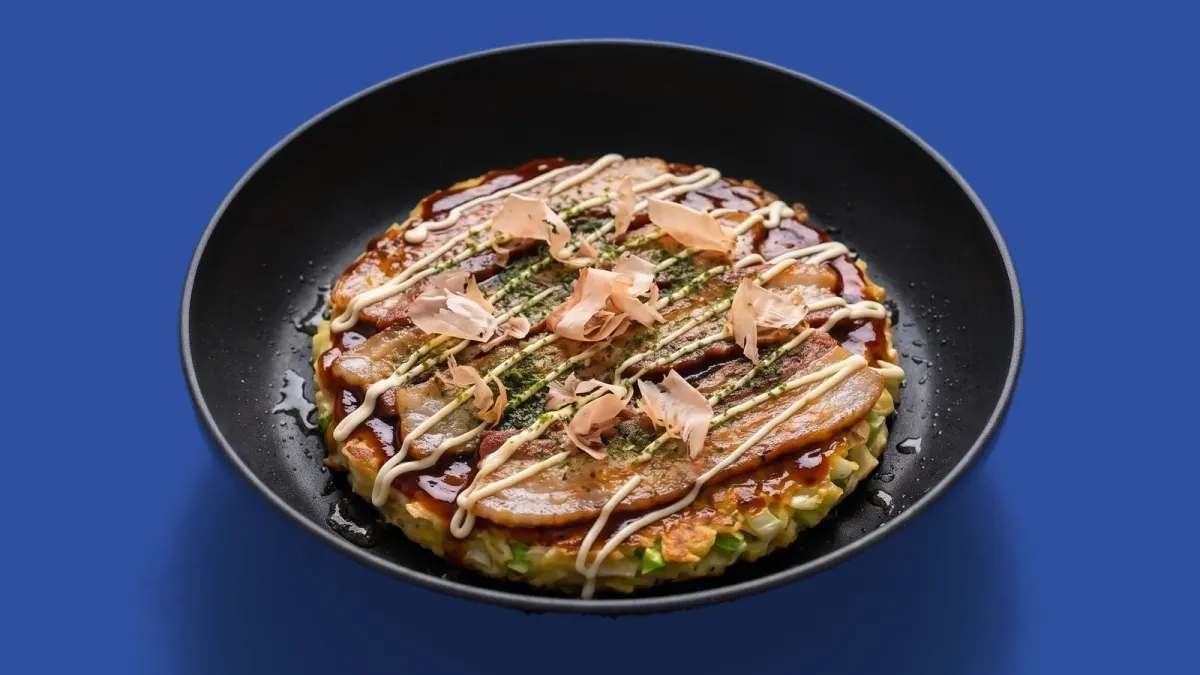
Osaka's cabbage and batter pancake with the pork belly on top, sauce and katsuobushi: lunch on a day off, in the frying pan or on the hotplate in the middle of the table
- In all
- 24min
- Hands-on
- 13min
- Waiting
- 11min
- You save With the steps in parallel, instead of one at a time.
- −2min
Difficulty: 2 of 5. 630 kcal each With the steps in parallel, instead of one at a time.
The median
The quantities are the median of the versions that give them, not one person’s opinion.
The time
The sources 25min
The plan 24min
6 of 12 sources state a time: 10min to 50min, median 25min.
Ingredients · 2 people
- 00 flour 100 g
- Dashi 150 ml
- Eggs 2
- White cabbage 240 g
- Thinly sliced pork belly 120 g
- Spring onions to taste
- Tonkatsu sauce 2.5 tablespoons
- Mayonnaise 1 tablespoon
- Katsuobushi (bonito flakes) to taste
- Aonori (green seaweed flakes) to taste
- Vegetable oil 1 tablespoon
The plan
24min, 13min of it hands-on.
for 2 · one cook · one pan and two pots
- 01 Chop the cabbage and spring onion hands-on, minutes 0–5
- 02 Whisk the flour into the dashi hands-on, minutes 5–8
- 03 Mix cabbage, egg and batter hands-on, minutes 8–10
- 04 Heat the frying pan watching, minutes 8–10
- 05 Pour, spread to two fingers and lay the belly watching, minutes 10–14
- 06 Flip hands-on, minutes 14–15
- 07 Cook with the lid on, belly down watching, minutes 15–19
- 08 Flip again and dry off the steam watching, minutes 19–22
- 09 Sauce, mayonnaise, katsuobushi and aonori hands-on, minutes 22–24
- hands-on
- watching
- waiting
The plan is for one cook, with one pan and two pots: PREP lines the steps up side by side.
In the app this plan guides you step by step, and rings when a pot is ready. Notify me
The steps
-
01 Chop the cabbage and spring onion
Cabbage in half-centimetre dice, spring onion in thin rounds.
- White cabbage in half-centimetre dice: that's the measure in the Ministry of Agriculture's entry, and dice — from half a centimetre up to two — is the cut of thirteen recipes out of twenty-five. Cut the leaves into strips, turn them ninety degrees and cut again: the core and the tough ribs go finer, because they cook less.
- An okonomiyaki sauce company tried three cuts with the same timings: julienne gives the softest piece and the most cooked cabbage, a fine chop leaves it crunchier, the dice sit in between and are the cut most people like. The short julienne out of a ready bag is fine if you're in a hurry: five recipes use it, two chop it coarsely.
- The cabbage is the body of the dish: it weighs more than twice what the flour does, and the teacher at a school for professionals in Osaka writes that batter and cabbage go one to one, with the batter already wet. Don't squeeze it: the water it gives up has to stay in the piece, not in the bowl.
- The spring onion is the green part in thin rounds: twelve recipes out of twenty-five put it in, thirteen don't. If you don't want it, skip it.
IT’S READY WHEN Even dice, thin ribs, spring onion in rounds: a heap that looks enormous next to the batter, and that's exactly right.
-
02 Whisk the flour into the dashi
Flour and dashi, three parts liquid to every two of flour, whisked to a thick cream.
- Pour the dashi onto the flour in two or three goes, working it with the whisk to crush the lumps: the batter comes out heavy and smooth, the kind that falls off the spoon in a ribbon. The ratio is three parts liquid to every two of flour, the median of twenty-five recipes: any thinner and it falls apart at the flip, any thicker and it makes a rubbery piece.
- Dashi is in eighteen recipes out of twenty-five: the real thing, or the granules dissolved in water — half to one teaspoon per glass, depending on the brand — which is what the home recipes do. With water alone it comes out well all the same, and four recipes use it: the flavour comes from the sauce.
- The Japanese ready-mixed flours have powdered dashi in them and a touch of baking powder, which four recipes add to plain flour as well for a puffier piece: it isn't in the list and it isn't needed, the cabbage and the egg puff it up on their own.
- Still no egg and no cabbage: those go in a moment before cooking.
IT’S READY WHEN A thick cream with no lumps, running off the whisk in a wide ribbon.
-
03 Mix cabbage, egg and batter
Into the cabbage bowl: whole egg and batter, a few turns from the bottom, and straight into the frying pan.
- Put the cabbage and the spring onion in a wide bowl, crack the whole egg over them and pour in the batter. With a big spoon stab down from above three or four times, then turn it from the bottom upwards: five or six turns and the cabbage is dressed in batter and holds together. It's the gesture in the Ministry's entry, and every technical source repeats the same rule: mix little, folding air in.
- A moment before cooking, and one piece at a time: as soon as it touches the batter the cabbage starts giving up water, and the mixture turns liquid and the piece heavy. Mix it all at once and you end up with patches of batter alone and patches of cabbage alone: for four people divide the batter between two bowls and mix the second only when the first is in the pan.
- Anyone who can find it grates nagaimo into it, the Japanese yam, grated to half the weight of the flour: nineteen recipes out of twenty-five put it in, it holds the air in the mixture and makes the piece fluffier. You can only buy it in certain Asian shops, so it isn't in the list: six recipes do without it, and the author of one of those, in a frying pan and much reviewed, writes that without it comes out soft and fluffy just the same.
- Same for the tenkasu, the fried crumbs of tempura batter, in sixteen recipes out of twenty-five and measured at a couple of tablespoons a piece where they are measured: not in the list, but if you've fried a tempura keep them, they give fat and crunch. And a pinch of chopped red pickled ginger, which nearly every recipe writes down as optional: that isn't in the list either, it brings acidity and colour, if you have it.
IT’S READY WHEN The cabbage is all veiled in batter and holds together in an airy heap, with no liquid in the bottom of the bowl.
-
04 Heat the frying pan
A 26-28 cm frying pan with a film of oil, medium heat, until the oil sizzles.
- A wide non-stick frying pan, where the piece for two fits with a finger's margin. Medium heat and a film of oil spread with kitchen paper: the pork belly gives up its own fat later on.
- On the table hotplate, which is how they cook it in Osaka, the temperature is two hundred degrees and all the pieces go on together; the teacher at the school for professionals keeps it higher, at two hundred and thirty. In the frying pan the heat stays medium for the first side and comes down after the flip.
- Since 2022 in Japan it's cooked more in the frying pan than on the hotplate: so says a sauce company's survey, run on two thousand five hundred people who eat okonomiyaki at least once every three months. The frying pan is the choice of fourteen recipes out of twenty-five, the hotplate of eight, and three leave it to you.
IT’S READY WHEN The oil runs liquid and a drop of batter sizzles straight away without smoking.
-
05 Pour, spread to two fingers and lay the belly
A heap in the middle, spread to two fingers thick, the slices of pork belly on top: four minutes a piece without touching it.
- Tip the mixture into the middle and spread it with the back of the spoon from the centre outwards, into a round two fingers high, a little lower in the middle so the heat gets through. Two centimetres is the thickness five sources agree on: lower and it dries out, higher and it stays raw inside.
- Lay the slices of pork belly on top, in a single layer in stripes, with the fatty part towards the edge: thirteen recipes out of twenty-five put it on like this, from the start, and at the flip it ends up underneath, frying in its own fat. Four, among them the Ministry's entry, lay it on a moment before turning: it comes out crisper and less bound to the piece, your call. Pork loin in place of the belly is fine, but it has to be shut between two layers of batter, or it dries out.
- Don't press with the fish slice and don't shift the piece: the air you mixed in goes away, and the piece turns into a floor tile. Three sources forbid it in three different words — don't move it, don't squash it, don't touch it — while the konamon association's technical guide allows a light pressure, but only with the tip of the fish slice and only after the flip.
- Medium heat, no lid. The edge starts to dry out and to take colour: that's the sign you can turn it, not the clock.
IT’S READY WHEN The edge is dry and golden all the way round, the middle has just set, and when you slide the fish slice underneath the piece moves in one.
-
06 Flip
Two fish slices underneath, from both sides, and a sharp flip towards you.
- Slide two fish slices under the piece from opposite sides, lift it and turn it over towards you with a flick of the wrist, in one go: hesitate and you break it. It's the gesture in the Ministry's entry and in four recipes, and with two fish slices even the piece for two comes off.
- If you'd rather use a plate: slide the piece onto a flat plate, cover it with the frying pan and turn the lot over. That plate has touched raw pork belly, and one of the sources warns about it in writing: wash it before you serve on it, or take another.
- Once it's turned you can even up the thickness with the tip of the fish slice, as the technical guide allows: never squash it with the flat of the fish slice, which drives the air out and flattens the piece.
IT’S READY WHEN The piece is whole, golden face up and the pork belly underneath sizzling.
-
07 Cook with the lid on, belly down
Lid on, medium-low heat, four minutes a piece: the steam cooks the middle while the pork belly fries.
- Turn the heat down and put the lid on: nineteen recipes out of twenty-five do it, and the company that tried it with and without saw the covered piece swell in the middle and cook right through. Without the lid it doesn't stay raw: it comes out lower, crisp outside and with the cabbage there under your teeth, and that's the choice of five recipes. Underneath, meanwhile, the pork belly fries in its own fat and takes colour.
- Pork belly is raw pork, and here it has to cook right through: the Japanese Ministry of Health asks for seventy-five degrees at the core for one minute, or sixty-three for half an hour, and since 2015 it has banned selling pork to be eaten raw; in Europe raw or undercooked pork is the leading cause of hepatitis E. The thin slices pressed against the bottom for four minutes get there: at the end they should be crisp at the edges with the fat clear, never pink and floppy. In pregnancy the illness is more serious: to be on the safe side, a minute more.
- The middle has to set too: the egg and the cabbage sit inside two fingers of batter, and the lid is what carries the heat in there. A skewer pushed into the centre should come out with no batter stuck to it.
IT’S READY WHEN Clear fat runs from the edge, the piece has swelled and no longer trembles in the middle; lift a corner and the pork belly is golden and crisp.
-
08 Flip again and dry off the steam
Take the lid off, turn it back with the pork belly on top and let it dry for three minutes a piece, over a medium heat.
- The second turn is easy: by now the piece is cooked and firm. Pork belly on top again, lid off, medium heat, three minutes a piece so the damp from the lid goes away and the surface is dry again. Thirteen recipes out of twenty-five do this third stage, and an okonomiyaki sauce company explains it in exactly those terms: you drive off the excess steam. Watch out for spitting fat.
- Eleven recipes serve it straight after the second side: if you're in a hurry that's fine, it comes out softer. An Osaka chain does the opposite, four turns and ten to fifteen minutes on the hotplate, roughly double the time at home.
- The right colour is golden, what the Japanese call fox colour, not brown: the Ministry of Agriculture measured acrylamide in this very dish and finds very little of it, but it forms on the browned parts. Just watch the colour.
IT’S READY WHEN The surface dry and golden on both faces, pork belly crisp at the edges, no steam rising from the piece.
-
09 Sauce, mayonnaise, katsuobushi and aonori
Sauce brushed over the whole face, stripes of mayonnaise, a sachet of katsuobushi and a dusting of aonori.
- In the order nearly every source gives: sauce brushed right to the edges, then the mayonnaise in stripes or zigzags, the katsuobushi — one sachet for the piece, which moves in the heat — and the aonori on top. Serve it in the pan, or cut it into wedges with the fish slice without going by way of a plate, the way they do in Osaka.
- Okonomiyaki sauce is thick and sweet, made of vegetables and fruit with twenty-odd spices; if you can't find it, tonkatsu sauce is the substitute a Japanese magazine names, and it's the entry in the list. Without even that: three parts Worcestershire sauce, one of ketchup and a teaspoon of sugar for every two tablespoons — the sugar isn't in the list — warmed for twenty seconds so it dissolves. The proportions are an adaptation, declared as such, not a median: Worcestershire is thinner and sharper than the average Japanese sauce, so the sugar goes above what the sources give.
- One company cookbook skips it altogether and brushes on its own soya sauce: that's a road too. And some finish with a few drops of lemon juice under the sauce, not sweet but sharp, a trick from a television cook: the lemon isn't in the list, but if you have one give it a try.
- In the Kansai it's eaten with a bowl of white rice alongside, and nobody laughs: a business daily and an Osaka chain both tell it. The rice isn't in the list because elsewhere it's a meal in itself.
IT’S READY WHEN The face glossy with dark sauce, white stripes of mayonnaise, the katsuobushi waving in the heat and the green of the aonori on top.
Where the sources disagree
- 1
With yam or without
Nineteen recipes out of twenty-five put Japanese yam in the batter, nearly always freshly grated; six do without. Here there's no yam, against the majority: in Europe you'll only find it in the odd Asian shop, and without it, as Delish Kitchen writes, it still comes out soft and fluffy. If you find nagaimo, grate in half the weight of the flour: it holds air and helps the batter rise.
- 2
Lid on or off
Nineteen recipes out of twenty-five cover the second side and five don't, Imai on NHK and Delish Kitchen among them. Otafuku cooked it both ways: with the lid the heat stays in, so the centre cooks through and puffs up; without it, the outside is just as crisp and the cabbage keeps more crunch. Here it's covered, like the majority; leave the lid off if you want to really feel the cabbage, as Otafuku suggests.
- 3
Flip once or twice
Thirteen recipes out of twenty-five flip the okonomiyaki a second time at the end; eleven stop at the second side. Here you flip it again and finish it uncovered, like the majority and like Otafuku, to drive off the steam and crisp up the pork belly again. Skip that last turn and it reaches the table a few minutes sooner, with the pork less crisp.
Where the numbers come from
This recipe compares 12 sources. The quantities are the median of the versions, not one person’s opinion: where the sources disagree, the majority wins. Here they all are.
- 農林水産省 うちの郷土料理 — お好み焼き 大阪府 (日本コナモン協会) —
- NHK きょうの料理 — 豚玉(お好み焼き), 佐竹右季子 (若竹学園, 大阪) 20min
- NHK きょうの料理 — お好み焼き, 土井善晴 50min
- NHK きょうの料理 — 豚玉お好み焼き, 今井亮 30min
- 白ごはん.com — 1枚分を作る簡単お好み焼きのレシピ (冨田ただすけ) 10min
- オタフクソース — 小麦粉から作る 関西お好み焼 30min
- 日清製粉グループ こむぎ粉くらぶ — お好み焼き(関西風) —
- デリッシュキッチン — 千切りキャベツのお好み焼き 20min
- オタフクソース — お好み焼アンケートレポート2022 (共同通信PRワイヤー) —
- 厚生労働省 — 豚のお肉や内臓を生食するのは、やめましょう —
- EFSA — Epatite E: è la carne di maiale cruda la principale causa d'infezione nell'UE (2017) —
- MEXT 日本食品標準成分表 八訂 — ぶた ばら 脂身つき 生 (11129), 366 kcal —
- With PREP’s plan 24min
Published .
Allergens
- Gluten
- Fish
- Milk
- Eggs
- Soya
They come from the recipe's list. The label on what you buy is what counts.
More recipes
- Karaage 41min
- Tempura 53min
- Churros with hot chocolate 1h
Coming to the App Store.
For 11min of this recipe’s 24min your hands are free: PREP tells you what to do meanwhile, and when to go back to the stove.
Leave your email: we’ll write once, when it’s out.
We count visits to the website without cookies and without knowing who you are.
One step left.