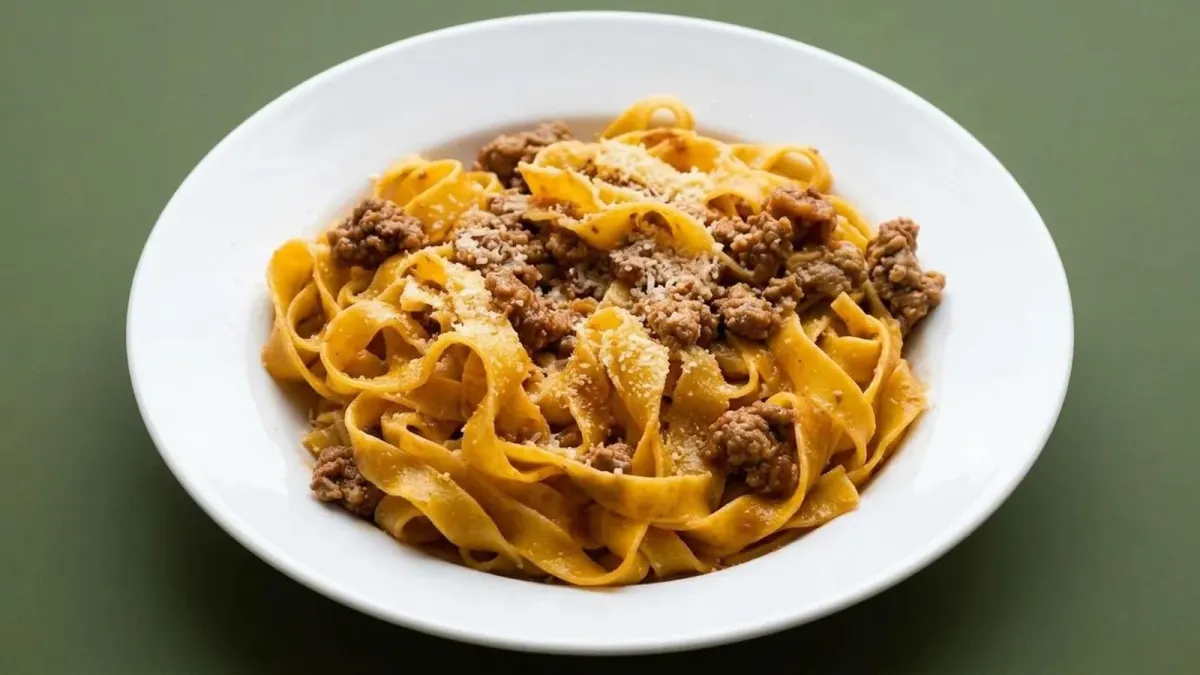
Tagliatelle al ragù
Sunday in a pot
- In all
- 2h37min
- Hands-on
- 37min
- Waiting
- 2h
- You saveWith the steps in parallel, instead of one at a time.
- −14min
Difficulty : 3 of 5690 kcal eachWith the steps in parallel, instead of one at a time.
The registered recipe
The quantities come from the registered recipe, scaled to our servings.
The time
The sources3h50min
The plan2h37min
3 of 9 sources state a time: 2h45min to 4h40min, median 3h50min.
Ingredients · 4 people
- Dried egg tagliatelle320 g
- Minced beef270 g
- Pancetta100 g
- Carrothalf a carrot
- Celery40 g
- Onionhalf an onion
- Tomato passata140 g
- Tomato puréehalf a tablespoon
- Dry white winehalf a glass
- Vegetable stock300 ml
- Whole milk70 ml
- Extra-virgin olive oil2 tablespoons
- Parmigiano40 g
- Saltto taste
The plan
2h37min, 37min of it hands-on.
for 4 · one cook · one pan and two pots
- 01Chop aromatics and pancetta hands-on, minutes 0–8
- 02Render the pancetta, then aromatics hands-on, minutes 8–18
- 03Brown the mince hands-on, minutes 18–28
- 04Deglaze, then tomato and stock hands-on, minutes 28–34
- 05Simmer low, milk halfway waiting, minutes 34–154
- 06Put the water on waiting, minutes 140–150
- 07Cook the tagliatelle waiting, minutes 150–154
- 08Toss with ragù, parmigiano hands-on, minutes 154–157
- hands-on
- watching
- waiting
The plan is for one cook, with one pan and two pots: PREP lines the steps up side by side.
In the app this plan guides you step by step, and rings when a pot is ready. Notify me
The steps
-
01Chop aromatics and pancetta
Equal parts carrot, celery, onion. Pancetta on its own.
- Small, even dice: it needs to melt into the sauce.
- Knife, not food processor: blades turn it to mush and draw out water.
- Keep the pancetta separate: it goes into the pot first, alone.
- Fresh pancetta, never smoked. And no garlic, rosemary, or parsley.
IT’S READY WHEN A fine, even chop, pancetta in its own little pile.
-
02Render the pancetta, then aromatics
Pancetta alone in the oil. Once it's rendered, the aromatics go in.
- Pancetta and oil first: it makes the fat everything else cooks in.
- Then the aromatics, medium-low heat, stirring with a wooden spoon.
- It should soften, not fry: the onion must never taste scorched.
- A heavy 24-26 cm pot. A thin bottom burns the soffritto.
IT’S READY WHEN Glossy, translucent vegetables, a sweet smell, no dark edges.
-
03Brown the mince
Turn up the heat, ten minutes, until it sizzles.
- Press it down and let it stick a little: that's flavour.
- It should sizzle, not boil in its own liquid.
- Beef, or beef and pork. Veal doesn't belong in ragù bolognese.
- Go for collagen-rich forequarter cuts: shin, shoulder, brisket.
IT’S READY WHEN Sizzling instead of simmering, the bottom of the pot amber.
-
04Deglaze, then tomato and stock
The wine must disappear completely. Then tomato purée, passata, stock.
- Wait until the wine smell is gone: if it stays, the ragù tastes sour.
- Scrape the bottom with the spoon: that's where the flavour is.
- Not much tomato, and that's on purpose: ragù is a meat sauce, not a tomato one.
- The stock boiling hot, never cold: cold stalls the cooking.
IT’S READY WHEN No wine smell, the sauce easing back to a gentle boil.
-
05Simmer low, milk halfway
Lowest heat, lid on, two hours. The milk at the halfway mark.
- Lid on: two hours uncovered leaves you with dry meat.
- It should make a lazy plop-plop, never boil hard.
- Hot stock whenever it tightens up, a little at a time.
- At the one-hour mark pour in the milk and let it cook off completely before moving on.
- Salt and pepper at the end, not before: as it reduces, everything concentrates.
- Three hours instead of two won't hurt, if you have the time.
IT’S READY WHEN Dark orange, not red: creamy, with glossy fat on the surface.
-
06Put the water on
Big pot, plenty of water: salt it once it boils.
- A litre for every hundred grams of pasta.
- Put it on towards the end of the simmer: it should be boiling for the tagliatelle, not keeping the ragù company.
IT’S READY WHEN A full, steady boil.
-
07Cook the tagliatelle
Egg tagliatelle cook fast: every minute counts.
- Egg pasta is less forgiving than dried.
- Set aside a cup of the cooking water.
IT’S READY WHEN Tender but with some bite left.
-
08Toss with ragù, parmigiano
Tagliatelle into the ragù, one toss, parmigiano, and to the table.
- Cooking water if it needs loosening up.
- Parmigiano half in, half on the plate.
IT’S READY WHEN Every tagliatella dressed in ragù.
Where the sources disagree
- 1
When the milk goes in
The sources have no majority here: Bressanini and Dissapore pour it in at the start of the simmer, the registered recipe halfway through, Peronaci towards the end, and Artusi adds cream once the sauce is done. This one goes in halfway, like the registered recipe, and is left to cook off completely; Peronaci keeps it for the end because, added early, it evaporates with everything else and leaves no trace.
- 2
How much tomato
This is the widest split: Artusi uses no tomato at all, Bressanini only triple-concentrated tomato purée and no passata, Misya more than anyone. This one goes light, purée and passata as the registered recipe asks, because ragù is a meat sauce; if you want it redder, head towards Misya, and if you want it without passata, Artusi and Bressanini are on your side.
- 3
Which meat
Beef only for the registered recipe, Peronaci and Spisni; beef and pork half and half for Misya and Dissapore; veal for Artusi, who uses nothing else, and in part for Bressanini, which is exactly the meat the registered recipe forbids. This one is beef, with pork if you like: veal is the ragù of the late nineteenth century, and that is why the ban has a history.
Where the numbers come from
This recipe compares 9 sources, but the quantities aren’t a median: they come from a registered recipe, the first one listed, scaled to our servings. The other sources only fill in where it is silent. Here they all are.
- Accademia Italiana della Cucina — ricetta depositata il 20 aprile 2023—
- Camera di Commercio di Bologna — il deposito—
- Bologna Welcome — le tagliatelle al ragù—
- Dissapore — i cinque errori del ragù—
- Pellegrino Artusi — La scienza in cucina, n. 87 «Maccheroni alla bolognese»—
- Dario Bressanini — il ragù alla quasi bolognese (Le Scienze, 2011)4h40min
- Sonia Peronaci — Ragù alla bolognese3h50min
- Misya — Ragù alla bolognese2h45min
- Alessandra Spisni — Ragù alla Bolognese (La Vecchia Scuola Bolognese)—
- With PREP’s plan2h37min
Allergens
- Gluten
- Eggs
- Celery
- Sulphur dioxide and sulphites
- Milk
They come from the recipe's list. The label on what you buy is what counts.
More recipes
- Aubergine parmigiana2h37min
- Spaghetti alla carbonara22min
- Soupe à l'oignon gratinée1h52min
Coming to the App Store.
For 2h of this recipe’s 2h37min your hands are free: PREP tells you what to do meanwhile, and when to go back to the stove.
Leave your email: we’ll write once, when it’s out.
We count visits to the website without cookies and without knowing who you are.
One step left.