Recipes › French cuisine · France
Soupe à l'oignon gratinée
All the flavour is in the part where nothing seems to be happening.
Ingredients
- Onion7.5
- Butter70 g
- 00 flour15 g
- Dry white wine1.5 glasses
- Beef stock1.5 litres
- Gruyère150 g
- Stale bread6.5 slices
- Fresh thymeto taste
- Bay leafto taste
- Nutmegto taste
- Saltto taste
- Black pepperto taste
The plan
- 01Slice the onionsminutes 0–12
- 02Caramelise the onionsminutes 12–57
- 08Grate the cheeseminutes 12–14
- 03Dust with flour (singer)minutes 57–59
- 04Deglaze with white wineminutes 59–64
- 05Bring to the boilminutes 64–70
- 06Simmer coveredminutes 70–100
- 07Toast the breadminutes 92–100
- 09Assemble the bowlsminutes 100–105
- 10Brown under the grillminutes 105–112
hands busykeep an eyewaiting
The plan is for one cook, with one pan and two pots: PREP lines the steps up side by side.
The steps
-
01 Slice the onions hands-on · 12min · minutes 0–12
Thin half-moons, all the same thickness.
- Brown onions: they hold up to the long cook without falling apart.
- Halve them from root to stem, then cut into half-moons with the grain. Cut that way, they hold their shape through the whole caramelisation instead of collapsing halfway.
- Even thickness matters more than thinness: uneven slices mean half burnt and half raw in the same pot.
- It looks like a mountain, and it should: caramelising, the onions lose nearly half their weight and two-thirds of their volume.
Cue. The layers stay separate and translucent against the light. If they come out crushed and wet, the knife isn't cutting — you're mashing them.
-
02 Caramelise the onions keep an eye · 45min · minutes 12–57
Wide pot uncovered, low heat, a stir now and then.
- Wide heavy-bottomed pot, lid off. First the onions throw off water and turn glassy, then the water goes and the colour starts: the second phase is the longer of the two.
- Salt right away, on the raw onions: it pulls the water out and shortens the first phase.
- Butter only, no oil. One source thins the butter with a splash of olive oil to guard against scorching: over low heat you don't need it, and the flavour loses out.
- Don't raise the heat to save time. The onions burn at the edges and the soup comes out bitter, and that's a fault you don't come back from.
- No sugar. One recipe in ten lists it; not here, because the sweetness comes out on its own and that's the whole point of the wait.
- Stir now and then, not constantly: what sticks to the bottom is caramel — scrape it up, but don't keep it from forming. Cooks working over higher heat stir often and finish in less than half the time — that's another technique, and the two don't mix.
Cue. Glossy chestnut colour all the way through the pot, not in patches. On the bottom a dark, sticky film: that's the flavour. Dull brown and an acrid smell means burnt.
-
08 Grate the cheese hands-on · 2min · minutes 12–14
Coarse holes on the grater, cheese cold from the fridge.
- Coarse holes. Grated fine, the cheese burns before it melts and leaves a dry crust instead of a stringy one.
- Gruyère is the first choice of six recipes out of ten; Comté is the second route, longer on the palate and less stringy.
- Grate it straight out of the fridge: at room temperature it clogs the grater.
- It looks like too much because it has to be: the cheese isn't seasoning, it seals the bowl.
Cue. Long shreds that stay separate from one another. If they clump, the cheese is too warm.
-
03 Dust with flour (singer) hands-on · 2min · minutes 57–59
Flour dusted over, a minute in the pot, and that's it.
- Flour sifted over the onions, stirred until it disappears, then a minute in the pot to cook out the raw taste.
- You want body, not thickness: about one level tablespoon per litre of stock. More than that and you've made onion velouté, which is another dish.
- Four recipes out of ten skip this step entirely, and one explicitly warns against any flour or starch thickener. Without it the soup stays thinner and cleaner: if that's how you want it, go straight to the wine.
- Two recipes put the garlic in with the flour. It doesn't belong here: it would cover the onion, which is the only thing that should come through.
Cue. The white has disappeared into the onions and the smell coming up is of biscuits, not glue.
-
04 Deglaze with white wine keep an eye · 5min · minutes 59–64
Wine into the screaming-hot pot, scrape the bottom, let it bubble away.
- Pour the wine in while the pot is still searing hot and scrape the bottom right away with a wooden spoon. That dark film is half the flavour and it only lifts while it's hot.
- Let it cook down until the bottom is nearly dry. If any wine hasn't cooked off, the soup stays sharp under the cheese, and you don't find out until it's served.
- Half the sources go straight to the stock with no alcohol: sweeter, but shorter on the palate.
- Two use cognac or armagnac in place of the wine, and one uses both — cognac first to lift the fond, then wine to reduce.
Cue. The sharpness of the alcohol is gone and no free liquid is left on the bottom: just glossy onions starting to sizzle again.
-
05 Bring to the boil waiting · 6min · minutes 64–70
Stock, thyme and bay, high heat until it boils.
- Stock to cover generously: nearly double the weight of the onions, counted by volume.
- Hot stock, not fridge-cold. Poured cold over scorching-hot onions it kills the heat in the pot, and the times given for this step stop meaning anything.
- Thyme and bay now, into the liquid. In the dry onions they'd have scorched and turned bitter.
- The sources split. Among those that use stock, chicken is named first more often than beef, and the two historical versions start from boiling water alone: onion and the fond in the pot were enough to make the stock. Beef is here for the flavour — darker, deeper. With chicken you taste the onion more.
- Don't salt now: the stock brings its own, and from here on the soup concentrates.
Cue. The surface lifts all at once and starts knocking against the sides of the pot.
-
06 Simmer covered waiting · 30min · minutes 70–100
Lid on, heat at its lowest, and you can leave it.
- This isn't about reducing, it's about binding: the onions finish breaking down and the stock stops tasting like stock.
- Pepper now, coarsely ground. Two recipes out of ten add nutmeg, and you only taste it if it's freshly grated.
- You can genuinely walk away: with the lid on it won't stick and won't dry out.
- Taste for salt at the end of this step, not before.
Cue. One bubble rising in the centre every two or three seconds. If the surface is churning, the heat is too high.
-
07 Toast the bread waiting · 8min · minutes 92–100
Slices in the oven at 180 °C, until they sound dry.
- Slices on the thin side, turned halfway through. They have to dry all the way to the centre, not brown on the surface.
- Stale bread, never fresh: fresh dissolves into the soup and turns to mush under the cheese.
- Baguette is the route four recipes take; country bread is the one from the gratinée des Halles, and it holds the weight of the cheese better.
- No garlic rubbed on top: none of the sources do it for this dish.
Cue. Tap a slice with a fingernail: it sounds dry and doesn't flex at all. Straw-coloured, not amber.
-
09 Assemble the bowls hands-on · 5min · minutes 100–105
Soup, bread floating, cheese out to the rim.
- Ovenproof bowls, not the soup plates from the cupboard: under the grill thin ceramic cracks.
- Soup almost to the rim, bread set floating without pushing it under, cheese covering everything.
- The cheese has to weld to the ceramic all the way around. That seal is what holds the heat in and builds the crust: leave a gap and the soup bubbles out through it.
- Don't fill to the brim: it swells, spills over and burns on the floor of the oven.
Cue. The bread floats level with the liquid and under the blanket of cheese you can't make out the soup any more.
-
10 Brown under the grill keep an eye · 7min · minutes 105–112
Under the grill, and you don't leave it.
- Grill at maximum, bowls in the top of the oven.
- You don't walk away. Golden crust and burnt crust are a few seconds apart, and under the grill there's no going back.
- The sources split on grill power: under a real salamander half this time is enough; in a home oven with the grill on you need all of it.
- Serve it boiling hot, right away, in the same bowl it browned in. The ceramic is far hotter than the soup: warn whoever sits down.
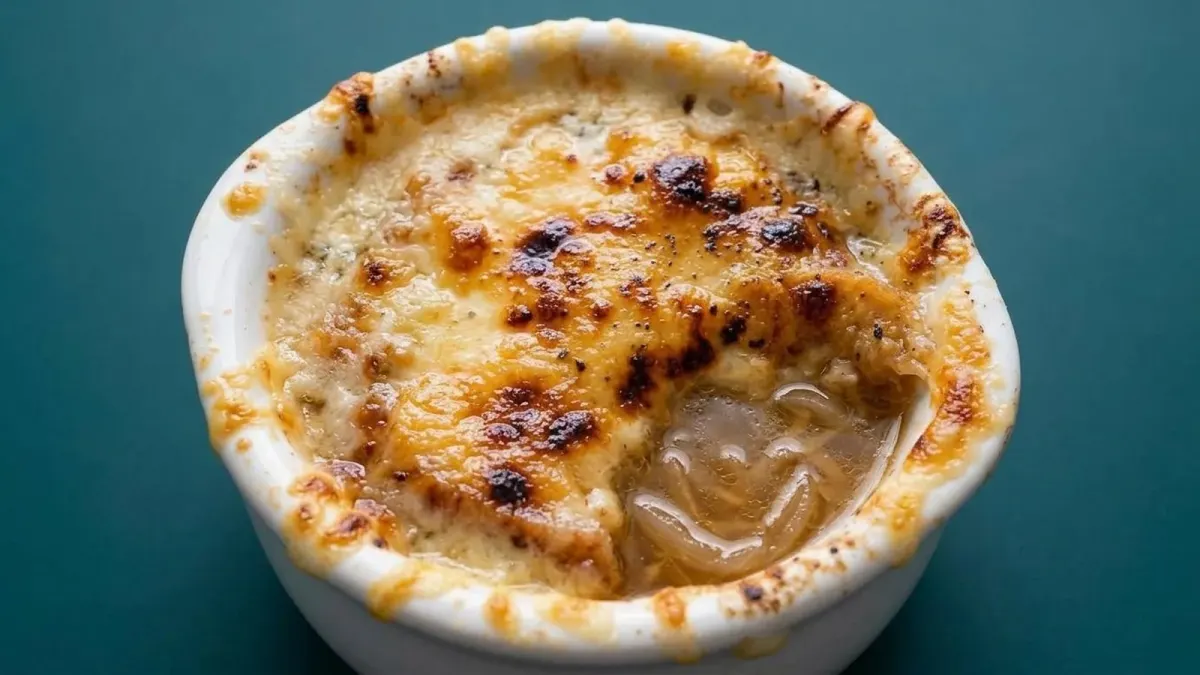
Cue. Crust puffed and blotched brown in irregular patches, never even. Sink the spoon in and the cheese pulls into strings while the soup bubbles underneath.
Allergens
- Milk
- Gluten
- Sulphur dioxide and sulphites
- Celery
They come from the recipe's list. The label on what you buy is what counts.
Where the numbers come from
This recipe compares 12 sources. The quantities are the median of the versions, not one person’s opinion: where the sources disagree, the majority wins. Here they all are.
- Le Cordon Bleu — French onion soup, in «Soups: Le Cordon Bleu Home Collection» (via ckbk). Attenzione: pagina parzialmente a pagamento, il metodo si interrompe a metà frase («Add the whi…») e la lista ingredienti è incompleta. Verificati e leggibili: i 20 min delle cipolle, gli 1-2 min della farina e la frase sul colore.
- Hachette — «La gratinée des Halles : la soupe à l'oignon emblématique de Paris»
- Paul Bocuse — Soupe à l'oignon, riportata da Pourdebon
- Philippe Etchebest — Soupe à l'oignon gratinée, riportata da Le Bonbon
- 750g.com — «Soupe à l'oignon gratinée : la vraie recette comme dans les bistrots parisiens»
- Chef Simon — Soupe à l'oignon gratinée
- Paris ZigZag — «Histoire d'un plat parisien mythique : la Gratinée des Halles»
- Ciqual 2013 (ANSES) — voce «Soupe à l'oignon, tout type», 22 kcal per 100 g, via informationsnutritionnelles.fr
- My Parisian Kitchen — Soupe à l'oignon gratinée
- La Cocinera Loca — Soupe gratinée à l'oignon
- KitchenAid France — Recette classique de soupe à l'oignon française
- La Cuisine de Géraldine — French onion soup
For 1h31min of this recipe’s 1h52min your hands are free: PREP fills them with a second dish or a side, and tells you what to do and when.
Leave your email: we’ll write once, when it’s out.
More recipes
- Tortilla de patatas 57min
- Paella valenciana 1h30min
- Tacos al pastor 4h37min