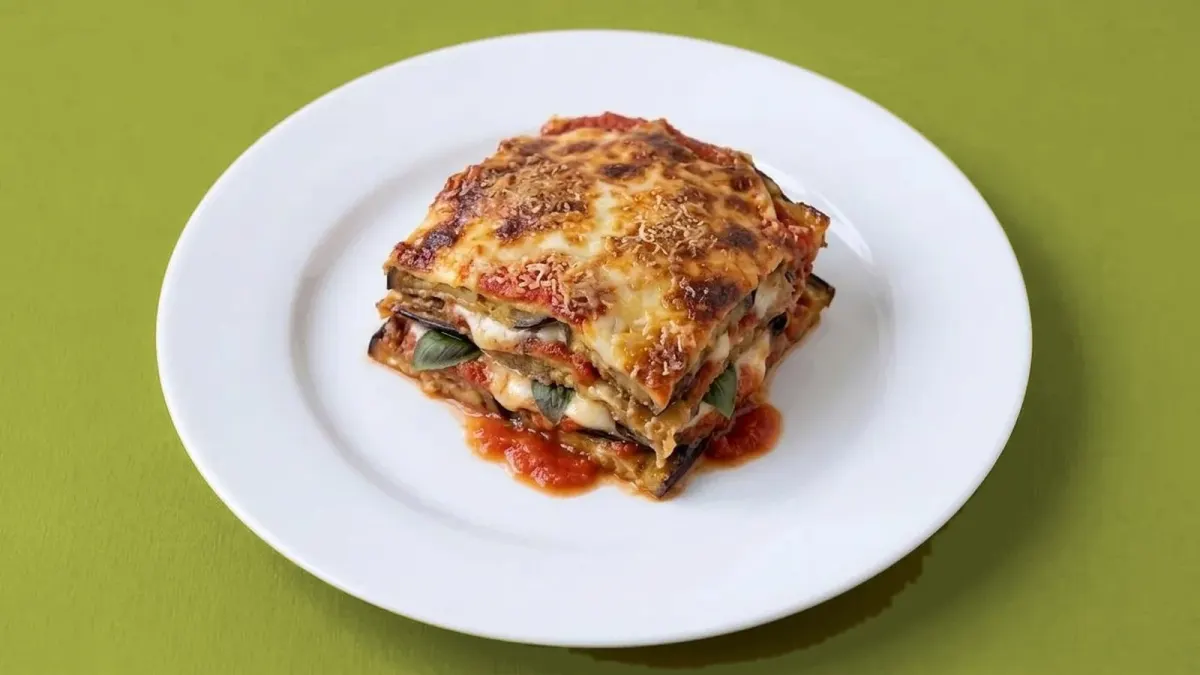
Aubergine parmigiana
Aubergine fried plain, not much mozzarella, a thick sauce: the rest is the resting before you cut it.
- In all
- 2h37min
- Hands-on
- 47min
- Waiting
- 1h50min
- You saveWith the steps in parallel, instead of one at a time.
- −37min
Difficulty : 3 of 5750 kcal each (estimate)With the steps in parallel, instead of one at a time.
The median
The quantities are the median of the versions that give them, not one person’s opinion.
The time
The sources1h50min
The plan2h37min
10 of 22 sources state a time: 45min to 3h45min, median 1h50min.
Ingredients · 4 people
- Aubergine850 g
- Tomato passata500 g
- Mozzarella200 g
- Parmigiano70 g
- Onionhalf an onion
- Fresh basil8 leaves
- Extra-virgin olive oil2 tablespoons
- Vegetable oil720 g
- Saltto taste
The plan
2h37min, 47min of it hands-on.
for 4 · one cook · one pan and two pots
- 01Slice the aubergine and onion hands-on, minutes 0–12
- 02Salt the aubergine waiting, minutes 12–72
- 03Rinse, squeeze, dry hands-on, minutes 72–77
- 04Heat the oil watching, minutes 72–77
- 05Make the sauce watching, minutes 75–97
- 06Fry the aubergine in batches hands-on, minutes 77–97
- 07Heat the oven waiting, minutes 97–107
- 08Build the layers hands-on, minutes 97–107
- 09Bake waiting, minutes 107–137
- 10Rest before cutting waiting, minutes 137–157
- hands-on
- watching
- waiting
The plan is for one cook, with one pan and two pots: PREP lines the steps up side by side.
In the app this plan guides you step by step, and rings when a pot is ready. Notify me
The steps
-
01Slice the aubergine and onion
Aubergine in lengthways slices half a centimetre thick, all the same; the onion finely chopped.
- Long dark aubergines or oval ones, firm and glossy. Lengthways, not in rounds: every slice gets flesh and seeds in equal parts and covers the dish with fewer joins.
- Half a centimetre is the measure in eleven recipes out of thirteen: thinner, they burn in the frying; thicker, they stay raw in the middle and drink more oil.
- Skin on: it holds the slice together and has flavour. Three recipes peel it, as was done in the nineteenth century; if it bothers you, peel off alternate strips.
- The onion finely chopped now: it's the base of the sauce, and it needs to be ready before the pan is hot.
IT’S READY WHEN Slices the same thickness from end to end, that stand up without bending.
-
02Salt the aubergine
In layers in a colander, salt between each layer, a plate with a weight on top, one hour.
- A tablespoon of salt per kilo, in layers, and a plate with a weight on top: the dark vegetable water drains away into the sink.
- Eleven recipes out of fifteen do it and the median is an hour; one stops at half an hour, one goes to two. It's less about bitterness, rare these days, and more about the frying: a dry slice drinks less oil.
- Skipping the step, as two recipes out of fifteen deliberately do with today's varieties, saves an hour and fries wetter slices: they spit more and absorb more.
- Meanwhile you make the sauce: nobody stands around idle.
IT’S READY WHEN Brown liquid in the bottom of the colander and pliable slices that bend without breaking.
-
03Rinse, squeeze, dry
A quick rinse under the tap, squeezed between your hands, dried between two tea towels.
- Nearly all the salt goes with the water: what's left is enough to season the slices, and there's no more salting in the dish.
- Properly dry: water in hot oil spits, and that's the first safety rule of frying, before taste even comes into it.
- Squeezed but not torn: the long slices have to stay whole to cover the dish.
IT’S READY WHEN Slices matt and dry to the touch, leaving no damp on the tea towel.
-
04Heat the oil
Deep frying pan or wide pan, a finger of vegetable oil or a little more, high heat up to 170-175 degrees.
- Vegetable oil, not extra-virgin: it takes the heat and doesn't mask the flavour. The two recipes that measure it use between a litre for six and a litre for four people: one finger in a wide pan, a finger and a half in a narrow one.
- The two recipes that measure say 170 and 175 degrees; the ceiling is 180, and that's the guidance of the Health Ministry and the CREA guidelines: above it, the oil breaks down fast.
- Without a thermometer: a scrap of aubergine should sizzle at once and float up in a moment, and the oil mustn't smoke.
- Never a lid, never water nearby, handle turned in towards the back of the hob.
IT’S READY WHEN The thermometer reads 170-175 degrees; without one, the test piece sizzles at once and the oil isn't smoking.
-
05Make the sauce
Onion in the oil over a gentle heat, then the passata, salt and basil: twenty minutes uncovered.
- Onion, not garlic: eight recipes out of fifteen start with onion, five with garlic, two use both. Gentle heat until it's translucent, without taking on colour.
- Rinse the passata bottle with a little water and pour it in: it reduces on its own afterwards. Twenty minutes uncovered is the median of twelve recipes; the range runs from ten to fifty.
- It should come out a thick sauce, not a thin one: a runny sauce is the first cause of a watery parmigiana.
- Half the basil with the heat off, torn by hand: a knife blackens it. The other half goes into the layers.
- Go light on the salt: mozzarella and parmigiano bring their own.
IT’S READY WHEN Thick, it coats the spoon without running and the trail it leaves closes slowly; no water at the edges of the pan.
-
06Fry the aubergine in batches
A few slices at a time, not overlapping, turned once; drained on kitchen paper in layers.
- A few at a time: a full pan sends the temperature crashing and the slices drink oil instead of browning. A batch takes a minute and a half, two at most, turning once only.
- Between batches let the oil come back up to heat: the flame stays high, and if it smokes turn it down.
- Plain, no flour and no egg: that's the route of eleven recipes out of sixteen. Three flour them, and the version the Cucchiaio d'Argento attributes to Naples dips them in egg too before the oil: the crust holds the slice together, and the egg cooks in the frying. If you want it that way, add flour and eggs to the shopping.
- Drain them in layers, with kitchen paper between each layer: the excess oil goes and the parmigiana doesn't weep.
- Don't salt them fresh from the pan: the salt left from the salting is enough, and salt in hot oil spoils it.
IT’S READY WHEN Golden on both sides, soft in the middle, edges just darkened; the paper underneath stays almost dry.
-
07Heat the oven
Conventional at 180 degrees, shelf in the middle.
- Conventional, not fan: the surface doesn't dry out before the inside is hot. With fan only, go down twenty degrees.
- Seven recipes out of fourteen sit at 180 degrees, six at 200, one at 190. At 200 the crust comes out darker in the same time: your choice, the minutes don't change.
- Switch it on while you fry: ten minutes before the dish goes in is enough.
IT’S READY WHEN The thermostat light goes out.
-
08Build the layers
A film of sauce, then aubergine, sauce, mozzarella in small pieces, parmigiano and basil; three or four layers, and on top only sauce and parmigiano.
- Mozzarella cut ahead and left to drain well, ideally fiordilatte kept in the fridge until the last moment: it's the whey from the mozzarella, along with a thin sauce, that makes a watery parmigiana.
- Slices side by side with no gaps, and with each layer you change direction: one lengthways, one crossways, so the portion holds together when cut.
- In a dish for four you get three or four layers: a few wide layers cook better than a tower.
- Not much mozzarella per layer and none on top: nine recipes out of thirteen finish with sauce and parmigiano, which make the crust, and three put mozzarella on the surface too, where it burns or turns rubbery.
- If you have time, let it settle for half an hour before it goes in the oven: one recipe lets it compact for two hours.
IT’S READY WHEN Top layer covered in sauce and parmigiano, no mozzarella showing; the dish full to a finger below the rim.
-
09Bake
Thirty minutes at 180 degrees, middle shelf, until the top is browned and the edges are bubbling.
- Thirty minutes is the median of thirteen recipes, from twenty to an hour. Everything is already cooked: the oven is there to melt, dry and make the crust.
- If the top darkens too soon, a sheet of foil laid over it.
- Ready when the sauce bubbles along the edges and the crust is golden: if the centre is still liquid, another five minutes.
- In the switched-off oven it holds for a long while, and for six recipes out of fifteen it's better the next day.
IT’S READY WHEN Top golden with dark patches, sauce simmering at the edges, and a blade pushed into the centre comes out hot.
-
10Rest before cutting
Twenty minutes out of the oven: the layers settle and the portion comes out whole.
- Cut piping hot it falls apart and runs: the rest is the time the liquids take to settle between the layers.
- Fifteen to twenty minutes is enough to cut it; half the recipes wait from an hour to a whole afternoon, or serve it warm, and three let it cool completely. It holds for hours without losing anything.
- The next day, reheated in the oven at 160 degrees covered with foil, it's as good as fresh. It keeps in the fridge for two or three days; it freezes too, already in portions.
IT’S READY WHEN Warm to the touch at the edge of the dish; the blade comes out clean and the portion stands up.
Where the sources disagree
- 1
Salt the aubergine or not
Eleven recipes out of fifteen salt the aubergine; GialloZafferano and Peronaci skip it on purpose, because today's varieties are hardly bitter. This one salts them, because a dry slice drinks less oil in the frying; if you're short of time you can skip it, knowing you'll be frying wetter slices.
- 2
Plain, floured or in egg
Eleven recipes out of sixteen fry the slices plain, three flour them, Artusi and the Cucchiaio d'Argento among them, and two let you choose between flour and egg. This one is plain, like the majority; if you want the crust that holds the slice together, add flour and eggs to the shopping.
- 3
Onion or garlic in the sauce
Eight recipes out of fifteen start from onion, five from garlic and two use both. This one uses onion, over gentle heat until translucent; if at home your sauce starts with garlic, that's the route of Misya, Cookaround, Dissapore, Casa Pappagallo and Stefano Barbato.
Where the numbers come from
This recipe compares 22 sources. The quantities are the median of the versions, not one person’s opinion: where the sources disagree, the majority wins. Here they all are.
- GialloZafferano — Parmigiana di melanzane2h20min
- Cookist — Parmigiana di melanzane2h25min
- Misya — Parmigiana di melanzane1h15min
- Cookaround — Parmigiana di melanzane1h10min
- Tavolartegusto — Parmigiana di melanzane1h
- Il Cucchiaio d'Argento — Parmigiana di melanzane (Riccardo Carnevali)3h15min
- Il Cucchiaio d'Argento — La parmigiana di melanzane, dalle origini alla nostra tavola—
- Sale&Pepe — La vera ricetta della parmigiana di melanzane1h20min
- Sale&Pepe — Parmigiana di melanzane, la preferita da Churchill—
- Dissapore — Melanzane alla parmigiana: la mamma di Cannavacciuolo vs. la mia—
- Luciano Pignataro — Parmigiana di melanzane, origine e ricetta in doppia versione (Raffaele Bracale)45min
- Sonia Peronaci — Parmigiana di melanzane3h05min
- Casa Pappagallo — Parmigiana di melanzane ricetta classica napoletana3h45min
- Chef Stefano Barbato — Parmigiana di melanzane, ricetta golosa—
- Accademia Italiana della Cucina — Parmigiana di melanzane (Campania)—
- AIFB — La Parmigiana di melanzane (Calendario del cibo italiano)—
- Pellegrino Artusi — La scienza in cucina, n. 403 Tortino di petonciani (Liber Liber)—
- Ippolito Cavalcanti — Cucina teorico-pratica, quinta edizione 1847, «Milinsane al parmegiano» (archive.org)—
- CREA — Linee guida per una sana alimentazione 2018, la frittura domestica—
- Ministero della Sanità — Circolare 11 gennaio 1991 n. 1, oli e grassi per friggere (copia su adriaticaoli.com)—
- CREA — tabelle di composizione, Mozzarella di vacca—
- CREA — tabelle di composizione, Basilico fresco—
- With PREP’s plan2h37min
Allergens
- Milk
They come from the recipe's list. The label on what you buy is what counts.
More recipes
- Spaghetti alla carbonara22min
- Tagliatelle al ragù2h37min
- Karaage41min
Coming to the App Store.
For 1h50min of this recipe’s 2h37min your hands are free: PREP tells you what to do meanwhile, and when to go back to the stove.
Leave your email: we’ll write once, when it’s out.
We count visits to the website without cookies and without knowing who you are.
One step left.