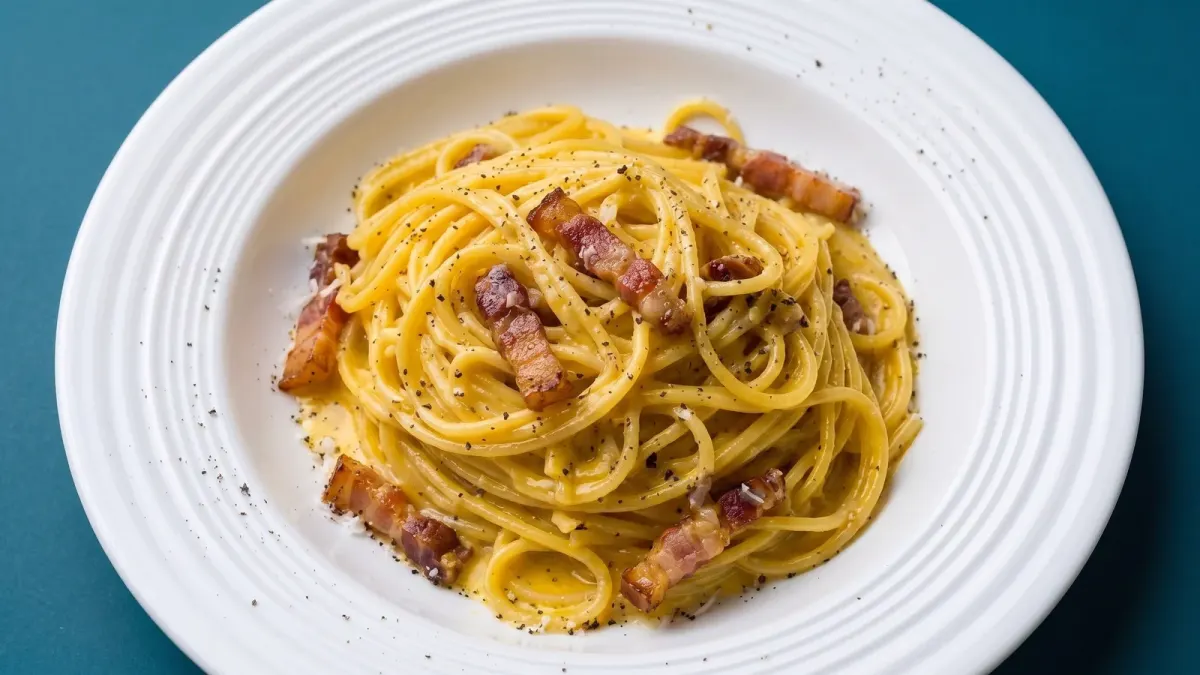
Spaghetti alla carbonara
Four ingredients, zero margin for error
- In all
- 22min
- Hands-on
- 12min
- Waiting
- 10min
- You save With the steps in parallel, instead of one at a time.
- −17min
Difficulty: 3 of 5. 955 kcal each With the steps in parallel, instead of one at a time.
The median
The quantities are the median of the versions that give them, not one person’s opinion.
The time
The sources 25min
The plan 22min
3 of 7 sources state a time: all 25min.
Ingredients · 2 people
- Spaghetti 200 g
- Guanciale 120 g
- Egg yolks 3
- Pecorino romano 60 g
- Black pepper to taste
- Salt to taste
The plan
22min, 12min of it hands-on.
for 2 · one cook · one pan and two pots
- 01 Put the water on waiting, minutes 0–10
- 02 Cut the guanciale hands-on, minutes 0–5
- 03 Mix yolks and pecorino hands-on, minutes 5–9
- 04 Cook the pasta waiting, minutes 10–19
- 05 Crisp the guanciale watching, minutes 11–19
- 06 Mantecatura hands-on, minutes 19–22
- hands-on
- watching
- waiting
The plan is for one cook, with one pan and two pots: PREP lines the steps up side by side.
The steps
-
01 Put the water on
Big pot, plenty of water, lid on.
- A litre of water for every hundred grams of pasta.
- Don't salt it yet: salted water takes longer to come to the boil.
- The lid halves the time.
IT’S READY WHEN A rolling boil that moves the whole surface, not little bubbles at the edges.
-
02 Cut the guanciale
Strips half a centimetre thick.
- Remove the rind but don't throw it away: whole in the pan, it perfumes the fat.
- Thick, not thin: they need to stay soft inside and crisp outside.
- Guanciale, not pancetta: it's fattier, and that fat is half the sauce.
- It looks like a lot because it is: it loses nearly half its weight as it renders.
IT’S READY WHEN Every piece the same size, so they cook evenly.
-
03 Mix yolks and pecorino
Yolks, finely grated pecorino, freshly ground pepper.
- One yolk per person plus one: that last one belongs to the pan.
- Yolks only. The white is water and proteins that scramble sooner.
- Grate it as finely as you can or the cream stays grainy.
- The egg stays nearly raw: use pasteurised eggs for children, the elderly, or during pregnancy.
IT’S READY WHEN A thick cream that coats the back of the spoon.
-
04 Cook the pasta
Salt the water, drop the pasta, set aside a ladle of the cooking water.
- Go light on the salt: pecorino and guanciale are salty enough already.
- Set the cooking water aside before you drain. Always.
- Drain a minute before the time on the packet: it finishes in the cream.
IT’S READY WHEN Properly al dente: bite a strand and the core is still pale.
-
05 Crisp the guanciale
Cold pan, medium-low heat, no added fat.
- Start with a cold pan: the fat renders instead of burning.
- No oil — the guanciale releases its own, and that's what you'll need later.
- If it sizzles hard, turn the heat down right away.
IT’S READY WHEN Clear fat and amber edges. If they turn brown you've gone too far.
-
06 Mantecatura
Heat off. Pasta into the guanciale first, then the cream with the pan off the hob.
- The yolk starts to set at 63 °C and is solid at 70 °C: below 65 °C the cream won't scramble, but the egg stays nearly raw.
- Move the pan off the heat and wait for the sizzling to stop.
- If you're afraid of blowing it, tip everything into a steel bowl: there's no heat underneath.
- Cooking water a little at a time, until it turns glossy.
- Toss the pasta by moving the pan, don't stir with a spoon.
IT’S READY WHEN Cream that slides across the plate. If it dries out, more cooking water.
Where the sources disagree
- 1
Yolks or whole eggs
Today's recipes use yolks only, one per person plus one; whole eggs and cream are the carbonara of the 1960s, documented in Luca Cesari's history, not a tourist's mistake. This one is yolks only, no cream: if you want the older version, bear in mind that the white scrambles sooner.
- 2
Pan or bowl
Monosilio and SiCucina bring the sauce together in a steel bowl, not in the pan. Here it happens in the guanciale pan, off the heat; the bowl, with no flame underneath, is the forgiving route, for anyone afraid of scrambling the egg.
- 3
How hot the egg sauce gets
SiCucina puts the danger zone at 62 °C, other sources say never above 65, Cookist pasteurises the yolks at 65 and Monosilio at 52 in a bain-marie, that is with more time and less heat. Here the egg sauce is made off the heat, below 65 °C, because the yolk starts to set at around 63: the egg stays nearly raw, so for children, the elderly or during pregnancy use pasteurised eggs.
Where the numbers come from
This recipe compares 7 sources. The quantities are the median of the versions, not one person’s opinion: where the sources disagree, the majority wins. Here they all are.
- Gambero Rosso — le 10 regole dei cuochi romani —
- Luciano Monosilio — Identità Golose —
- Cookist 25min
- SiCucina 25min
- Cuoco Goloso 25min
- Luca Cesari — storia della carbonara, 1960-2000 —
- CREA — tabelle di composizione degli alimenti —
- With PREP’s plan 22min
Published , updated .
Allergens
- Gluten
- Eggs
- Milk
They come from the recipe's list. The label on what you buy is what counts.
More recipes
- Tagliatelle al ragù 2h37min
- Aubergine parmigiana 2h37min
- Soupe à l'oignon gratinée 1h52min
Coming to the App Store.
For 10min of this recipe’s 22min your hands are free: PREP tells you what to do meanwhile, and when to go back to the stove.
To hear when it’s out, write to francesco@preprecipe.com.
We count visits to the website without cookies and without knowing who you are.