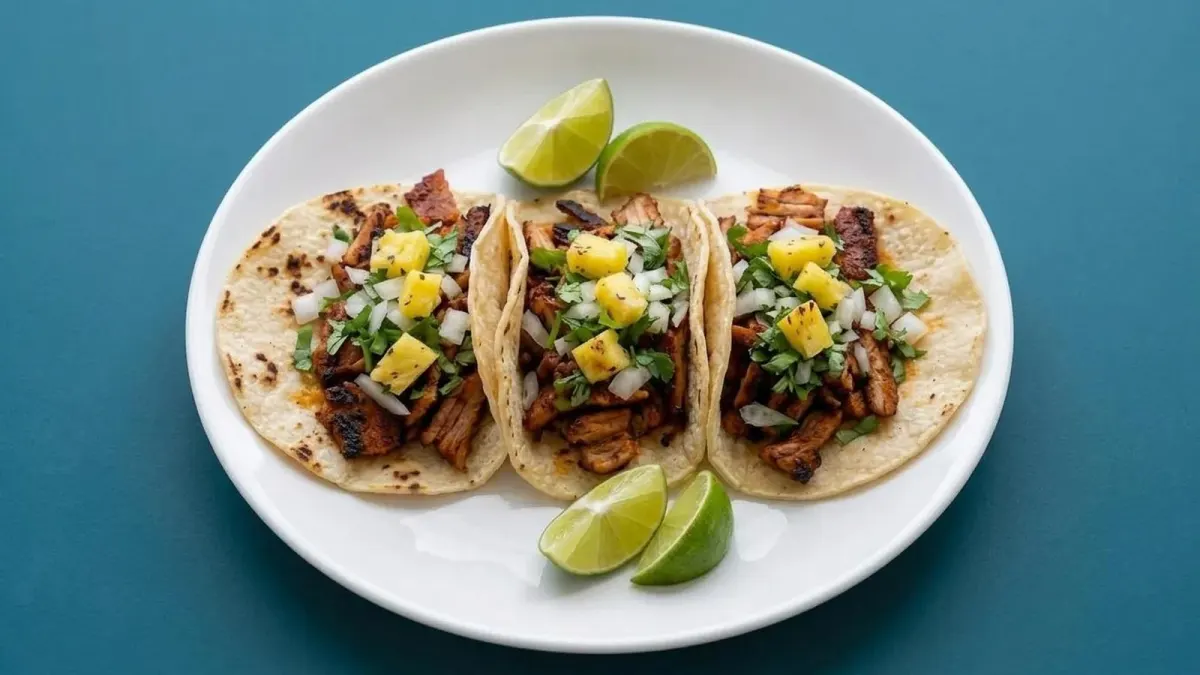
Tacos al pastor
The trompo doesn't fit in your kitchen. The night in the fridge does.
- In all
- 4h29min
- Hands-on
- 1h13min
- Waiting
- 3h16min
- You saveWith the steps in parallel, instead of one at a time.
- −33min
Difficulty : 3 of 5585 kcal eachWith the steps in parallel, instead of one at a time.
The median
The quantities are the median of the versions that give them, not one person’s opinion.
The time
The sources2h03min
The plan4h29min
6 of 17 sources state a time: 50min to 5h, median 2h03min.
Ingredients · 4 people
- Pork shoulder600 g
- Dried guajillo chillies4
- Dried ancho chillies2
- Achiote pasteto taste
- Wine vinegar3 tablespoons
- Orange2
- Garlic3 cloves
- Onion2
- Ground cumin1 teaspoon
- Dried oregano1 tablespoon
- Clovesto taste
- Pineapple260 g
- Corn tortillas16
- Fresh coriander1 handful
- Lime2
- Vegetable oilto taste
- Saltto taste
- Black pepperto taste
The plan
4h29min, 1h13min of it hands-on.
for 4 · one cook · one pan and two pots
- 01Clean and toast the chillies hands-on, minutes 0–7
- 02Boil water for the chillies waiting, minutes 2–7
- 03Slice the pork thinly hands-on, minutes 7–15
- 04Soak the chillies waiting, minutes 7–22
- 05Blend the adobo hands-on, minutes 22–30
- 06Coat the pork in adobo hands-on, minutes 30–34
- 07Marinate in the fridge waiting, minutes 34–214
- 08Take the chill off the pork waiting, minutes 214–234
- 09Slice the pineapple hands-on, minutes 214–219
- 10Chop onion and coriander hands-on, minutes 219–225
- 11Heat the pan watching, minutes 225–229
- 12Caramelise the pineapple watching, minutes 229–234
- 13Sear the pork in batches hands-on, minutes 234–250
- 14Chop the meat in the pan hands-on, minutes 250–253
- 15Warm the tortillas hands-on, minutes 253–265
- 16Build the tacos hands-on, minutes 265–269
- hands-on
- watching
- waiting
The plan is for one cook, with one pan and two pots: PREP lines the steps up side by side.
In the app this plan guides you step by step, and rings when a pot is ready. Notify me
The steps
-
01Clean and toast the chillies
Stalks, seeds and veins out. Then a quick blast in a dry pan: chillies, onion, garlic.
- Guajillo and ancho are the pairing most sources use: the first brings colour and acidity, the second sweetness and body. Four of the nine cookbooks that give quantities for the adobo use guajillo alone, and you get a leaner adobo, redder and more aggressive.
- The white veins are where the heat sits: take them all out if you want it red without the sting.
- Dry frying pan, no oil. Toast the chillies until their smell changes and they puff slightly. If they smoke they're burnt and the adobo turns bitter: there's no coming back from that, you start again.
- Same pan, after the chillies: half the onion in thick slices and the garlic cloves whole, until they take on dark blotches and soften. Raw in the blender they stay sharp and you taste them all night; charred they go sweet. Cocina Vital roasts them, Bon Viveur browns them in a pan: same idea.
IT’S READY WHEN A smell of toasted nuts and skin pulling tight, not a wisp of smoke. Onion and garlic with dark blotches and flesh that gives.
-
02Boil water for the chillies
Pot of water on the heat, lid on.
- You need water at a real boil. If it's only lukewarm, the chillies hydrate badly and stay leathery in the middle, and in the blender they turn into flecks of skin.
- Just enough to cover the chillies in the bowl; extra water only makes you wait longer for the boil.
- Lid on, always. It's the only free way to shorten this wait.
IT’S READY WHEN A rolling boil that moves the whole surface, not little bubbles at the edges.
-
03Slice the pork thinly
Wide slices, half a centimetre thick.
- Pork shoulder is the right cut: the fat running through it keeps the slice tender on the hot pan. A lean cut dries out and turns to sawdust, no matter how much adobo you put on it.
- Sources run from three millimetres to a full centimetre. Half a centimetre is the median and it's also the most forgiving thickness: thinner and it falls apart when you chop it, thicker and the centre is still raw by the time the edges have gone black.
- Cut the meat straight from the fridge, not at room temperature: the knife goes clean through instead of sliding.
- Wide slices, not cubes. On the trompo the meat sits as wide slices stacked up, and that shape is what lets the adobo get in fast.
IT’S READY WHEN The slice drapes over the knife without breaking, and laid on the board it spreads out on its own.
-
04Soak the chillies
Cover with boiling water and let them swell.
- Hold them under with a saucer. The ones that float stay hard on the side sticking out of the water, and you notice it.
- Set aside a ladleful of the soaking water: it's what gets the blender turning, and it's the most flavourful liquid you have.
- If one chilli did get burnt, the water is bitter: throw it out and use clean water, because all that bitterness goes into the adobo.
IT’S READY WHEN The flesh gives under your thumb and the skin lifts away from the inside.
-
05Blend the adobo
Everything in the blender, then through a strainer.
- Soaked chillies, achiote, the charred garlic and onion, vinegar, orange juice, cumin, oregano and whole cloves all together, with the reserved soaking water to get the blade turning.
- You want a thick paste that coats the spoon, not a sauce. If it runs, the meat won't hold it and it separates in the fridge.
- The strainer isn't fussiness: chilli skins stay behind no matter what, and in your mouth they feel like scraps of papery skin.
- Salt and pepper now. Salt inside the adobo works into the meat overnight; salt put on the cooked meat stays on the surface.
- Set aside a few spoonfuls of adobo before it touches the raw meat, in its own container. That's the one that goes back into the pan at the end of cooking. Pati Jinich does exactly this: she reserves part of the marinade before coating the meat.
- Sources split on the acid here: most use vinegar, often with orange juice; a minority go with pineapple juice. Pineapple contains bromelain, a mix of enzymes that digest protein. The sources that use it still marinate overnight: bromelain is the mechanism, not a ban they observe.
IT’S READY WHEN An even brick red, no flecks of skin, and the spoon comes out coated.
-
06Coat the pork in adobo
Slice by slice, in layers, the way a trompo is loaded.
- Rub the adobo into both sides of every slice and stack them one on top of the other. That's exactly how the trompo is built, and at home it does the same job: keep every face wet.
- Be generous with the adobo. Whatever's left goes over the stack: from here on it has touched raw pork, so it stays with the meat and ends up in the pan with it, not on the plate at the end.
- The gesture comes from a long way off. Shawarma reached Puebla with the Lebanese and Syrian migration of the early twentieth century; in the 1920s pork took the place of the original meat and the tortilla the place of the bread, but the form we know only settled in the 1960s, with the children of those migrants.
- Sealed container, straight into the fridge. Raw pork at room temperature is the classic way to grow something inside your lunch.
IT’S READY WHEN No pink left uncovered: the whole surface is brick red, including between one slice and the next.
-
07Marinate in the fridge
Into the fridge, covered, and the kitchen shuts down.
- This is where the dish can break into two sessions: adobo and marinating in the evening, cooking the next day. It isn't time you can compress and it isn't time you're present for: this is the one recipe where the real work is remembering to start the day before.
- The spread across sources is the widest of those compared: from two hours to forty-eight. The median of the stated minimums is three hours, which is what the card counts; a full night is the ideal nearly all of them name, Larousse included, and worth planning for if you can.
- Under two hours the adobo colours the surface and nothing more: the taco comes out red outside and bland inside.
- With vinegar, a long marinade does no harm. If you take the pineapple juice variant, know that bromelain works on the fibres: the sources that use it still go overnight, but from there on the risk of mushy meat is yours.
IT’S READY WHEN The meat has gone from bright red to deep dark red, even where two slices were touching.
-
08Take the chill off the pork
Out of the fridge while you prep the rest.
- Fridge-cold meat on a screaming-hot pan seizes up and throws off water: it boils instead of browning, and the charred edge never comes.
- It doesn't need to reach room temperature, it just needs to lose the chill.
- Half an hour is the ceiling. Past that, raw pork out of the fridge stops being a smart idea.
IT’S READY WHEN The surface is no longer cold to the touch but the middle of the stack still is.
-
09Slice the pineapple
Slices a centimetre thick, skin off.
- Thick slices. Thin ones fall apart in the pan, stay watery and never caramelise.
- On the trompo the pineapple sits on top and drips down the meat as it turns: that's where the sweetness of pastor comes from. In a frying pan you get the same effect by caramelising it before the meat, in the same pan.
- Mexico genuinely splits here: pineapple is the signature of the central style, and some consider it a late addition. Larousse puts it in the definition of the dish, most recipes keep it, some taquerias in the north don't.
IT’S READY WHEN The slice stands up on its own and the knife meets firm flesh, not stringy.
-
10Chop onion and coriander
Finely chopped, and the limes into wedges.
- Raw white onion and coriander are the fixed garnish in every Mexican source, along with the lime. It isn't decoration: they're the acid and the bite that stand up to the pork fat.
- Chop it once the meat has finished marinating, not the night before. Coriander cut ahead blackens and loses its scent, and the onion turns aggressive.
- Part of the onion already went into the adobo, charred: the rest goes here, raw.
IT’S READY WHEN The coriander is still bright green and hasn't left liquid on the board.
-
11Heat the pan
Empty pan, high heat, until it just barely smokes.
- It has to be screaming hot before anything touches it: at home that's the only way to get near the charred edges of the trompo.
- Heavy frying pan, cast iron or heavy-based. Light ones lose their heat the instant you load the meat, and from there on they boil it.
- A film of neutral oil, not a pool. The adobo is already fatty, and excess oil fries instead of browning.
IT’S READY WHEN A drop of water skips and vanishes in a second, without sizzling for long.
-
12Caramelise the pineapple
Slices in the pan, once on each side.
- Turn them once and once only. Unbroken contact is what builds the crust: move them around and all you get is warm pineapple.
- The caramelising sugar leaves a dark film on the bottom of the pan that the meat picks up later. That's the technical reason the pineapple goes first and in the same pan, not separately.
- Take them out and keep them whole: they get chopped only when you build the tacos, so they don't bleed juice onto the plate.
IT’S READY WHEN Brown stripes on the side that touched the pan and edges that curl. If it stays pale yellow, the pan wasn't hot enough.
-
13Sear the pork in batches
One layer at a time, high heat.
- In batches, always. An overloaded pan cools down, the meat throws off its water and ends up boiled and grey: this is the mistake that ruins pastor made at home more than anything you could get wrong in the adobo. The slices have to sit in a single layer, not touching.
- Between batches add a fresh film of oil and let the pan get screaming hot again. Load the second batch onto a cooled pan and it comes out different from the first.
- The adobo left on the stack of raw meat goes into the pan with the meat and cooks with it. The reserved adobo stays out: it has another job.
- Thin slices are done through the centre long before they're ready on the surface: the problem here isn't safety, it's dryness. Profeco, UNAM and INIFAP give 62.7 °C as the safe internal temperature for pork, followed by a short rest. Mexico's NOM-251 standard doesn't go that low: for whole cuts of pork it sets 68 °C, and the 63 °C that appears in the same clause covers fish, whole cuts of beef and egg, not pork. Larousse cooks its pastor to 70 °C. The reference to keep is the regulation's: 68 °C.
- The pink that remains in fully cooked pork is myoglobin, not undercooking: UNAM, INIFAP and Profeco say so together. Colour is not a thermometer.
IT’S READY WHEN Blackened edges and a surface glossy with caramelised adobo. If the pan hisses instead of sizzling, you've loaded too much.
-
14Chop the meat in the pan
Knife straight in the pan, meat into small dice, then the reserved adobo.
- Chop it hot and in the pan, not on the board. The juices stay where they're useful and the dice pick up a second round of crust on the base of the pan.
- Small dice, not long strips: in the taco the meat has to stay put and not escape on the first bite.
- Once it's all chopped, lower the heat, put everything back together and pour in the adobo you set aside — the one that never touched raw meat. One quick toss and that's it: on a screaming-hot pan the achiote turns bitter fast.
- Pati Jinich instead cuts thin strips a couple of centimetres wide: that's the version for people who want to see the slice in the taco rather than chopped meat. In Monterrey the same dish is called tacos de trompo.
IT’S READY WHEN The cubes come apart without sticking to each other and the bottom of the pan is dry, not wet.
-
15Warm the tortillas
Meat out, pan clear, tortillas in small batches.
- The meat comes out first, into a covered bowl. Tortillas won't fit on half a pan, and meat waiting over the heat while you warm them dries out. Same pan, with everything stuck to it: don't wash it between the two jobs.
- A few at a time, not overlapping, and lower the heat: the pan is still screaming hot from the meat and will burn the first batch if you don't bring it down.
- A few seconds per side, dry, no fat: they should go soft and foldable, not crisp. A crisp tortilla is a tortilla chip, not a taco.
- Keep them under a tea towel as they come off. Uncovered, they stiffen in the time it takes you to build the first few.
IT’S READY WHEN They puff slightly and fold in half without cracking along the fold.
-
16Build the tacos
Meat, pineapple, onion, coriander, lime. In that order.
- Chop the caramelised pineapple now, not earlier: hot against cold and sweet against sour are half of what makes this taco different from any other pork taco.
- The order isn't about looks. The meat greases the tortilla and holds it together, pineapple and onion sit on top where they stay crisp, the lime gets squeezed last and runs through everything.
- Eat them right away, standing up if that's what it takes. A lukewarm taco al pastor is a different dish, and a worse one.
IT’S READY WHEN The tortilla holds without going soggy and the first bite has hot, sour and sweet all at once.
Where the sources disagree
- 1
How long to marinate
On marinating the sources don't even agree on the minimum, and seven sources out of nine name a full night as the ideal. The card counts the median of the minimums, so the dish can be made in a day; if you can start the evening before, a night in the fridge gives a taco with flavour right through.
- 2
Which acid in the adobo
Vinegar is in nearly all of them; orange juice is added by four cookbooks out of twelve plus Larousse, pineapple juice by three: Qué Cocino Hoy, MexGrocer and Paulina Cocina. Here it's vinegar and orange: if you go for pineapple, its bromelain works on the fibres, and with a long marinade the meat can turn mushy.
- 3
Guajillo alone or with ancho
Of the nine cookbooks that give quantities for the adobo, five put ancho alongside guajillo and four use guajillo alone. Here it's the pair, because guajillo brings colour and acidity and ancho sweetness and body; with guajillo alone the adobo comes out leaner, redder and more aggressive.
Where the numbers come from
This recipe compares 17 sources. The quantities are the median of the versions, not one person’s opinion: where the sources disagree, the majority wins. Here they all are.
- Larousse Cocina — Pastor negro2h45min
- Larousse Cocina — Diccionario Enciclopédico de la Gastronomía Mexicana, «tacos al pastor»—
- Pati Jinich — Tacos al pastor3h05min
- Recetas Mexas — Tacos al pastor, receta auténtica1h10min
- CocinaDelirante — Adobo para tacos al pastor como de taquería—
- Cocina Fácil (Editorial Televisa) — Adobo para tacos al pastor—
- Cocina Fácil — Tacos al pastor en 6 simples pasos—
- Cocina Vital — Adobo para tacos al pastor—
- UnoTV — Tacos al pastor caseros en sartén—
- Qué Cocino Hoy — Tacos al pastor (receta casera)50min
- Bon Viveur — Tacos al pastor1h20min
- Paulina Cocina — Tacos al pastor, receta original—
- MexGrocer — Tacos al pastor recipe (achiote, guajillo, piña)5h
- El Universal Puebla — Shawarma, la historia del platillo que dio origen a los tacos al pastor—
- El Imparcial — UNAM, INIFAP y Profeco sobre el color y la cocción de la carne de cerdo—
- Diario Oficial de la Federación — NOM-251-SSA1-2009, 7.3.1—
- Rathnavelu et al., "Potential role of bromelain in clinical and therapeutic applications" (PMC)—
- With PREP’s plan4h29min
Allergens
- Sulphur dioxide and sulphites
They come from the recipe's list. The label on what you buy is what counts.
More recipes
- Guacamole12min
- Moussaka2h29min
- Aubergine parmigiana2h37min
Coming to the App Store.
For 3h16min of this recipe’s 4h29min your hands are free: PREP tells you what to do meanwhile, and when to go back to the stove.
Leave your email: we’ll write once, when it’s out.
We count visits to the website without cookies and without knowing who you are.
One step left.