Recipes › Greek cuisine · Greece
Moussaka
Three kitchens running in parallel and half an hour of patience at the end.
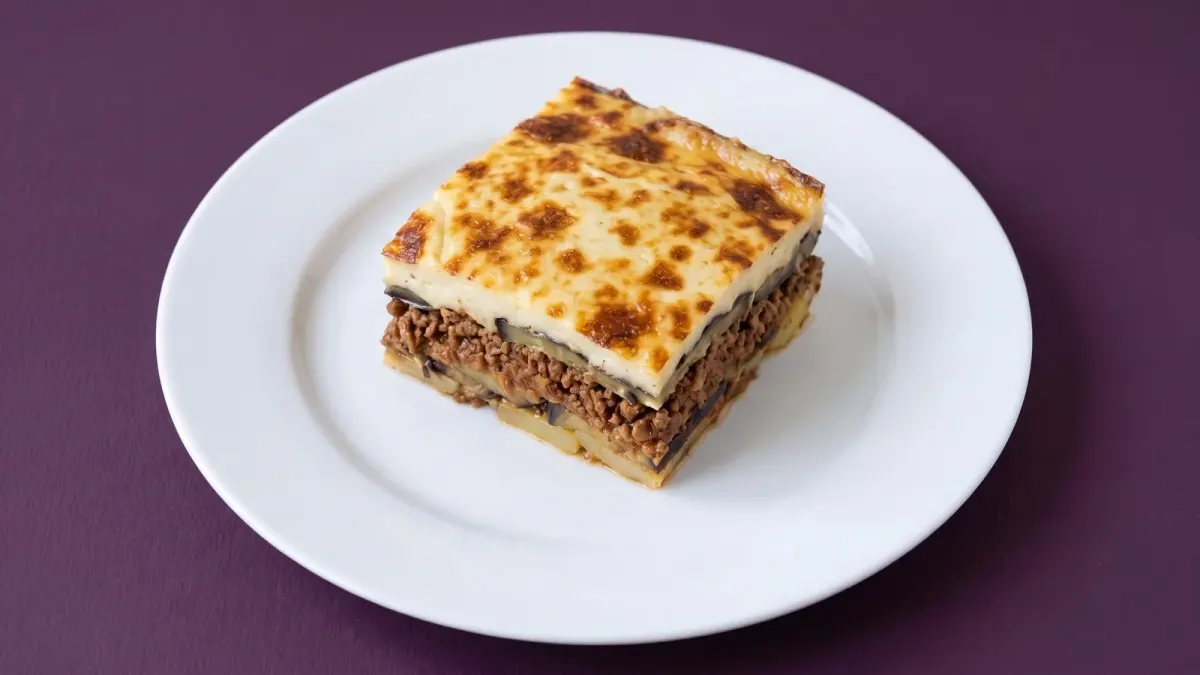
Ingredients
- Aubergine600 g
- Potatoes400 g
- Minced beef300 g
- Onion1
- Garlic2 cloves
- Whole peeled tomatoes400 g
- Tomato purée1 tablespoon
- Red winehalf a glass
- Ground cinnamonhalf a teaspoon
- Bay leafto taste
- Extra-virgin olive oil300 g
- Butter60 g
- 00 flour60 g
- Whole milk600 ml
- Egg yolks2
- Kefalotyri100 g
- Nutmegto taste
- Saltto taste
- Black pepperto taste
The plan
- 05Chop onion and garlicminutes 0–4
- 02Peel and slice the potatoesminutes 4–9
- 03Fry the potatoesminutes 9–25
- 06Sweat the onion and garlicminutes 11–16
- 07Brown the minceminutes 16–25
- 08Tomato purée, spices, wineminutes 25–28
- 01Slice the aubergineminutes 28–34
- 09Simmer the meat sauceminutes 28–56
- 11Make the rouxminutes 34–38
- 12Add the milk and thickenminutes 38–44
- 04Fry the aubergineminutes 44–56
- 13Cool the béchamel to lukewarmminutes 51–56
- 10Cool the sauce to lukewarmminutes 56–66
- 14Yolks and kefalotyriminutes 56–59
- 15Heat the ovenminutes 59–74
- 16Build the layersminutes 66–74
- 17Bake the moussakaminutes 74–119
- 18Let it restminutes 119–149
hands busykeep an eyewaiting
The plan is for one cook, with one pan and two pots: PREP lines the steps up side by side.
The steps
-
05 Chop onion and garlic hands-on · 4min · minutes 0–4
Onion fine, garlic finer still, kept apart.
- The onion has to disappear into the meat sauce, not turn up in chunks under the béchamel.
- Keep them in two piles: they go into the pot at two different moments.
Cue. Pieces of two or three millimetres, all the same. If the onion slides under the blade instead of cutting, the knife is blunt.
-
02 Peel and slice the potatoes hands-on · 5min · minutes 4–9
Peeled and in rounds, one centimetre again.
- Same thickness as the aubergine: in the final bake they have to finish cooking together.
- Rinse and dry them well after slicing. Starch on the surface glues the slices to each other and makes them stick to the bottom of the pan.
- The potatoes are the bottom layer, the one that carries the weight of everything else.
Cue. The rounds stand up on their own and don't bend between your fingers.
-
03 Fry the potatoes hands-on · 16min · minutes 9–25
Oil halfway up the slices, two batches, never overlapping.
- They go first: frying the aubergine darkens the oil and the potatoes would come out grey.
- The oil should come halfway up the slices, not cover them. Turn them once, no more.
- They have to come out cooked, not just coloured. In the final bake they're buried under everything else and get almost no direct heat: what doesn't cook now stays raw forever.
- Between batches let the oil come back up to heat. Dropped into cooled oil, the slices drink it instead of frying in it.
- Onto kitchen paper the moment they come out, in a single layer.
Cue. Golden edges and the knife tip goes in without resistance. If they fall apart you cut them too thin.
-
06 Sweat the onion and garlic keep an eye · 5min · minutes 11–16
Pot, oil, medium heat: onion first, garlic after.
- It has to turn translucent and sweet, never brown. The Greek meat sauce doesn't have the dark base of the Italian one: here the sweetness comes from the onion, not from browning.
- The garlic goes in halfway through. Put it in at the start and by the time the onion is ready it's already bitter.
- The meat sauce is made in a pot, not a frying pan. The frying pan is for the vegetables and it's tied up for a long time.
Cue. Glassy onion and no sound of frying. If it's sizzling hard, your heat is too high.
-
07 Brown the mince keep an eye · 9min · minutes 16–25
Into the pot on high heat, leave it until it colours, then break it up.
- First you leave it alone until it grips the pot and takes on colour, then you break it up. Stir it right away and the meat boils in its own liquid and stays grey: that's the mistake that ruins the sauce before the tomato even shows up.
- Doing nothing is the work. That's why this step doesn't tie up your hands: you're at the hob, but the vegetable pan keeps going.
- Break it up properly when the moment comes. In moussaka the sauce is a thin layer and every lump shows up under the knife.
- Salt and pepper now, lightly: the sauce will reduce by half.
Cue. The bottom of the pot is dry and the meat sizzles instead of bubbling.
-
08 Tomato purée, spices, wine hands-on · 3min · minutes 25–28
Toast the purée with cinnamon and bay, then deglaze with wine.
- The purée has to cook on the dry bottom of the pot before anything wets it. Raw, it stays sour and bitter, and that bitterness never leaves.
- Cinnamon and bay go in now, pot hot and still without liquid: this is the moment the spices open up.
- Cinnamon is the signature of Greek moussaka; four verified sources out of ten put it in. But it shouldn't announce itself: if you can taste cinnamon, you used too much.
- The wine boils off almost immediately. Scrape the bottom with the spoon while it bubbles: what you lift is the flavour.
Cue. The purée has gone from red to dark brick and the sharp smell of wine is gone.
-
01 Slice the aubergine hands-on · 6min · minutes 28–34
One-centimetre slices, all the same.
- One centimetre. Sources run from half a centimetre to a full one: thinner and the slice falls apart in the pan and disappears between the layers; thicker and it stays raw under the béchamel.
- No salting to draw out water. Only two of the verified recipes do it, and today's aubergine isn't as bitter as it was fifty years ago.
- If you salt them anyway, leave them in the salt until they bead with water, then rinse and squeeze them dry: the reason isn't bitterness, it's oil. Flesh that has already collapsed drinks less of it in the pan.
- Stack them aside: what matters is that they all go into the pan in three batches.
Cue. Cut open, the flesh is firm and the seeds are pale and barely visible. Brown seeds and spongy flesh: old aubergine, it'll be bitter. Browning on the cut surface is normal and tells you nothing.
-
09 Simmer the meat sauce keep an eye · 28min · minutes 28–56
Tinned tomatoes in, low heat, uncovered, until it dries out.
- Uncovered the whole time: moussaka's meat sauce has to dry out. If it stays loose it soaks the layers, the béchamel sinks and the slice won't stand up.
- Stir it every three or four minutes. You can't leave the kitchen: a thin layer of meat on the bottom catches before you notice.
- Sources run between ten and forty-five minutes. The median falls just under half an hour, which is also the point where the tinned tomatoes stop tasting like the tin.
- Adjust the salt only at the end. What you salted at the start is twice as concentrated now.
- Fish out the bay leaf before you spread the sauce. Under the béchamel nobody finds it until they hit it with a knife.
Cue. The spoon leaves a trail on the bottom that fills in slowly. Oil surfaces at the edges.
-
11 Make the roux hands-on · 4min · minutes 34–38
Butter melted, flour in all at once, whisk right away.
- Butter and flour by equal weight: that's the ratio in five of the verified sources. The others diverge — some double the butter, some make it with olive oil.
- It has to cook until it stops tasting of raw flour, but without taking on colour. Moussaka's béchamel is white: a blond roux shows through the crust.
- This is the second pot. The first is tied up with the meat sauce and doesn't free up until you assemble.
- You start once the sauce is already simmering, not before: finished béchamel can't sit for long.
Cue. The paste pulls away from the bottom in one mass and smells of biscuits just out of the oven.
-
12 Add the milk and thicken hands-on · 6min · minutes 38–44
Milk in stages, and a whisk that never stops.
- A little milk at a time. The first addition has to be absorbed completely before the second, and at that point lumps stop forming: it's the only method that actually works.
- Whisk without stopping. Stop your hand and the bottom catches, and the scorched taste goes through the whole béchamel.
- It has to hold on top of the meat sauce, not run down between the layers. At this stage the whisk trail only needs to hold for an instant: it'll finish thickening once the yolks and the cheese go in.
Cue. The first big bubbles breaking lazily at the surface. The whisk leaves a trail that holds a second before it closes over.
-
04 Fry the aubergine hands-on · 12min · minutes 44–56
Same pan, same oil, three batches.
- Aubergine is a sponge: it drinks oil in the first few seconds and gives some of it back only when the flesh collapses. The pan has to be genuinely hot, or it just drinks.
- Don't crowd them. Slices that touch each other steam instead of frying, stay white in the middle and never collapse.
- To cut down on the oil, some roast them at around 200 °C, and some go up to 220 °C: all that time in the pan disappears, and the dish comes out drier and less rounded.
- Out onto kitchen paper, blotted on top too.
Cue. Translucent and yielding, golden at the edges. If the centres stay white and opaque, put them back down.
-
13 Cool the béchamel to lukewarm waiting · 5min · minutes 51–56
Off the heat, until it stops steaming.
- This is only for the yolks: in boiling-hot béchamel they set into yellow threads and there's no going back.
- It doesn't take long. Any longer and a skin forms on the surface, and that skin shows up as streaks on the baked crust.
- Don't cover it: the steam condenses on the lid and drips back in.
Cue. The steam is gone and the back of your hand held over the pot feels heat but doesn't pull away.
-
10 Cool the sauce to lukewarm waiting · 10min · minutes 56–66
Off the heat, uncovered, until it stops bubbling.
- Boiling-hot sauce liquefies the béchamel: it runs down between the layers instead of staying on top, and no crust forms.
- Uncovered, the way it simmered. Covered, it takes back the moisture you just drove out.
- It fits inside the oven preheat or the last batch of frying: it costs you no extra time.
Cue. No more steam rising and the surface has gone matte. The back of your hand over the pot feels heat but doesn't pull away.
-
14 Yolks and kefalotyri hands-on · 3min · minutes 56–59
Yolks one at a time, then kefalotyri and nutmeg.
- The béchamel was grafted on by Tselementes, and it's the reason Greek moussaka looks like none of its Mediterranean cousins. The eggs in it are the variable: the verified sources more often beat in whole eggs, yolks alone are the minority. Here it's yolks, which give the puffed crust without letting it collapse as it cools.
- One at a time, whisking hard between each. Added all at once, they never blend in evenly.
- Kefalotyri is hard and very salty: taste before you add any more salt.
- Hold back a handful of cheese for the top.
- Beat it together just before you layer. Left standing it skins over, and the skin shows up as streaks on the baked crust.
Cue. The béchamel goes from white to full yellow and turns glossy instead of matte.
-
15 Heat the oven waiting · 15min · minutes 59–74
180 °C, fan if you have it.
- 180 °C is the median across the sources, which run from 170 °C to 220 °C. Hotter colours the surface before the centre is even warm.
- Shelf in the middle. Higher up, the béchamel sits right under the element and burns in patches.
Cue. The indicator light goes out and the air coming out when you open the door burns the back of your hand.
-
16 Build the layers hands-on · 8min · minutes 66–74
Potatoes down first, aubergine, meat sauce, aubergine, béchamel on top.
- The potatoes are the base and carry the weight. The aubergine splits into two layers, above and below the meat sauce: that's what keeps the slice standing up.
- Part of the béchamel gets stirred into the meat sauce before you spread it. It binds the meat and keeps it from crumbling under the knife: that's the trick that holds the slice together.
- The sauce has to be lukewarm when it meets the béchamel. Boiling hot, it liquefies the béchamel, and it runs down between the layers instead of staying on top.
- Spread the top béchamel all the way to the edges, sealing. Anywhere left uncovered, the sauce dries out and burns.
- The last handful of kefalotyri over the top, before it goes in the oven.
Cue. The béchamel layer is a finger deep and the surface is flat: bumps turn into burns.
-
17 Bake the moussaka waiting · 45min · minutes 74–119
180 °C, middle shelf, and don't open the door.
- Don't open the oven during the first half of the bake. The crust is rising on the yolks, and a blast of cold air drops it for good.
- If it colours too early, lay a sheet of foil over it and move on: it's the surface colouring first, not the centre cooking last.
- Under the crust it has to come to a real simmer: that's where the meat sauce and the béchamel bind into a single block.
Cue. Surface puffed and golden in patches, never even. At the edges the béchamel has pulled away from the dish and you can see it simmering underneath.
-
18 Let it rest waiting · 30min · minutes 119–149
Out of the oven, warm before you cut.
- This isn't advice: it's the difference between a portion and a pile. Straight out of the oven the béchamel is still liquid under the crust and the slice collapses.
- The ones who give a number disagree, from half an hour to a full hour. Half an hour is the minimum that works: under that, the béchamel hasn't firmed back up.
- Warm, not hot. Moussaka is one of the few baked dishes that's better at room temperature than piping hot.
- The next day it cuts perfectly and reheats better than a layered dish has any right to.
Cue. The knife goes all the way down and the slice comes out whole, layers distinct and the béchamel not running onto the plate.
Allergens
- Sulphur dioxide and sulphites
- Milk
- Gluten
- Eggs
They come from the recipe's list. The label on what you buy is what counts.
Where the numbers come from
This recipe compares 14 sources. The quantities are the median of the versions, not one person’s opinion: where the sources disagree, the majority wins. Here they all are.
- Αργυρώ Μπαρμπαρίγου — Μουσακάς
- Γιώργος Τσούλης — Μουσακάς
- Cantina / Πρώτο Θέμα — Μουσακάς
- Paxxi — Μουσακάς
- BOVARY — Συνταγή για μουσακά
- Ioanna's Notebook — Παραδοσιακός Μουσακάς
- Cookpad Ελλάδα — Κλασικός μουσακάς της γιαγιάς
- Cookpad Ελλάδα — Μουσακάς κλασικός της μαμάς
- Cookpad Ελλάδα — Μουσακάς ο Κλασικός
- Cookpad Ελλάδα — Μουσακάς (8 μερίδες)
- Greek Gastronomy Guide — Μουσακάς
- Βικιπαίδεια — Μουσακάς
- Βικιπαίδεια — Νικόλαος Τσελεμεντές
- medNutrition — Λεξικό διατροφής: Μελιτζάνα
For 1h22min of this recipe’s 2h29min your hands are free: PREP fills them with a second dish or a side, and tells you what to do and when.
Leave your email: we’ll write once, when it’s out.
More recipes
- Aubergine parmigiana 2h37min
- Karaage 41min
- Spaghetti alla carbonara 22min