Recipes › Mexican cuisine · Mexico
Guacamole
No cooking: the only thing you can get wrong is the texture.
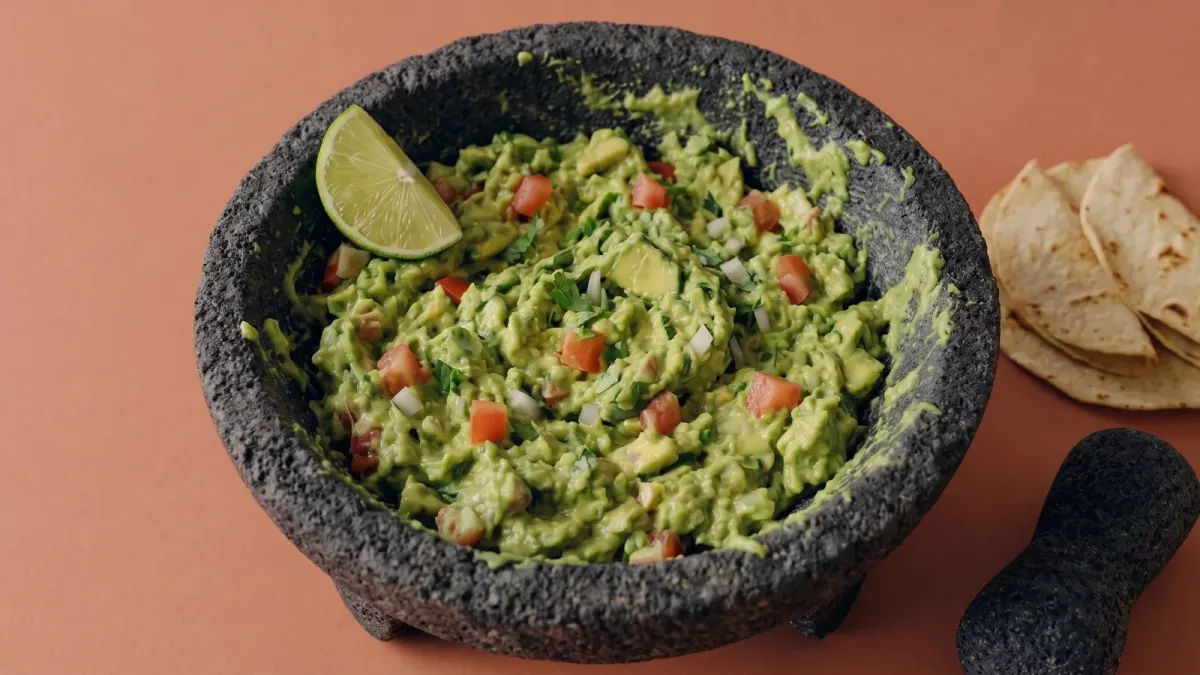
Ingredients
- Avocado3
- Onionhalf an onion
- Serrano chillies2
- Fresh coriander2.5 handfuls
- Lime1
- Ripe tomatoes2
- Saltto taste
The plan
- 01Chop chilli, onion, corianderminutes 0–5
- 04Open and scoop the avocadosminutes 5–7
- 02Dice the tomatominutes 7–9
- 03Pound the base in a molcajeteminutes 9–10
- 05Mash with the limeminutes 10–11
- 06Fold in and serveminutes 11–12
hands busykeep an eyewaiting
The plan is for one cook, with one pan and two pots: PREP lines the steps up side by side.
The steps
-
01 Chop chilli, onion, coriander hands-on · 5min · minutes 0–5
Knife, never the blender: onion, chilli and coriander finely chopped.
- Wash and dry the coriander well before it meets the knife: nothing cooks here, and the water left on it loosens the guacamole.
- The white onion has to be chopped really finely. In big pieces it stays raw in the mouth and covers the avocado instead of holding it up.
- You set the heat of the serrano with the seeds and the veins: in for full heat, out if kids are eating the guacamole too. Larousse básico wants it without seeds or veins, ASPIC leaves them in on purpose, Pati Jinich calls them optional.
- From the coriander you use the leaves and the tender part of the stems: there's more aroma in the stems than in the leaves, and they get thrown away out of habit. Pati Jinich puts it right in the ingredient list: leaves and upper stems.
- Set the coriander aside: it goes in last, otherwise the pestle shreds it into wet grass.
Cue. Onion and chilli in tiny dry grains on the board. The coriander releases its scent the moment you press it with the flat of the blade.
-
04 Open and scoop the avocados hands-on · 2min · minutes 5–7
Cut around the stone, twist, spoon against the skin.
- Knife down to the stone, all the way around, then twist the two halves in opposite directions: they come apart on their own.
- Run the spoon scraping right against the skin. The greenest and most flavourful flesh is exactly the part stuck to the skin, and it's the part that gets thrown out when you're in a hurry.
- Ripe but not soft. If the little stalk comes away and it's pale green underneath, the avocado is ready; if it's brown underneath, it's stringy inside.
- Room temperature, not from the fridge: cold flesh is firm and stays in chunks under the pestle. It's the first of Enrique Olvera's rules for guacamole — he keeps them out of the fridge until the exact moment he uses them.
- This isn't a light side. Universidad Intercontinental puts the fat at about fifteen parts per hundred of flesh, mostly oleic acid, and suggests a portion of a third or half an avocado, four or five times a week: here you're above that, because this is a shared table salsa, not a dish you sit down to.
Cue. The flesh gives under your thumb like butter just out of the fridge, but doesn't cave in.
-
02 Dice the tomato hands-on · 2min · minutes 7–9
Firm tomato, core and seeds out, small dice.
- Wash the tomato before the knife: raw stays raw, and there's no cooking here to fix it.
- Take out the watery core along with the seeds. That's what waters the guacamole down and turns it into a puddle while it's still on the table.
- This is where the sources genuinely split. Larousse Cocina, Cocina Vital, Maricruz Avalos and México Desconocido put it in; ASPIC, Pati Jinich and Enrique Olvera leave it out. Four to three — and Olvera comes in through a news article, not a recipe published under his name.
- Whoever skips it has the oldest voice on their side: in Alonso de Molina's 1571 vocabulary, ahuacamolli is glossed "manjar de auacates con chilli", avocado and chilli and nothing more. But the historical sources don't agree here: México Desconocido already lists jitomate among the pre-Hispanic ingredients.
- Firm and not overripe: the dice have to hold their shape even after you've folded everything together.
Cue. Dice that stay separate on the board, not a mush that bleeds water into the wood.
-
03 Pound the base in a molcajete hands-on · 1min · minutes 9–10
Chilli, onion and salt in the molcajete, pounded to a paste.
- This base before the avocado is Pati Jinich's method: the salt is the abrasive that breaks the fibres of the chilli and the onion against the stone.
- The molcajete is porous volcanic stone: it grinds instead of mashing everything to mush. Without one, a bowl and the tines of a fork come close enough: either way, mash these three on their own first. With no molcajete, Olvera reaches for a fork too.
- The salt here is working, not seasoning. The salt for taste goes in at the end, tasting as you go.
- ASPIC, Cocina Vital and Larousse start from the flesh with salt instead, and the chilli stays chunkier. Maricruz even opens with garlic and cumin: that's the variant this recipe doesn't follow.
Cue. A green, damp paste clinging to the stone, with no pieces of onion still recognisable.
-
05 Mash with the lime hands-on · 1min · minutes 10–11
Flesh in, lime straight over it, mash roughly.
- The lime isn't only flavour: the acidity slows the enzymatic browning of flesh exposed to air, which is why you squeeze it while you mash and not at the end, so it reaches every surface as it's uncovered. El Financiero flags the flip side, citing a recipe by Ricardo Muñoz Zurita: the juice turns it sour, so you add it a little at a time, tasting.
- The avocado stone left in the bowl does nothing. El Financiero, citing Larousse Cocina, calls it a myth: it doesn't prevent oxidation. It shields only the flesh physically underneath it — that's why that one patch stays green, and that's where the story comes from.
- Never the blender. You get a smooth purée, good for spreading and wrong for scooping up with a totopo. What you want is martajado, coarse.
- Larousse, in the guacamole clásico, mashes with salt alone, no citrus. It's a legitimate choice, but then you serve it right away.
Cue. Lumps of flesh that stay whole when you drag the spoon through, inside a creamy base. If it's all smooth, you went too far.
-
06 Fold in and serve hands-on · 1min · minutes 11–12
Coriander and tomato last, fold from the bottom, taste.
- Fold them in from the bottom, don't pound: the tomato has to stay in dice and the coriander shouldn't get shredded.
- Taste now. Salt and lime get adjusted only here, when all the flavours are together and the flesh has already taken up the acidity. Larousse Cocina and Pati Jinich close the same way, both finishing with a last check on the salt.
- It goes to the table at room temperature or barely cool, as Larousse indicates. Don't make it ahead: the darkening starts early and cling film pressed to the surface only slows it down.
- No garlic, and never cream. Of the Mexican recipes consulted here, only one uses garlic, pounding it with salt and cumin, and México Desconocido records it among the post-Conquest additions; cream has nothing to do with this dish.
Cue. The spoon leaves a furrow that closes over slowly. Bright green on the surface, no grey edges.
Allergens
None of the 14 named allergens.
They come from the recipe's list. The label on what you buy is what counts.
Where the numbers come from
This recipe compares 12 sources. The quantities are the median of the versions, not one person’s opinion: where the sources disagree, the majority wins. Here they all are.
- Larousse Cocina — Guacamole clásico
- Larousse Cocina — Guacamole básico
- ASPIC Instituto Gastronómico (Città del Messico) — Receta del Guacamole
- Pati Jinich — Guacamole
- Pati Jinich — Guacamole de chile verde
- Cocina Vital — Cómo hacer Guacamole casero en molcajete | Receta mexicana
- México Desconocido — Guacamole, una salsa de origen prehispánico que nos encanta
- Maricruz Avalos — Cómo hacer guacamole en molcajete
- Gran Diccionario Náhuatl, UNAM — voce ahuacamolli (Molina 1571, Códice Florentino, Wimmer 2004)
- El Financiero — ¿Cómo evitar que el guacamole se oxide?
- Universidad Intercontinental (UIC) — El aguacate en la consulta y en el plato. La ciencia detrás del «oro verde»
- Directo al Paladar — Las claves para hacer el mejor guacamole casero según un chef mexicano con dos estrellas Michelin (Enrique Olvera, Pujol)
This recipe is all hands-on: 12min with no waiting. PREP keeps the time, step by step, and at the end makes you a postcard.
Leave your email: we’ll write once, when it’s out.
More recipes
- Tacos al pastor 4h37min
- Moussaka 2h29min
- Aubergine parmigiana 2h37min