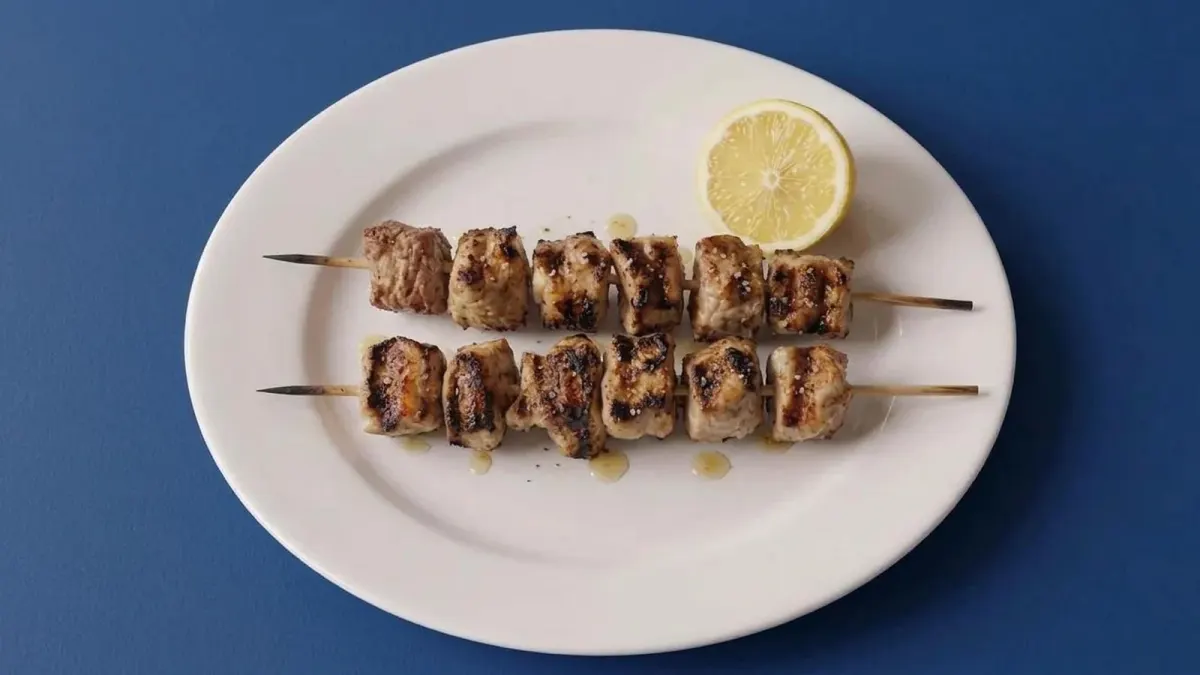
Pork souvlaki
Two hours in the fridge, then the pan twice
- In all
- 3h04min
- Hands-on
- 29min
- Waiting
- 2h35min
- You save With the steps in parallel, instead of one at a time.
- −34min
Difficulty: 2 of 5. 455 kcal each (estimate) With the steps in parallel, instead of one at a time.
The median
The quantities are the median of the versions that give them, not one person’s opinion.
The time
The sources 2h05min
The plan 3h04min
6 of 14 sources state a time: 50min to 20h30min, median 2h05min.
Ingredients · 4 people
- Pork collar 800 g
- Extra-virgin olive oil 4 tablespoons
- Lemon 2
- Dry white wine half a glass
- Garlic 2 cloves
- Onion 1
- Dried oregano 2 tablespoons
- Sweet paprika 1 teaspoon
- Mustard 1 teaspoon
- Salt to taste
- Black pepper to taste
The plan
3h04min, 29min of it hands-on.
for 4 · one cook · one pan and two pots
- 01 Cube the pork collar hands-on, minutes 0–8
- 02 Whisk the marinade hands-on, minutes 8–13
- 03 Submerge and massage hands-on, minutes 13–16
- 04 Marinate in the fridge waiting, minutes 16–136
- 05 Soak the skewers waiting, minutes 109–139
- 06 Drain and pat dry hands-on, minutes 136–139
- 07 Thread the skewers hands-on, minutes 139–147
- 08 Heat the pan watching, minutes 143–147
- 09 Cook the skewers — batch 1 watching, minutes 147–162
- 10 Cook the skewers — batch 2 watching, minutes 162–177
- 11 Rest off the heat waiting, minutes 177–182
- 12 Lemon, oregano, salt hands-on, minutes 182–184
- hands-on
- watching
- waiting
The plan is for one cook, with one pan and two pots: PREP lines the steps up side by side.
In the app this plan guides you step by step, and rings when a pot is ready. Notify me
The steps
-
01 Cube the pork collar
Cubes of about three centimetres, all the same size.
- Collar, not loin: the intramuscular fat in the collar melts in the short time on the grill and keeps the cube moist.
- Three sources out of eleven go for a lean cut — leg in two, tenderloin as an alternative in one. It works, but only if you shorten the cooking: with no intramuscular fat, the margin between pink and stringy is one minute.
- Between two and three centimetres is the range among the sources that measure: under that the cube dries out before it takes colour, over three it's still raw inside when the outside is already done. Three here, because the list is worked out on two skewers each of four cubes: with two-centimetre cubes you'd need about three times as many.
- Don't trim the fat: it's exactly what you bought the collar for.
- Raw pork: board and knife get washed before they touch anything else.
IT’S READY WHEN Every cube the same size. If one is bigger than the rest, it'll be the one that comes out raw.
-
02 Whisk the marinade
Oil, wine, garlic, onion, oregano, paprika, mustard: emulsify.
- Garlic crushed and onion thinly sliced, not finely chopped: they're there to lend their scent and then leave the stage, not to stick to the cubes and burn.
- No lemon here. Eight Greek sources out of eleven keep citrus out of the pork marinade, and one says it outright: acid left in contact too long toughens the surface. The lemon comes at the end, on hot meat.
- The oil should coat the meat, not drown it. Overdo it and you'll spend the whole cooking time putting out flare-ups.
- Little salt in the marinade, on purpose: the bulk of it goes on the meat at the end, where you taste it.
- No yogurt. In the Greek sources it turns up in the chicken marinade, never in the pork.
IT’S READY WHEN Marinade cloudy and bound: the oil no longer separates when you stop whisking.
-
03 Submerge and massage
Cubes in, hands in, then cover.
- Work it in with your hands, not with a spoon: the marinade has to get into the folds of the muscle, not slide over them.
- Cover the bowl. The marinade picks up fridge smells within hours and gives every one of them back.
- Once you're done, wash your hands and the dirty bowl before you touch anything else.
IT’S READY WHEN Every cube coated and glossy, no pale side left dry.
-
04 Marinate in the fridge
In the fridge, covered, and forget it.
- Two hours is the median of the eleven stated minimums and also the figure that repeats most: three recipes use exactly the same wording, "at least two hours", and two more start from the same number.
- If you have time, leave it overnight — that's the route the barbecue sources take, reaching eight to twelve and even twelve to twenty hours — and the marinade gets in deeper.
- Better not to go past overnight: the acid starts working the surface and turns it mealy. That isn't something the sources say: the longest source goes well beyond and doesn't complain.
- In the fridge, always. Raw pork marinating at room temperature is the most direct way to cultivate what you don't want.
IT’S READY WHEN The meat has gone from pink to dull on the surface and the oil has set on the rim of the bowl.
-
05 Soak the skewers
Wooden skewers soaking in cold water.
- Dry wood burns before the meat does and leaves an ashy taste on the cubes at the ends.
- The two Greek sources that put a clock on this give the same number: half an hour. A third just says to wet them, no minutes.
- With metal skewers you skip the step: they conduct heat and cook from the inside too, but they'll burn bare hands.
IT’S READY WHEN Wood evenly darkened and heavy in the hand, no longer pale and light.
-
06 Drain and pat dry
Drain, pat dry, pick the onion and garlic off the cubes.
- Wet meat doesn't brown: the liquid evaporates and steals heat from the surface, and the cubes boil instead of searing.
- Bits of onion and garlic left clinging burn before the meat does and taste bitter. All of them come off.
- Leftover marinade gets thrown out: it's touched raw pork and it doesn't come back to the table as a sauce.
IT’S READY WHEN The last sheet of kitchen paper comes away almost dry.
-
07 Thread the skewers
Four cubes per skewer, touching but not pressed.
- Two skewers per person, four cubes each: that's the portion the whole list is calculated from, and it's the one from the bylined source that states weight, skewers and servings together.
- Push the cubes together without squashing them. Pressed, they steam against each other and stay grey where they touch.
- Leave a stretch of bare wood at one end: that's the handle, and you'll use it on every turn.
- Nomenclature, which in Greece is a serious matter: this is kalamaki, the small souvlaki on the little wooden stick. All kalamaki are souvlaki, not all souvlaki are kalamaki. Gyros is something else again: meat stacked on a vertical spit, shaved into thin slices.
IT’S READY WHEN The cubes touch but you can see light between them, and the skewer holds straight when you lift it by one end.
-
08 Heat the pan
Heavy pan over high heat, empty.
- Cast iron or a heavy frying pan: cold meat drops the temperature of the metal, and a light pan never recovers.
- High heat. The Greek sources talk about coals or a strong fire, never a gentle flame: the crust forms in the first few minutes or not at all.
- Over coals or on a large griddle the same rule applies: metal or grate up to temperature before the meat goes on.
- No oil in the empty metal: it smokes before the surface is up to temperature, and the cubes come out of the marinade coated enough as it is.
- Stay with it. There's not much room between the right point and smoke, and with the pan empty there's nothing to absorb the heat.
IT’S READY WHEN A drop of water hisses and vanishes on the spot. If it skates across the surface you're already past it.
-
09 Cook the skewers — batch 1
Four sides, turning every two or three minutes.
- A threaded skewer is square in practice: it has four faces, and turning it once leaves you with two pale ones. The sources count two sides and state the time for those; the four sides are this recipe's own choice, made within the same total time, not a number lifted from them.
- 63 °C at the centre of the middle cube, plus three minutes off the heat: that's the safety threshold for whole-muscle pork, and it's a food-safety rule, not a doneness level. The thermometer goes into the middle cube, which is always the last to heat.
- A home frying pan holds one batch per two people: the time on the heat multiplies by the number of batches. Over coals or on a large griddle there's a single batch and the second one is skipped.
- With neither a barbecue nor a heavy frying pan, it goes in the oven at 180 °C: the two sources that do it take three to four times as long, and the crust never arrives.
- Don't press the skewers down with the fish slice: what squirts out is the juice you're trying to keep in.
IT’S READY WHEN Dark crust in irregular patches, meat that no longer gives under the tongs, 63 °C on the thermometer in the middle cube.
-
10 Cook the skewers — batch 2
The rest of the skewers, same four sides.
- A home frying pan won't hold all the skewers at once: this is the time nobody ever writes into a recipe, and here it sits in the minutes instead of a footnote.
- Skip this step if you're cooking over coals or on a large griddle: there it's one batch only.
- The first batch waits covered while the second cooks, and rests in the meantime: the first batch's rest is already done by the time the second comes off the heat.
- The pan is already up to temperature, but it cooled under the first load of cold meat. Give it a minute empty over high heat before you load it again.
IT’S READY WHEN The same patchy dark crust as the first batch, and the same reading on the thermometer in the middle cube.
-
11 Rest off the heat
Off the heat, covered, still.
- Three minutes is the safety minimum, not the cook's rest: the internal temperature keeps climbing off the heat and finishes the job. Five is the number from the one Greek souvlaki source that puts a clock on the rest.
- Cover them without sealing them. Shut tight, the crust softens in its own steam and you've thrown away the fire you just gave it.
- Serving right away means seeing the juice on the plate instead of tasting it in your mouth.
IT’S READY WHEN A few drops under the skewers, not a puddle: the juice has gone back into the meat.
-
12 Lemon, oregano, salt
Lemon squeezed over, oregano crumbled between your fingers, coarse salt.
- The lemon at the end isn't optional: it's the move that closes Greek souvlaki, and it's also the only place the Greek sources put it. Most of them keep citrus out of the marinade and squeeze it only here, on the crust already formed.
- Crumble the oregano between your fingers over the hot meat: the steam rising off it opens it up. Thrown onto a cold plate it does nothing.
- Coarse salt now, on the crust, where you taste it. Little of it went into the marinade on purpose.
IT’S READY WHEN The lemon hisses the moment it hits the crust while it's still hot.
Where the sources disagree
- 1
Collar or a lean cut
Of the eight recipes that say which cut to use, six name the collar, three of them with shoulder as an alternative and one with the leaner tenderloin; the other two use the leg. Here it's collar, because its fat melts during the short cooking and keeps each cube juicy; with leg or tenderloin, which dry out fast, take the skewers off the heat sooner.
- 2
Lemon before or after
Three recipes out of eleven put lemon in the marinade, two with orange too; the other eight leave it out, and Mamazilla adds it on top once the skewers are out of the oven. This recipe goes with the majority: no citrus in the marinade, lemon on the hot crust at the end. If you want it in the marinade, don't leave the meat in for more than a day: one recipe site warns that acid, over time, turns it mushy.
- 3
Two hours or overnight
On marinating time, the sources' minimums run from an hour to more than a night: five out of eleven start at two hours, Athinorama Tasty and Meat & Grill Stories want at least a night, and four that settle for less still suggest the evening before. Here it's two hours, the median of the minimums and the most common figure, so you can make it the same day; start the night before and the marinade gets in deeper.
Where the numbers come from
This recipe compares 14 sources. The quantities are the median of the versions, not one person’s opinion: where the sources disagree, the majority wins. Here they all are.
- Αργυρώ Μπαρμπαρίγου — Χοιρινά σουβλάκια 50min
- Athinorama Tasty — Χοιρινά σουβλάκια —
- Meat & Grill Stories — Σουβλάκια χοιρινά με κρασί και θρούμπι 12h30min–
20h30min - Συνταγές μου — Η απόλυτη συνταγή για σουβλάκι χοιρινό —
- Σταύρος Βαρθαλίτης — Χειροποίητα χοιρινά σουβλάκια από μπριζόλες λαιμού 3h40min
- iefimerida — Συνταγή για άπαιχτα σουβλάκια στο σπίτι —
- MamaPeinao — Μαρινάδα για χοιρινό σουβλάκι 1h07min
- Γιώργος Τσούλης — Χοιρινά σουβλάκια 2h55min
- Mamazilla — Χοιρινά σουβλάκια στο φούρνο 1h15min
- Bovary — Τα πιο τρυφερά χοιρινά σουβλάκια —
- Χρυσές Συνταγές — Η καλύτερη μαρινάδα για χοιρινά σουβλάκια —
- In2life — Σουβλάκι: Περί ονοματολογίας, ορολογίας και Ιστορίας —
- Your Diet Game — Πόσες θερμίδες έχει το σουβλάκι —
- GrillMe — Βαθμοί ψησίματος κρέατος: όλα όσα πρέπει να γνωρίζετε —
- With PREP’s plan 3h04min
Published .
Allergens
- Sulphur dioxide and sulphites
- Mustard
They come from the recipe's list. The label on what you buy is what counts.
More recipes
- Tzatziki 59min
- Moussaka 2h29min
- Aubergine parmigiana 2h37min
Coming to the App Store.
For 2h35min of this recipe’s 3h04min your hands are free: PREP tells you what to do meanwhile, and when to go back to the stove.
Leave your email: we’ll write once, when it’s out.
We count visits to the website without cookies and without knowing who you are.
One step left.