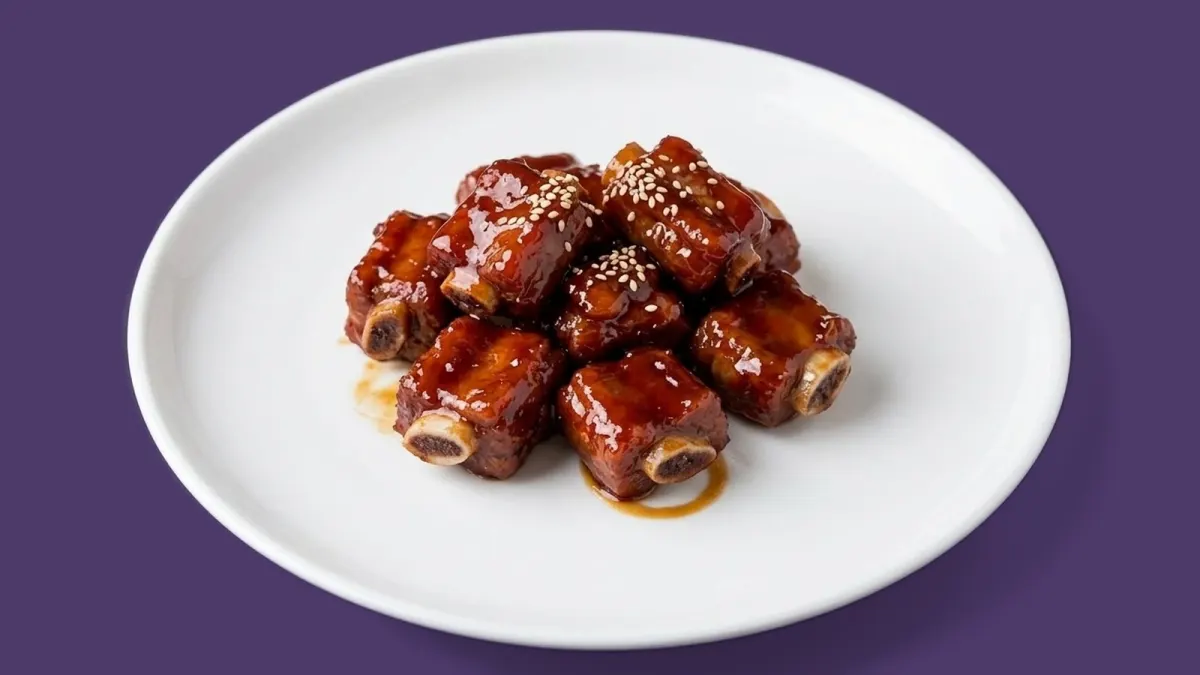
Shanghai sweet and sour ribs
Shanghai's home-style sweet and sour: hot with rice, or cold at a feast
- In all
- 1h05min
- Hands-on
- 28min
- Waiting
- 37min
- You save With the steps in parallel, instead of one at a time.
- −3min
Difficulty: 2 of 5. 420 kcal each With the steps in parallel, instead of one at a time.
The median
The quantities are the median of the versions that give them, not one person’s opinion.
The time
The plan 1h05min
Only 2 of 13 sources state a time for the whole recipe, 20min and 1h: not enough for a comparison, so here there’s only the plan.
Ingredients · 4 people
- Pork spare ribs 700 g
- Rock sugar 55 g
- Chinkiang black vinegar 4 tablespoons
- Soya sauce 2.5 tablespoons
- Shaoxing rice wine 1.5 tablespoons
- Fresh ginger 15 g
- Spring onions 1
- Vegetable oil 2 tablespoons
- Sesame seeds to taste
- Salt to taste
The plan
1h05min, 28min of it hands-on.
for 4 · one cook · one pan and two pots
- 01 Cut the ribs hands-on, minutes 0–5
- 02 Blanch the ribs waiting, minutes 5–15
- 03 Make the sauce hands-on, minutes 5–8
- 04 Drain and rinse the ribs hands-on, minutes 15–17
- 05 Brown the ribs hands-on, minutes 17–25
- 06 Braise, covered waiting, minutes 25–55
- 07 Reduce to a glaze hands-on, minutes 55–63
- 08 Remove the aromatics and serve hands-on, minutes 63–65
- hands-on
- watching
- waiting
The plan is for one cook, with one pan and two pots: PREP lines the steps up side by side.
In the app this plan guides you step by step, and rings when a pot is ready. Notify me
The steps
-
01 Cut the ribs
Cut the ribs apart between the bones and chop them into pieces four or five centimetres long.
- The right cut is the rib tips, the end with the cartilage and not much bone, which in China they call «little ribs» (小排): it stays tender in the braise and you eat it with chopsticks. Almost all the sources ask for pieces four or five centimetres long.
- The bone is cut with a cleaver, not a knife: if you haven't got one, ask the butcher to cut them into pieces, as two popular Chinese cookbooks advise. If you buy them already cut, they're fine as they are.
- Cut between the bones, then across, with clean strokes, because a crushed bone leaves splinters. Before cooking, run your fingers over the pieces and pick out any splinters, which you'd feel between your teeth: that's the advice of someone who cooked them following a chef at a Shanghai restaurant.
- Raw pork spreads germs: wash the chopping board and knife before they touch anything else. Italy's national health institute, the ISS, asks for raw food to be kept apart from cooked, and EFSA, the European Food Safety Authority, counts pork among the foods that carry salmonella.
IT’S READY WHEN Pieces with one bone each, all the same size, no splinters.
-
02 Blanch the ribs
Cover with cold water, bring to the boil over a high heat, then give them two minutes.
- Sixteen versions out of twenty-seven put the ribs in water before anything else; the other eleven brown them or fry them raw. Almost all of those that say how start them in cold water, not boiling water: that way the blood and impurities come out slowly and rise as scum.
- When the water boils, skim off the grey scum with a ladle and give them two minutes. No more is needed: this is about cleaning the meat, not cooking it.
- Six versions don't stop at blanching and cook the ribs in water before the sauce, from ten minutes up to two hours: the meat comes out softer, but the flavour goes into the water, which becomes a stock worth keeping. One of the most followed, Shanghai's «mum's rule», doesn't blanch them at all: it soaks them for ten minutes in lukewarm water and dries them.
IT’S READY WHEN A rolling boil and grey scum on the surface.
-
03 Make the sauce
Slice the ginger, cut the spring onion into short lengths, crack the rock sugar and mix the wine, soya sauce and three quarters of the vinegar.
- In Shanghai the quantities are remembered with a counting rhyme, «one, two, three, four, five». In the version one cook says was handed down by her mother, the five is the half kilo of ribs, and each half kilo takes one tablespoon of wine, two of soya sauce, three of vinegar and four of sugar. The medians of sixteen versions bear it out for the wine, soya sauce and vinegar; the sugar falls between the third and the fourth tablespoon, and that's the amount on this card.
- The same rhyme also goes round in a different order: wine, soya sauce, sugar, vinegar and five tablespoons of water, with more vinegar than sugar. It's the one in the most-copied cookbooks, and in the Shanghai column of «The Paper» too. This card sits in between, where the median falls.
- The sugar is rock sugar (冰糖), in big crystals: the old cooks of Shanghai prefer it because it makes the sauce glossier, «The Paper» explains, and almost all the versions that call themselves Shanghai ones use it. Crack it into small bits with a meat mallet or the bottom of a small saucepan: big pieces dissolve too slowly, warns master chef Chen Jianxin's lesson. If you can't find it, white sugar will do: a little less, because it's sweeter.
- Keep back a quarter of the vinegar in a small glass: it goes in at the end. Eleven of the nineteen versions that braise the ribs in the sauce, like this one, do so, because the vinegar boils off and its sharpness with it; the other eight pour it all in at the start.
- The vinegar is Chinkiang black vinegar (香醋), from Zhenjiang, sweet and malty: fifteen versions out of twenty-seven use it. Balsamic vinegar is no substitute: Omnivore's Cookbook warns that it adds a sweetness the dish doesn't want. If you can't find Chinkiang, The Woks of Life suggests rice vinegar. It contains wheat, like Shaoxing rice wine: anyone who can't eat gluten should look for the Taiwanese black vinegar that Omnivore's Cookbook lists as gluten-free, and read the label.
IT’S READY WHEN Liquids mixed in the bowl, rock sugar in small bits, ginger sliced and spring onion in pieces, ready beside the hob.
-
04 Drain and rinse the ribs
Drain them and rinse them under lukewarm water, then dry them well.
- Rinse them one by one under lukewarm water: scum left on the pieces would turn into grey lumps in the sauce. Two popular cookbooks ask for lukewarm water, and a third wants hot water at every step, so the meat stays tender.
- Dry them well with kitchen paper, «as much as possible», asks «mum's rule»: wet, they spit in the oil and won't brown.
- Throw away the blanching water.
IT’S READY WHEN Clean pieces, no scum, dry to the touch.
-
05 Brown the ribs
Oil in the wok, ginger and spring onion until fragrant, then the ribs until golden on every side.
- A wok or a wide frying pan, over a medium-high heat: a moment of ginger and spring onion in the hot oil, then the ribs in a single layer, left alone until they come away on their own before you turn them.
- Golden, not cooked: the meat finishes in the braise. Seventeen versions out of twenty-seven brown them like this. Eight deep-fry them in plenty of oil, sometimes twice and in a batter: a popular cookbook recommends that for when you have guests, because the ribs can be fried ahead. Here we stick to a home frying pan.
- The fat the ribs render stays in the wok and goes into the glaze. «Mum's rule» browns them dry, with no oil, precisely to draw that fat out.
- Ten versions out of twenty-seven, before pouring in the liquids, melt the rock sugar in the oil until it's the colour of amber and turn the ribs in it: that's the caramel (炒糖色), which gives the colour without dark soya sauce. If you do it, keep the heat low and your eyes on the sugar: a Shanghai column in «The Paper» warns that if it cooks too far the sauce won't come together and the ribs turn «stringy» like brittle, and a popular cookbook warns that boiling caramel spits hard when the water goes in.
IT’S READY WHEN Ribs golden on every side, clear fat on the bottom, a smell of ginger.
-
06 Braise, covered
Pour in the sauce, the rock sugar and hot water level with the ribs, bring to the boil, cover and cook gently for half an hour.
- The water should come level with the ribs, not drown them: «mum's rule» wants it «more or less level with the meat», two popular cookbooks just above. Hot, boiling if you can: that's what all the versions that say so pour in, so that the meat, which is already cooking, doesn't stop.
- Boil hard, then lid on and a low heat: it should simmer gently. The rock sugar dissolves in the boiling liquid; turn the pieces a couple of times, because the sugar tends to stick to the bottom.
- Half an hour is the median of the versions that braise ribs that have only been blanched: twenty minutes for half a kilo and forty for a kilo, says «mum's rule»; anyone who wants them falling off the bone goes up to an hour. They're ready when a chopstick, or the tip of a knife, slides into the meat with no resistance: that's the sign the Shanghai neighbour uses to tell the meat is cooked.
- Twelve versions out of twenty-seven also add dark soya sauce (老抽), for a deeper colour: those who want it put in about a teaspoon for every half kilo of ribs, along with the sauce. «Mum's rule» rules it out by name, and this card doesn't use it. Five versions also add star anise, cinnamon or bay leaves, but a Shanghai food blog writes that they don't belong in the traditional dish, and this card leaves them out.
IT’S READY WHEN A chopstick slides into the meat with no resistance and the liquid has dropped below halfway up the pieces.
-
07 Reduce to a glaze
Lid off, a high heat, turn the ribs until the sauce coats them glossy; the vinegar you kept back goes in for the last minute.
- A high heat and the lid off: the liquid boils in big bubbles and reduces. When the bubbles turn small and close together and the sauce forms a thread as it drops from the spoon, start turning the pieces without stopping: this is when the sugar sticks and burns, and «mum's rule» says to turn them often.
- In the last minute pour in the vinegar you kept back and turn the ribs again: the smell of vinegar that the braise had carried off comes back. Eleven versions do it, among them the one recreated from a video by a chef at a Shanghai restaurant.
- Taste the sauce before it has fully reduced: if it's too sharp, a few more bits of rock sugar; if it's flat, a pinch of salt. The character of the dish, writes «The Paper», is «very sweet and very sour»: don't be afraid of either.
- By the end much of the liquid in the pan is fat from the ribs, not sauce: «mum's rule» warns about it. If there's a lot, tilt the wok and spoon some of it off before serving.
IT’S READY WHEN Dark, glossy sauce coating every piece and no longer running across the bottom; small, close bubbles.
-
08 Remove the aromatics and serve
Take out the ginger and spring onion, put the ribs on the plate and sprinkle with sesame seeds, if you're using them.
- The ginger and spring onion have given all they had to give: take them out before serving. Ten versions out of twenty-seven put toasted sesame seeds on top; «mum's rule» says it already looks good without.
- It's eaten hot, with a bowl of plain white rice that isn't on this card, and that's the everyday way. In Shanghai it's also a cold starter (冷菜) at festive dinners: «mum's rule» puts it among the eight cold dishes of the Chinese New Year's Eve dinner, «The Paper» calls it good «hot and cold», and The Woks of Life serves it at room temperature.
- If you want it cold, let it cool a little and put it in the fridge in a small, shallow container, as the ISS asks, so that cooked food cools quickly; take it out shortly before serving. Don't leave it on the table for hours: «keep food at safe temperatures» is one of the World Health Organization's five keys to safer food.
IT’S READY WHEN Dark, glossy ribs on the plate, no ginger or spring onion, a little thick glaze on the bottom.
Where the sources disagree
- 1
Blanch or not
Sixteen versions out of twenty-seven put the ribs in water first, and six go as far as precooking them; the other eleven brown or fry them raw, and one of the most followed, the Shanghai version handed down from mother to daughter, says there's no need. Here it's a quick blanch, the most common choice, so the blood and impurities end up in the water, not the sauce; to save a pot, follow that one: a soak in lukewarm water.
- 2
Rock sugar or white
Thirteen versions out of twenty-seven use rock sugar or say it's better, thirteen use white sugar and one palm sugar. The tie is broken by the versions that call themselves Shanghai ones, like this one, where rock sugar wins clearly: the old cooks prefer it because it makes the sauce glossier, says a Shanghai column on The Paper. If you can't find it, white sugar will do: a little less, because it's sweeter.
- 3
Vinegar in two goes
Of the nineteen versions that braise the ribs in the sauce, like this one, eleven add all or part of the vinegar towards the end, and eight pour it all in at the start. Here a quarter goes in for the last minute, the median share, because vinegar boils off in the braise, and its tang with it; pour it all in straight away and the sweet and sour comes out rounder and gentler.
Where the numbers come from
This recipe compares 13 sources. The quantities are the median of the versions, not one person’s opinion: where the sources disagree, the majority wins. Here they all are.
- 下厨房 — 糖醋排骨/糖醋小排(不放油)(12345口诀做出正宗上海本帮), 鱼片私厨 —
- 下厨房 — 糖醋小排(上海本帮菜), 君君love烘焙 —
- 下厨房 — 糖醋排骨, 云卷云姝 —
- 下厨房 — 上海糖醋小排, 好麵之女 —
- 下厨房 — 糖醋小排, 呤儿 —
- 下厨房 — 传统本帮菜 糖醋小排, Jackeyhang —
- 下厨房 — 糖醋排骨, 莫言catlam —
- 澎湃新闻 (The Paper), 上海老底子 — 舌尖上海丨一碗糖醋小排,嗲了阿拉的魂 —
- 食品科学 (Shipin Kexue), 2012, 33(12): 324-329 — 速冻菜肴糖醋排骨工艺优化 —
- The Woks of Life — Shanghai Sweet and Sour Ribs 1h
- Omnivore's Cookbook — Sweet and Sour Ribs 糖醋小排 20min
- ISS EpiCentro — Salmonella —
- EFSA — Salmonella —
- With PREP’s plan 1h05min
Published .
Allergens
- Gluten
- Soya
- Sesame
They come from the recipe's list. The label on what you buy is what counts.
More recipes
- Kung pao chicken 27min
- Spaghetti alla carbonara 22min
- Tagliatelle al ragù 2h37min
Coming to the App Store.
For 37min of this recipe’s 1h05min your hands are free: PREP tells you what to do meanwhile, and when to go back to the stove.
Leave your email: we’ll write once, when it’s out.
We count visits to the website without cookies and without knowing who you are.
One step left.