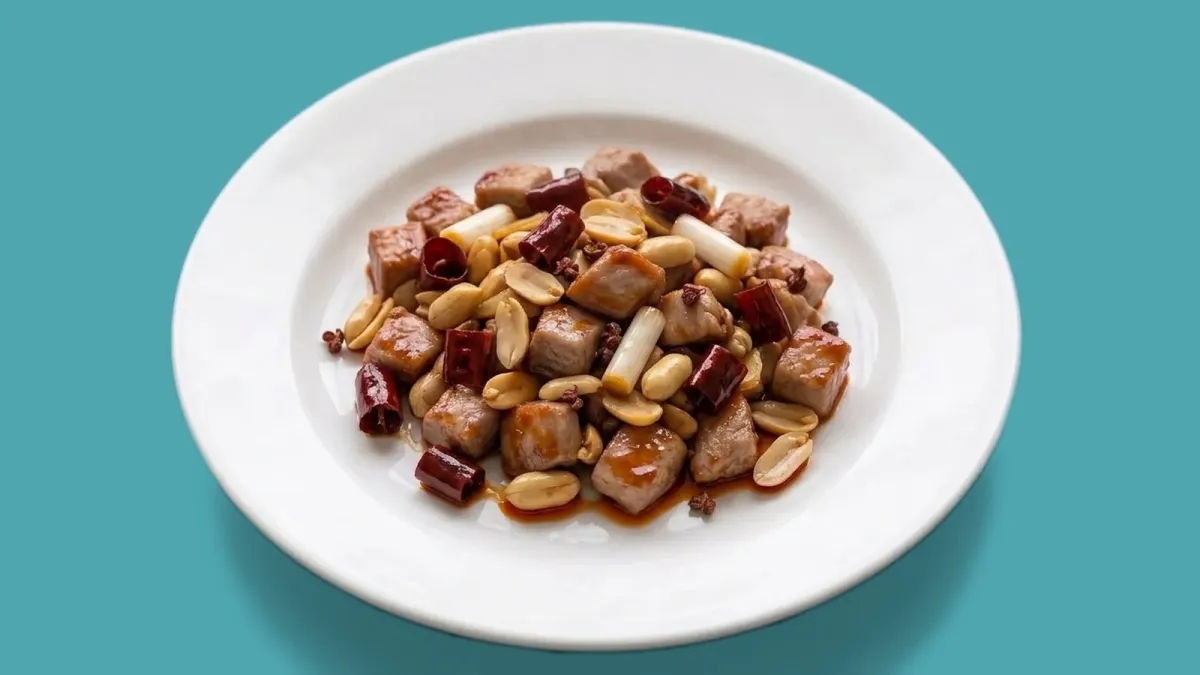
Kung pao chicken
Governor Ding's chicken, with toasted chillies and crunchy peanuts
- In all
- 27min
- Hands-on
- 26min
- Waiting
- 1min
- You save With the steps in parallel, instead of one at a time.
- −24min
Difficulty: 2 of 5. 425 kcal each With the steps in parallel, instead of one at a time.
The median
The quantities are the median of the versions that give them, not one person’s opinion.
The time
The sources 30min
The plan 27min
3 of 14 sources state a time: 20min to 40min, median 30min.
Ingredients · 4 people
- Chicken breast 400 g
- Raw peanuts 80 g
- Dried red chillies 12
- Sichuan peppercorns 1 teaspoon
- Spring onions 6
- Fresh ginger 15 g
- Garlic 4 cloves
- Soya sauce 1.5 tablespoons
- Dark soya sauce half a tablespoon
- Shaoxing rice wine 1 tablespoon
- Sugar 18 g
- Chinkiang black vinegar 1 tablespoon
- Potato starch 1 tablespoon
- Vegetable oil 5 tablespoons
- Salt to taste
The plan
27min, 26min of it hands-on.
for 4 · one cook · one pan and two pots
- 01 Dice the chicken hands-on, minutes 0–5
- 02 Leave the chicken to marinate waiting, minutes 5–20
- 03 Fry the peanuts hands-on, minutes 5–12
- 04 Prep the chillies and aromatics hands-on, minutes 12–17
- 05 Leave the peanuts to cool waiting, minutes 15–25
- 06 Make the sauce hands-on, minutes 17–19
- 07 Flash-fry the chicken hands-on, minutes 20–23
- 08 Fry the chillies and aromatics hands-on, minutes 23–25
- 09 Return the chicken and thicken the sauce hands-on, minutes 25–27
- hands-on
- watching
- waiting
The plan is for one cook, with one pan and two pots: PREP lines the steps up side by side.
In the app this plan guides you step by step, and rings when a pot is ready. Notify me
The steps
-
01 Dice the chicken
Take off any skin and cut the breast into dice of a centimetre and a half, all the same size.
- Breast is what nine versions out of sixteen use, along with the Sichuan standard, Fuchsia Dunlop and the encyclopaedia. The other seven use thigh, boned and skinned, which stays tender even if it spends a moment too long in the wok, and three recipes that use breast suggest it themselves: if you prefer it, use the same weight.
- Breast dries out quickly: the encyclopaedia version and a home cookbook pound it with the back of the knife before cutting it, so it stays more tender and takes the marinade better. Do the same if you like.
- Dice of a centimetre and a half, all the same size: it's the measurement given by Fuchsia Dunlop, Omnivore's Cookbook and two Chinese cookbooks. Smaller, they dry out; bigger, they stay raw in the centre. First into strips as wide as the dice, then across.
- Wash the chopping board and knife before you touch the aromatics: undercooked chicken, and food that has touched raw chicken, are the commonest source of Campylobacter, says EFSA, the European Food Safety Authority.
IT’S READY WHEN Dice all the same size, no skin and no white sinew.
-
02 Leave the chicken to marinate
Salt, half the soya sauce, the wine and two thirds of the starch: mix with your hands and leave to rest.
- A pinch of salt, half the light soya sauce, all the Shaoxing wine and two thirds of the potato starch, with a splash of water if the meat is dry: mix with your hands until every piece has a glossy coating. It's the marinade in almost all the sources, and the coating of starch is what keeps the chicken tender in the wok.
- As long as it takes to prepare the rest: fifteen minutes is the median of eleven sources, Fuchsia Dunlop leaves it to marinate while she cuts the aromatics, one Chinese source goes up to two hours. If you leave it longer, put it in the fridge.
- Three Chinese recipes add an egg or an egg white, for silkier chicken: it isn't needed, and it isn't on the list.
IT’S READY WHEN Every piece is glossy under a thin coating, with no liquid on the bottom of the bowl.
-
03 Fry the peanuts
In the wok with all the oil, starting cold over a low heat, stirring: lift them out as soon as they're golden.
- A wok or a wide frying pan, all the oil, the peanuts in while it's cold and a low heat: it's the «冷锅冷油», cold wok and cold oil, of the Chinese cookbooks, because starting cold the peanut cooks through without burning outside. Stir all the time.
- They're ready when the skins darken, they crackle and inside they're a golden cream colour: one Chinese cookbook says to take them out as soon as you hear a rapid crackling, because the heat that's left goes on cooking them. Lift them out with the slotted spoon and leave the oil in the wok: it's for the chicken.
- The red skins: five sources take them off, blanching the peanuts first or rubbing them while hot; That Spicy Chick and one Chinese cookbook leave them on, for colour and aroma. If you find them already skinned, raw, they're just as good.
- If you only have roasted unsalted peanuts, skip this step and add them at the end: Fuchsia Dunlop and four other sources do that. Whole peanuts, with no mould and no rancid smell: peanuts are where aflatoxins are looked for, and the draft Chinese standard for the ready-made dish sets a limit for them.
IT’S READY WHEN Golden in the centre if you break one, skins darkened, and they've stopped crackling loudly.
-
04 Prep the chillies and aromatics
Garlic and ginger thinly sliced, the white of the spring onions in short lengths, the chillies in pieces with no seeds.
- Garlic and ginger in thin slices, as Fuchsia Dunlop wants them: chopped, they burn at once in the hot oil.
- Only the white part of the spring onions, in pieces as long as they are wide: that way they're the same size as the diced chicken. In China it's the white of 大葱, the big Chinese spring onion; Chinese cookbooks want plenty of it, because it turns sweet as it cooks.
- The chillies in pieces of a centimetre and a half, cut with scissors, shaking out the seeds: Fuchsia Dunlop and two Chinese sources take them out, because the seeds burn before the skin and turn bitter. If you want the dish less hot, use fewer chillies; the pepper stays.
IT’S READY WHEN Garlic and ginger in thin slices, white pieces all the same, chillies split open with no seeds.
-
05 Leave the peanuts to cool
Spread out on a plate until cold: they turn crunchy as they cool.
- Straight out of the oil they're still soft: they only turn crunchy once cold, as The Woks of Life writes, and the encyclopaedia recipe spreads them on a wide plate so they cool.
- Spread out in a single layer, not heaped up in a bowl: the steam trapped underneath softens them.
- Whole peanuts aren't given to children under five, because of the risk of choking: the NHS says so. For them, chop them finely or crush them. And they're one of the fourteen allergens: anyone eating with you needs to know.
IT’S READY WHEN Cold to the touch and crunchy between the teeth.
-
06 Make the sauce
Sugar, black vinegar, both soya sauces, the rest of the starch and three times as much water as vinegar: stir until the sugar dissolves.
- It's the «碗汁», the sauce in the bowl: it's made beforehand because in the wok there's no time to pour in one ingredient at a time, and meanwhile the chicken toughens. Almost all the Chinese sources say so.
- Sugar and vinegar roughly equal, with a little more sugar: it's the «荔枝味», the lychee flavour: a light sweet and sour, a long way from the thick restaurant sauce. The Chinese sources give ratios between two to one and one to two; the median of the weights sits in the middle. The other half of the light soya sauce goes in here, with the dark, which gives the colour.
- Chinese black vinegar, Zhenjiang or Sichuan's Baoning, dark and almost sweet: ten sources out of sixteen. With a pale vinegar, as The Woks of Life uses, the dish comes out sharper and less deep.
- In place of the water, chicken stock works well, as Fuchsia Dunlop and Omnivore's Cookbook use. The starch settles: stir again just before pouring.
IT’S READY WHEN The sugar no longer grates on the bottom of the bowl; the sauce is dark and cloudy.
-
07 Flash-fry the chicken
Hot oil, the chicken scattered into the wok: leave it still for a moment, then toss it until white outside and lift it out.
- High heat: when the oil shimmers, add the chicken and spread it out. Leave it still for as long as the starch coating takes to set, then move it about with the wok ladle until the pieces separate and turn white outside: ten sources out of fifteen flash-fry it and take it out, and put it back at the end.
- White outside and still pink in the centre: it finishes cooking with the sauce. Lift it out with the slotted spoon into a bowl and leave the oil in the wok.
- Fuchsia Dunlop, and four Chinese sources with her, does it all in one go without taking it out: first the chillies, then the chicken, then aromatics and sauce. It works with fierce heat; on a home hob, chicken taken out and put back is more forgiving.
- For more than four servings the wok can't cope: the chicken boils instead of frying. Flash-fry it in two batches.
IT’S READY WHEN The pieces are separate and white on every side, still pink if you open one.
-
08 Fry the chillies and aromatics
Medium heat: chillies and Sichuan pepper until the chillies darken, then garlic, ginger and spring onions.
- It's the step that makes the dish, the «糊辣», the scorched-chilli flavour: the chillies have to turn dark red, almost brown, but never black: burnt, they make the whole dish bitter. Fuchsia Dunlop, That Spicy Chick and three Chinese cookbooks all warn about it.
- Medium heat, not high: the Chinese sources turn the heat down for this moment. Chillies and Sichuan pepper together, in the oil that's left; if they darken too fast, take the wok off the heat, as Fuchsia Dunlop advises.
- The Sichuan pepper stays in the dish in eight sources; in five it's lifted out with the ladle as soon as it smells fragrant, for anyone who doesn't want to bite on it. Here it stays, and there's little of it: in kung pao it doesn't numb the mouth as it does in mapo tofu, it perfumes it.
- As soon as the chillies have taken colour, garlic, ginger and spring onions: half a minute, until fragrant.
IT’S READY WHEN Dark red, glossy chillies, none of them black; a smell of toasted chillies and pepper.
-
09 Return the chicken and thicken the sauce
High heat, chicken in, then the sauce stirred again: toss until glossy, add the peanuts and serve at once.
- Put the chicken back and turn the heat up, toss for a moment, then stir the sauce again and pour it all round: in a few seconds it thickens and coats every piece. The right colour is «棕红», reddish brown, which the Sichuan standard prescribes for this dish.
- The chicken has to be cooked through to the centre: open one of the biggest pieces, as Fuchsia Dunlop does. It must be white and firm, with no pink. The Campylobacter in raw chicken is killed only by cooking, as Italy's national health institute, the ISS, points out.
- The peanuts last, two turns of the ladle and off the heat: every source repeats it, because in the hot sauce they soften, and a kung pao with soft peanuts isn't kung pao any more.
- To the table straight away, with plain white rice, which isn't on this card. The Sichuan standard for hot dishes asks for ten minutes at most between the wok and the table.
- No cucumber, no carrot, no peppers: those are the additions of northern China and of restaurants abroad, and they make the sauce watery. In Guizhou, where Ding Baozhen was born, the governor who gives the dish its name, it's made with a paste of dried chillies soaked and pounded with garlic and ginger (糍粑辣椒) and chicken with the skin on: it's another dish, and four sources tell its story.
IT’S READY WHEN The sauce has vanished into a glossy reddish-brown coating round the chicken and peanuts, with no liquid on the bottom of the wok.
Where the sources disagree
- 1
Breast or thigh
Nine versions out of sixteen use breast, seven thigh. Here it's breast, like the majority, the study that cooks the dish to the Sichuan standard and Fuchsia Dunlop's book; thigh stays tender even if it spends a moment too long in the wok, and three of the breast recipes suggest it themselves: if you'd rather use it, take it boneless and skinless, at the same weight.
- 2
Raw or roasted peanuts
Ten versions out of fifteen start from raw peanuts and cook them at home; five, including Fuchsia Dunlop's, use them ready-made, fried or roasted. Here they're raw, like the majority, fried starting in cold oil, which then stays in the wok for the chicken, and left to cool, because they only turn crunchy once cold; if you only have unsalted roasted ones, skip the frying and add them at the end.
- 3
Remove the chicken or not
Ten versions out of fifteen sear the chicken, lift it out while the chillies and aromatics fry, then put it back with the sauce; the other five, like Fuchsia Dunlop in her Chengdu version, cook everything in one go without taking it out. Here the chicken comes out and goes back in, like the majority, because it's more forgiving on a home hob; doing it all in one go saves a step but needs a fierce flame.
Where the numbers come from
This recipe compares 14 sources. The quantities are the median of the versions, not one person’s opinion: where the sources disagree, the majority wins. Here they all are.
- 食品工业科技 2023 — 宫保鸡丁烹制过程中品质的变化 (四川旅游学院) —
- 中国新闻网 / 成都商报 — 四川省质监局定川菜标准 (2015) —
- 中国社会科学网 — 旧时餐饮广告中的贵阳美食渊源 (贵州省档案馆, 2023) —
- 烹饪网 — 宫保鸡丁 —
- 下厨房 — 宫保鸡丁, 豆牛 —
- 新浪 — 家常宫保鸡丁做法 —
- 搜狐 — 宫保鸡丁的家常做法:鸡肉滑嫩花生香脆的秘密 —
- 团体标准 T/GBAS — 预制菜 宫保鸡丁 —
- Fuchsia Dunlop, Every Grain of Rice — Gong Bao chicken with peanuts (via The Splendid Table) —
- China Sichuan Food — Kung Pao Chicken 20min
- The Woks of Life — Kung Pao Chicken 40min
- Omnivore's Cookbook — Kung Pao Chicken 30min
- EFSA — Campylobacter —
- NHS — Foods to avoid giving babies and young children —
- With PREP’s plan 27min
Published .
Allergens
- Peanuts
- Soya
- Gluten
They come from the recipe's list. The label on what you buy is what counts.
More recipes
- Shanghai sweet and sour ribs 1h05min
- Spaghetti alla carbonara 22min
- Tagliatelle al ragù 2h37min
Coming to the App Store.
For 1min of this recipe’s 27min your hands are free: PREP tells you what to do meanwhile, and when to go back to the stove.
Leave your email: we’ll write once, when it’s out.
We count visits to the website without cookies and without knowing who you are.
One step left.