Pulpo a la gallega
Three scares in unsalted water, then a wet wooden plate: the octopus does the rest.
- In all
- 1h31min
- Hands-on
- 21min
- Waiting
- 1h10min
- You save With the steps in parallel, instead of one at a time.
- −15min
Difficulty: 2 of 5. 535 kcal each With the steps in parallel, instead of one at a time.
The median
The quantities are the median of the versions that give them, not one person’s opinion.
The time
The sources 50min
The plan 1h31min
9 of 27 sources state a time: 35min to 1h30min, median 50min.
Ingredients · 4 people
- Octopus 2000 g
- Potatoes 750 g
- Sweet pimentón 1 tablespoon
- Hot pimentón 1 teaspoon
- Extra-virgin olive oil 4 tablespoons
- Salt to taste
The plan
1h31min, 21min of it hands-on.
for 4 · one cook · one pan and two pots
- 01 Wash the octopus hands-on, minutes 0–5
- 02 Put the water on waiting, minutes 0–15
- 03 Scare the octopus three times hands-on, minutes 15–16
- 04 Boil the octopus waiting, minutes 16–51
- 05 Peel and cut the potatoes hands-on, minutes 16–21
- 06 Rest in the water waiting, minutes 51–66
- 07 Cook the potatoes in the octopus water waiting, minutes 66–86
- 08 Cut the octopus with scissors hands-on, minutes 66–71
- 09 Dress it on the wooden plate hands-on, minutes 86–91
- hands-on
- watching
- waiting
The plan is for one cook, with one pan and two pots: PREP lines the steps up side by side.
In the app this plan guides you step by step, and rings when a pot is ready. Notify me
The steps
-
01 Wash the octopus
Under cold water, one tentacle at a time, rubbing the suckers; the head turned inside out like a glove.
- Sand gets caught in the suckers: El Cocinero Casero puts it in a bowl of cold water and rubs the tentacles one by one, then turns the head inside out and rinses the inside. Cocina Casera washes the tentacles «de uno en uno» and the inside of the head.
- Frozen octopus from the fishmonger's comes already gutted. If yours is whole, turn the head inside out, empty it and cut out the beak with scissors, as PequeRecetas and El Español describe.
- Wash the potatoes now, if you want them in their skins: they go into the octopus water and don't get rinsed again.
IT’S READY WHEN The water runs clear and the suckers feel clean, with no grit.
-
02 Put the water on
The biggest pot you have, enough water to cover the octopus by two fingers, no salt, lid on.
- No salt: it's the rule in every Galician recipe, and Directo al Paladar states it first. The octopus gets salted on the plate, at the end; salt in the water toughens it, says El Progreso.
- Big and tall, so the octopus doesn't drop the temperature too far when it goes in: Pan de Broa insists the water has to come back to the boil quickly. The pulpeiro uses little water, barely more than it takes to cover it.
- The pulpeiras cook in copper, and Divina Cocina tells of the copper coin or the cork thrown into the pot: it's folklore, and Pan de Broa says so plainly, you don't need any special equipment, just a wide pot.
- Just water: no onion and no bay leaf. Two recipes out of eighteen add a bay leaf (Canal Cocina and Cocina Casera), only one adds onion, the «á feira» card from the Real Academia de Gastronomía, along with the readers' recipes; the pulpeira uses water and nothing else, and the octopus should taste of the sea.
IT’S READY WHEN A rolling boil that moves the whole surface, not little bubbles at the edges.
-
03 Scare the octopus three times
Held by the head, in and out of the boiling water: three times, three seconds each time, then let go of it.
- «Asustar el pulpo», scaring the octopus: seventeen recipes out of eighteen still do it, nearly always three times. It's for the skin, not for tenderness: El Español puts it in black and white, without the scare the skin comes away as it cooks and the tentacles don't curl.
- Three seconds a dip (Bon Viveur), five for El Cocinero Casero; Cocina Casera waits for the water to come back to the boil between one scare and the next. Recetas de Escándalo does it tentacle by tentacle, cut away from the head: fine if the octopus won't go in whole.
- The pulpeiro from O Carballiño doesn't scare it at all: he lowers it in when the water boils, and that's that. It's the only dissenting voice, and PequeRecetas admits there's room for doubt: the skin stays on even if you just leave it a few minutes longer in the hot water.
- Cocina Casera tells the story behind it: in the monastery of Oseira it was dipped three times in the name of the Father, the Son and the Holy Spirit. Technique or blessing, the action is the same.
IT’S READY WHEN By the third dip the tentacles have curled upwards and the skin is taut and red: now leave it in the water.
-
04 Boil the octopus
From when the water comes back to the boil, over a medium heat, uncovered: a little over a quarter of an hour per kilo, then the fork decides.
- The rule goes by weight: seventeen to eighteen minutes per kilo for the Galician cook at El Español, eighteen to twenty for El Cocinero Casero, twenty for Bon Viveur, twenty for the first kilo and ten for every kilo after that for the Galician chefs El Español spoke to, twenty-five for the Real Academia de Gastronomía, thirty minutes «por cada 1,8 kg a 2 kg» for Directo al Paladar. Across eighteen times scaled to a two-kilo octopus the median is thirty-five minutes, and that's the time on this card.
- The time doesn't multiply with the number of diners: two octopuses in the same pot take the same time as one. What counts is the weight of each octopus: a smaller one, like the one for the minimum portions, needs cooking and resting in proportion to its weight. The pulpeiro from O Carballiño says the opposite of what you'd expect: the more octopus you cook, the less time it takes. In the big pot of the ferias, the fairs, ten minutes at the boil and half an hour's rest are enough.
- The pulpeiro does the same at home: fifteen minutes over a high heat and then twenty on the lowest heat, barely bubbling. Pan de Broa comes close, twenty to twenty-five minutes and a long rest. It's the O Carballiño school, the octopus a shade more al dente than the way they serve it in Madrid, and it sits here in the detail because the majority keep it at the boil right to the end.
- The test is the fork, not the clock: push it into the thickest part, where the tentacles join the head. It should go in as if into a boiled potato, says Directo al Paladar; if it resists, another five minutes and try again.
- Overcooked is worse than undercooked: the suckers fall off and the flesh turns rubbery, warns El Cocinero Casero. Stop a shade early, because the rest in the water goes on cooking it.
- Safety: anisakis lives in cephalopods too, octopus included, and the Spanish Consumer Affairs Ministry names it in writing. It dies at sixty degrees for a minute right through the piece; here the octopus boils for over half an hour and nothing else is needed. Freezing at minus twenty for five days, which AESAN asks of anyone eating it raw or lightly cooked, isn't needed here, because the octopus is boiled; if you make a carpaccio out of it instead, the two or three days in the freezer that some recipes suggest for tenderness aren't enough, you need AESAN's five.
IT’S READY WHEN The fork goes into the thickest part as if into a boiled potato, with no resistance and without breaking through; the skin is intact and brick red.
-
05 Peel and cut the potatoes
Potatoes peeled and cut in half, or whole if they're small: these are the cachelos.
- A cachelo, according to the Real Academia Galega dictionary, is a potato boiled in pieces without its skin, «polbo con cachelos»; the other meaning, skin on and sliced, belongs with fish grilled over embers. Here they're peeled and halved, as in Rooteiro (Arguiñano halves them and peels them afterwards); whole if they're small (Bon Viveur, Divina Cocina). If you peel them well ahead of cooking, keep them under cold water: left in the air they turn grey.
- Skin on, well scrubbed, for PequeRecetas and El Español: you peel them afterwards, while they're warm. That works, but in the octopus water the skin lets less colour and less flavour through, and colour and flavour are exactly what you're after.
- A Galician potato, if you can find one, or in any case a potato that holds its shape in cooking and doesn't fall apart: on the plate it has to bear the weight of the octopus.
- Sliced before cooking, a finger thick, for El Progreso and for the Galician cook at El Español: they cook in a quarter of an hour but break more easily when you drain them. Pan de Broa puts them into the water in rounds, skin on, while the octopus rests.
IT’S READY WHEN Pieces all the same size, so they cook together: half a medium potato, or a small potato whole.
-
06 Rest in the water
Heat off, the octopus stays in its water: this is where it finishes tenderising.
- Ten recipes out of eighteen leave it in the water with the heat off, from four minutes (Arguiñano) to twenty (PequeRecetas, Pan de Broa, the pulpeiro); the median sits just over a quarter of an hour, and this card keeps to the quarter of an hour. Cocina Casera, El Progreso and Rooteiro take it out and let it rest in the open air: you can, but it cools sooner and cuts less well.
- For the Galician chefs El Español spoke to, the rest goes by weight like the cooking, eight to ten minutes per kilo. It's the time in which the flesh settles and the heat reaches the centre of the head without the boil shredding it.
- Don't throw the water away: the potatoes go into it straight afterwards, and it's what you wet the wooden plate with. Keep a glassful back and you can reheat the leftovers in it the next day, as Recetas de Escándalo suggests.
IT’S READY WHEN Lift it by the head with a hook or tongs and the tentacles hang soft but whole, and the skin doesn't come away where you touch it.
-
07 Cook the potatoes in the octopus water
Octopus out onto a tray, potatoes into the same water, bring it back to the boil: a good quarter of an hour.
- In the same water as the octopus: it's the choice in eleven recipes out of eighteen, two of which leave it open, and Gallina Blanca gives the reason, the potatoes take on the colour and the taste of the sea. Directo al Paladar cooks them there for a quarter of an hour after lifting the octopus out; Arguiñano warns that they get stained, and that's the point.
- In a separate pot for Bon Viveur, PequeRecetas, the Spanish olive oil recipe book and the «a la gallega» card from the Real Academia de Gastronomía, with salt in the water for PequeRecetas and for the Real Academia: white, more neutral potatoes. If you have two rings you can do them while the octopus boils and save twenty minutes; on the plate the difference in colour shows.
- Recetas de Escándalo puts them, skin on, into the octopus pot for the last twenty minutes of cooking: it's quicker, but then they sit in the water through the rest and fall apart. Better afterwards.
- No salt now either: the potatoes get salted on the plate along with the octopus, with the coarse salt.
IT’S READY WHEN The knife goes into the middle of the half potato with no resistance and the potato doesn't fall apart when you lift it out with the slotted spoon.
-
08 Cut the octopus with scissors
Still hot, with kitchen scissors: rounds a centimetre thick from the tentacles, the head in small pieces.
- Scissors, and it's the rule in nearly every recipe (Cocina Casera allows a knife too): while it's hot, a knife leaves the skin on the chopping board, say El Cocinero Casero and Directo al Paladar. The pulpeiro from O Carballiño calls it one of the seven keys to the dish.
- A centimetre thick for Directo al Paladar, Cocina Casera, Gallina Blanca and the Galician cook at El Español; one or two for Arguiñano, two for the Real Academia de Gastronomía. Pan de Broa cuts on the diagonal and thinner, half a centimetre, starting from the thick end of the tentacle.
- Take one tentacle at a time off the head and cut it starting from the base; the head goes into small pieces, and it's good eating, says Gallina Blanca. Pan de Broa and the Real Academia de Gastronomía sit the octopus head down on an upturned bowl, so it drains and the tentacles hang and are easy to cut.
- Let it cool for a minute if it's too hot to handle, but no longer: cold, it cuts with a knife but loses flavour and toughens, warns Divina Cocina.
IT’S READY WHEN Rounds all the same, with the red skin still on and the suckers whole around the edge; the tray underneath collects only a little water.
-
09 Dress it on the wooden plate
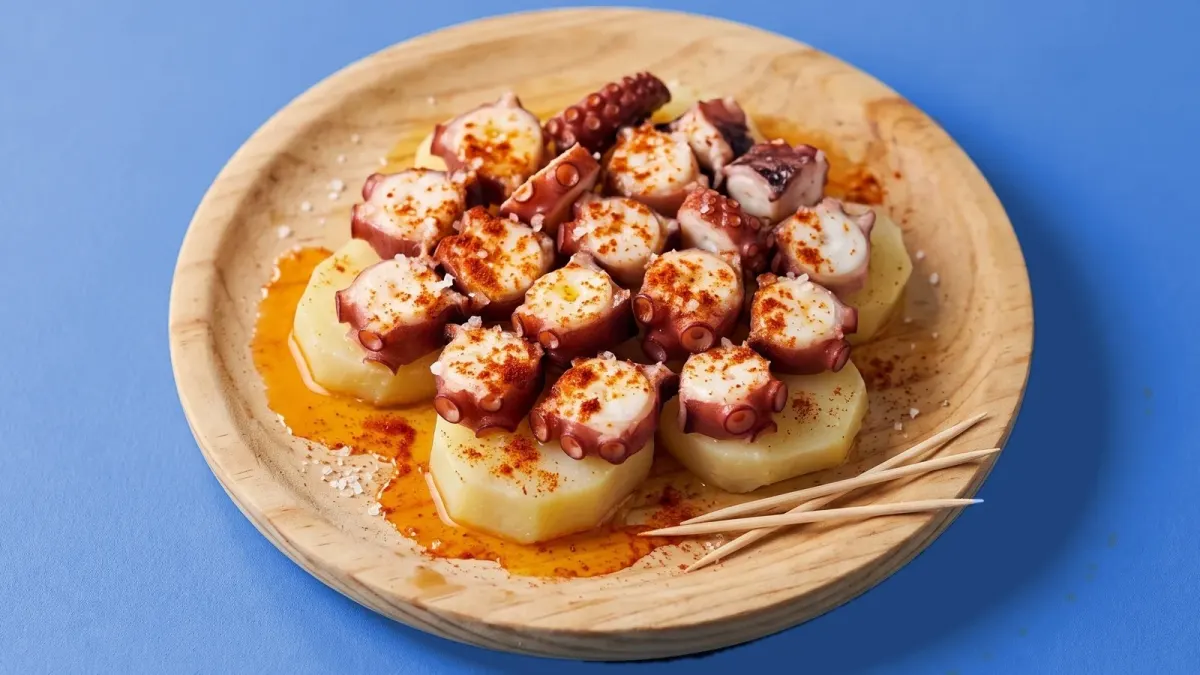
Wooden plate dipped in the octopus water, potatoes underneath, octopus on top: coarse salt, pimentón, a generous drizzle of oil. Straight to the table.
- The wooden plate isn't folklore: Directo al Paladar and El Español tell how the pulpeiras dip it in the cooking water before serving, so it warms up, tastes of octopus and doesn't soak up the oil. What stays on the surface is the emulsion of water, oil and pimentón, and that's the sauce of the dish. If you haven't got one, a warm flat plate with a spoonful of its water over it, as in Recetas de Escándalo.
- First the potatoes, the boiled halves cut into slices a finger thick, then the rounds of octopus on top, without piling them up too much. In Galicia pulpo á feira is served on its own; with the cachelos underneath it becomes «a la gallega», and eight recipes out of eighteen draw exactly this distinction, the Real Academia de Gastronomía with two separate cards.
- Half a kilo of raw octopus a head, which cooks down to a quarter of a kilo, is the dish of the ferias and the measure in five sources out of eleven, from the pulpeiro to the Galician cook at El Español; Cocina Casera uses twice that. The bar portion is half that: Bon Viveur, El Cocinero Casero, Gallina Blanca and the Real Academia de Gastronomía sit between two hundred and three hundred grams raw a head. Served as a tapa, count half a portion a head.
- The order: coarse salt, pimentón, oil last. The oil comes last in ten recipes out of eighteen: the pulpeiro from O Carballiño, Directo al Paladar, Bon Viveur, El Cocinero Casero, Recetas de Escándalo and El Progreso salt first and then add the pimentón, while PequeRecetas, Pan de Broa, Gallina Blanca and the «a la gallega» card from the Real Academia de Gastronomía put the pimentón on before the salt. Seven pour the oil first, Arguiñano and the Galician cook at El Español among them, and Rooteiro puts it in the middle: it works just the same, but oil poured last carries the pimentón down into the sauce on the plate, and that's the pulpeiro's reasoning.
- Not much pimentón: it should add a touch, not mask the taste of the sea, and the pulpeiro insists on it. Sweet with a hint of hot is the choice in eight recipes out of eighteen, seven leave you to choose between the two, two use only sweet and one only hot; the pulpeiras keep it ready mixed, two parts sweet to one part hot for Pan de Broa, three to one for Divina Cocina. Arguiñano taps it through a sieve with his fingers, so it falls evenly. Anyone who doesn't want the heat uses only sweet, as Cocina Casera does; never smoked, says Recetas de Escándalo, it masks everything, and Gallina Blanca, which offers it among the choices, is the only one.
- Extra-virgin olive oil «sin miedo», without fear, says the pulpeiro, and Pan de Broa calls it «aceite do pulpo»: while you dress it keep the plate tilted a little, so the water drains off and the oil stays.
- Hot or warm, never cold: cold, the octopus toughens and loses flavour (Divina Cocina). Leftovers, with nothing on them, keep in the fridge in a sealed container for two to four days according to the recipes, and reheat for two to three minutes in the water you kept back; no openly available official source sets the days, so it's caution, not a rule. The potatoes, on the other hand, should be eaten the same day.
IT’S READY WHEN The octopus is glossy with oil, red with pimentón in patches and not in a layer; an orange sauce of water, oil and pimentón has pooled on the plate.
Where the sources disagree
- 1
Where to cook the potatoes
Eleven recipes out of eighteen cook the potatoes in the octopus water, and two of those leave it up to you; four, Bon Viveur and PequeRecetas among them, use a separate pan. Here they go into the same water, after the octopus, because they take on its flavour and colour, as even PequeRecetas admits; cooked apart they stay white and milder, and with two rings free you can do them while the octopus boils and save time.
- 2
Scare the octopus or not
Seventeen recipes out of eighteen scare the octopus before boiling it, almost always three times: into the boiling water and straight out, so the skin doesn't come away during cooking. The only one who doesn't mention it is the O Carballiño pulpeiro interviewed by Directo al Paladar, who puts it in once the water is already boiling. Here it's three scares; if you'd rather skip them, PequeRecetas admits a little longer in the hot water seems to do the same.
- 3
Pimentón: sweet, hot or both
Eight recipes out of eighteen mix sweet and hot pimentón, seven leave the choice to you, two use only sweet and one only hot. Here it's sweet with a hint of hot, used sparingly, because it should add a touch without masking the taste of the sea, as the O Carballiño pulpeiro insists; if you don't like heat, use sweet alone. Only Gallina Blanca offers smoked, as one option, and Recetas de Escándalo rules it out: it stands out too much.
Where the numbers come from
This recipe compares 27 sources. The quantities are the median of the versions, not one person’s opinion: where the sources disagree, the majority wins. Here they all are.
- Directo al Paladar — Receta de pulpo a la gallega o pulpo a feira (Pintxo) 45min
- Directo al Paladar — Las siete claves del mejor pulpeiro de Galicia (Paco Gómez, O Carballiño) —
- Directo al Paladar — El verdadero secreto de las pulpeiras gallegas: la tabla de madera (Liliana Fuchs) —
- Hogarmanía — Pulpo a la gallega con patatas, Karlos Arguiñano (Bruno Oteiza) 1h04min
- Bon Viveur — Pulpo a la gallega: la receta tradicional para hacerlo en casa 35min
- El Cocinero Casero — Pulpo á feira 40min
- PequeRecetas — Pulpo a la gallega (pulpo a feira) 1h30min
- Recetas de Escándalo — Pulpo a la gallega o pulpo á feira, receta tradicional 50min
- Divina Cocina — Cómo hacer el pulpo a la gallega —
- Cocina Casera — Pulpo a Feira o a la Gallega 55min
- Canal Cocina — Pulpo a la gallega (David Suriol y Juan Pozuelo) —
- El Español — Cómo cocinar un pulpo, tres recetas explicadas por una gallega (Mer Bonilla) —
- El Español — Cómo hacer pulpo a la gallega: trucos para que te quede perfecto —
- El Español (Quincemil) — Los chefs coinciden: el pulpo perfecto no se golpea (Alba Naveira) —
- El Progreso — Disfruta de un San Froilán á feira: 10 pulperías recomendadas en Lugo —
- Pan de Broa — Cómo hacer el tradicional pulpo gallego «pulpo á feira» —
- Rooteiro — Cómo hacer pulpo a la gallega o a feira 50min–
1h - Gallina Blanca — Pulpo a la gallega 40min
- Aceites de Oliva de España — Receta de pulpo a la gallega —
- Real Academia de Gastronomía — Pulpo a feira (España en 19 platos) —
- Real Academia de Gastronomía — Pulpo a la gallega —
- Real Academia Galega — Dicionario, «cachelo» —
- Turismo de Galicia — Festa do Polbo en O Carballiño (Fiesta de Interés Turístico Internacional) —
- Carta España (Ministerio de Inclusión) — O Carballiño, paraíso del pulpo a feira —
- Ministerio de Derechos Sociales, Consumo y Agenda 2030 — Anisakis (pescado y cefalópodos: calamar, pulpo, sepia) —
- AESAN — Anisakiasis (28/08/2023) —
- CREA — Polpo (Octopus vulgaris), 127150 —
- With PREP’s plan 1h31min
Published .
Allergens
- Molluscs
They come from the recipe's list. The label on what you buy is what counts.
More recipes
- Crema catalana 4h17min
- Churros with hot chocolate 1h
- Tortilla de patatas 57min
Coming to the App Store.
For 1h10min of this recipe’s 1h31min your hands are free: PREP tells you what to do meanwhile, and when to go back to the stove.
Leave your email: we’ll write once, when it’s out.
We count visits to the website without cookies and without knowing who you are.
One step left.