Crema catalana
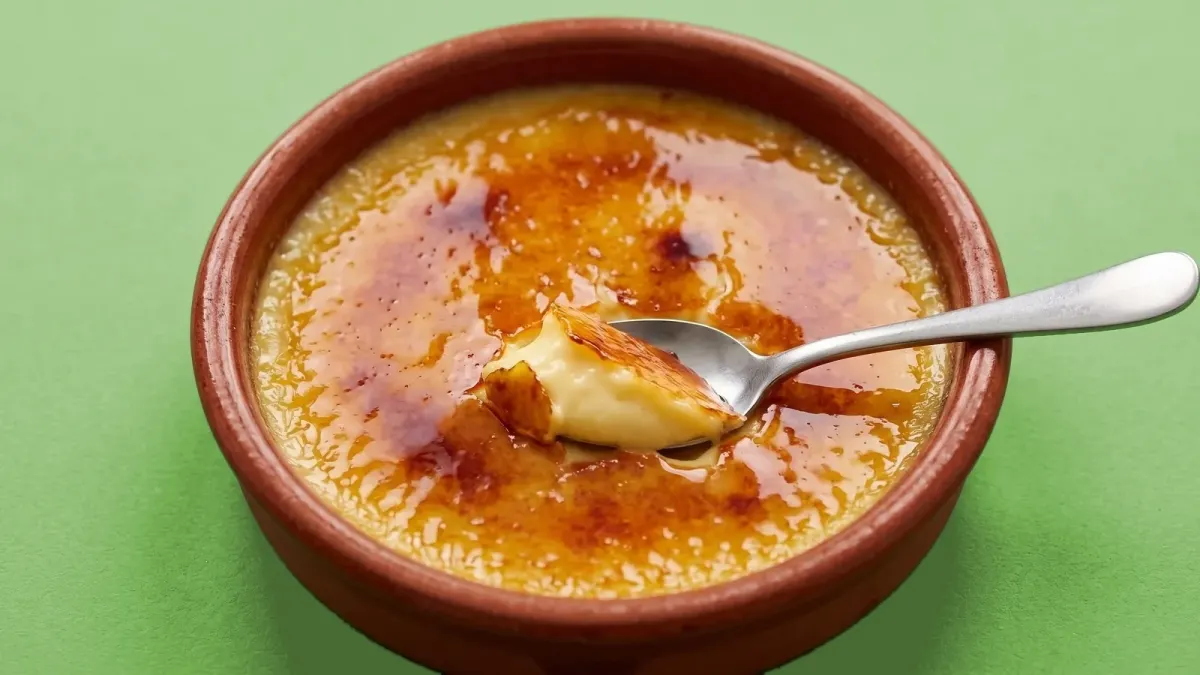
The custard of Saint Joseph's Day: milk scented with cinnamon and lemon, egg yolks, and a sugar crust that cracks under the spoon.
- In all
- 4h17min
- Hands-on
- 21min
- Waiting
- 3h56min
Difficulty: 3 of 5. 375 kcal each
The median
The quantities are the median of the versions that give them, not one person’s opinion.
The time
The sources 30min
The plan 4h17min
8 of 30 sources state a time: 20min to 1h30min, median 30min.
Ingredients · 4 people
- Whole milk 700 ml
- Egg yolks 6
- Sugar 160 g
- Cornflour 30 g
- Lemon 1
- Cinnamon sticks 1
The plan
4h17min, 21min of it hands-on.
for 4 · one cook · one pan and two pots
- 01 Peel the lemon in strips hands-on, minutes 0–2
- 02 Heat the milk with the aromatics watching, minutes 2–8
- 03 Leave to infuse waiting, minutes 8–28
- 04 Beat the yolks with the sugar hands-on, minutes 28–32
- 05 Pour the milk onto the yolks hands-on, minutes 32–34
- 06 Thicken the custard hands-on, minutes 34–42
- 07 Pour into the cazuelitas hands-on, minutes 42–44
- 08 Cool to lukewarm waiting, minutes 44–74
- 09 Rest in the fridge waiting, minutes 74–254
- 10 Caramelise the sugar and serve hands-on, minutes 254–257
- hands-on
- watching
- waiting
The plan is for one cook, with one pan and two pots: PREP lines the steps up side by side.
In the app this plan guides you step by step, and rings when a pot is ready. Notify me
The steps
-
01 Peel the lemon in strips
Wash the lemon, then take the peel off in strips with a vegetable peeler: only the yellow, none of the white.
- Seven recipes out of twenty-two say it in the same words: the white pith under the peel is bitter, and you taste it in the milk. If the peeler takes some with it, lay the strip yellow side down and scrape the pith off with a spoon, as Javi Recetas does.
- Wash the lemon in lukewarm water and rub it: the peel of shop-bought lemons is often treated on the surface, and here the peel is the only part you use.
- One lemon per litre of milk is the rule in fourteen recipes; five use half. With half, the custard tastes more of milk and cinnamon; with a whole one, the citrus comes through: here, one.
- Six recipes out of twenty-two add a strip of orange peel alongside the lemon, and two leave it optional: it isn't the majority, the Catalan canon that Cuina.cat cites is cinnamon and lemon, and here there's no orange. If you like it, a strip of orange goes into the same saucepan and gets sieved out with the rest.
IT’S READY WHEN Strips that are yellow on both sides, with none of the white, spongy pith clinging underneath.
-
02 Heat the milk with the aromatics
Set aside a little cold milk, about a fifth, for dissolving the cornflour. The rest into the small saucepan with the lemon peel and the cinnamon stick, over a medium heat, until it's just below the boil.
- The cold milk is for later, to dissolve the cornflour without lumps: nine recipes set it aside before turning on the heat, Arguiñano included. If you forget, the cornflour still dissolves in a splash of lukewarm milk, just with more patience.
- Twelve recipes bring the milk right up to the boil and nine stop it a moment before: the sign is the same, small bubbles at the edge and steam rising. Don't walk away in the last moments, because milk boils over in a second, as El Comidista warns.
- A cinnamon stick, not ground cinnamon: the powder can't be sieved out and leaves the custard grey and sandy. One stick is enough for a litre; Carme Ruscalleda's mother put in two, and she's the only one.
- Whole milk, in every recipe that specifies it: the fat makes the creaminess. Hule y Mantel suggests that anyone with skimmed milk add a tenth of the volume in cream, but that isn't the recipe: crema catalana is milk, not cream, and that's what sets it apart from crème brûlée.
IT’S READY WHEN A ring of fine bubbles around the edge of the saucepan and a veil of steam above: the milk is just below the boil, and a second away from boiling over.
-
03 Leave to infuse
Heat off, lid on the saucepan: the cinnamon and lemon do their work while the milk cools to lukewarm.
- Twelve recipes out of twenty-two let the milk stand before adding it to the yolks, ten pour it in boiling. Those who wait go from five minutes to an hour, and twenty is the median: long enough for the cinnamon to come through, not so long that dinner has to wait.
- The wait does two things at once: it scents the milk and brings the temperature down. Hule y Mantel says it plainly: if the milk hits the yolks boiling hot, the yolks scramble. With the lid on, the scent stays in and no skin forms.
- The yolks are prepared at the end of this wait, not before: yolks and sugar must not sit together waiting.
- If you're in a hurry, you can skip the wait as Arguiñano and the Corpus de la Cuina Catalana do, pouring the milk straight off the heat, but in a thin stream and stirring without stopping: the scent will be lighter and the risk of lumps higher.
IT’S READY WHEN The saucepan is cool enough to touch with your hand, and the milk, when you smell it, smells of cinnamon before it smells of milk.
-
04 Beat the yolks with the sugar
Separate the yolks into the bowl, beat them with the sugar for the custard until they turn pale, then add the cornflour dissolved in the cold milk you set aside.
- A little under a third of the sugar stays out, for the crust: one level tablespoon per cazuelita, the little dish it's served in. Put it in a saucer now, so you're not hunting for it at the end.
- A hand whisk, not an electric one, and without whipping: the mixture should turn pale and gain just a little volume, as Paula's Apron writes, not turn to foam. Too much air makes a custard full of tiny bubbles.
- Don't leave the yolks and sugar sitting together: the sugar, as Paula's Apron puts it, «burns» the yolks, and you're left with hard yellow specks that no sieve will take out; El Comidista says the same, the mixture is made at the last moment. Beat only when the milk is ready, and pour it in at once.
- Two schools on the cornflour, and the majority is on the other side: eleven recipes mix it dry into the yolks and sugar, nine dissolve it in the cold milk set aside, two put it into the hot milk. Here it's the cold milk, with Arguiñano, because it never makes lumps: four grams per hundred millilitres of milk, which is about a level teaspoon and a half per glass.
- Eight yolks per litre is the median of twenty-two recipes, and the range runs from three to twelve: with fewer, the custard holds only thanks to the cornflour and tastes of milk; with more, it turns into an egg pudding. Hule y Mantel recalls that before cornflour the yolks were doubled, and it was a sweet for the tables of the well-off.
- The whites aren't thrown away: covered in the fridge, or in the freezer, they wait for a meringue, as Cocina Casera suggests, or bulk out an omelette.
IT’S READY WHEN The mixture is pale yellow, smooth, and falls off the whisk in a ribbon, with no grains of sugar and no white lumps of cornflour.
-
05 Pour the milk onto the yolks
Pour the lukewarm milk through the sieve onto the yolks, in a thin stream, whisking as you go.
- The sieve holds back the peel, the stick and the skin on the milk: fourteen recipes use one, and the custard comes out smooth. If a bit of peel gets through, take it out now, not later.
- In a thin stream and stirring: the milk goes onto the yolks, not the yolks into the milk. Eighteen recipes out of twenty-two do it this way, because the temperature rises slowly and the yolks don't cook on contact. PequeRecetas and Paula's Apron pour in a splash first, stir, and then the rest.
- The milk should be lukewarm, not boiling: that's what the wait earlier was for. If you skipped the infusion, pour even more slowly.
- Four do the opposite and pour the yolks into the milk: Directo al Paladar and Rechupete into milk still on the heat, Lolita la Pastelera and Hule y Mantel into milk left to cool to lukewarm. It works with the whisk going without a pause, but with hot milk it's the approach with the least margin.
IT’S READY WHEN A pale yellow liquid, even throughout, with no whitish threads of cooked yolk at the bottom of the bowl.
-
06 Thicken the custard
Everything back into the saucepan, over a low heat, the whisk always moving and scraping the bottom: the custard thickens without coming to the boil.
- This is the step that decides the dish. A low heat and a whisk that never stops: Cuina.cat speaks for all of them, if you turn up the heat the custard spits and doesn't bind, if you stop stirring it catches on the bottom. Keep your hand on the handle and don't leave the saucepan.
- Below the boil, with nine recipes and the Enciclopèdia Catalana: above a hundred degrees the yolks scramble and the custard splits. Four recipes, the Corpus de la Cuina Catalana and Ruscalleda first among them, take it off the moment it comes to the boil, and they get away with it because the cornflour protects the yolks: it's an option, but one with no margin.
- Hule y Mantel is the only one that measures: 80 degrees on the thermometer, and that, it says, is the point where the custard on the spoon stops sliding off like milk. If you have a thermometer, 80 is the number to look for; the boil, at a hundred, is the ceiling you don't touch.
- The sign that the custard is ready comes almost all at once, as Recetas de Escándalo writes: for minutes it looks like milk, then the whisk leaves furrows on the bottom and the spoon comes out coated. Once cold, it will be firmer than this: stop a shade early, not late.
- Egg and temperature: the Spanish rule for anyone cooking for the public asks for 70 degrees for two seconds at the centre of dishes made with raw egg, and AESAN ties salmonella precisely to «huevos y productos a base de huevo crudo o poco cocinados». A custard that has thickened has passed that threshold, because the yolk only sets at a higher temperature: it's a deduction from the physics, not a line in a recipe. The 80 degrees Hule y Mantel measures sit above it, and if you have the thermometer you read them off and rest easy.
- Off the heat it carries on cooking in the residual heat of the saucepan: stir for another minute, as El Comidista and Rechupete say, so the bottom doesn't set while the surface is still liquid.
IT’S READY WHEN The whisk leaves furrows that close slowly, the spoon comes out coated in a film that doesn't run, and not a single bubble has risen from the bottom.
-
07 Pour into the cazuelitas
Straight away, with a ladle, into the earthenware cazuelitas, and smooth the surface with the back of a spoon.
- The cazuelitas are the shallow earthenware dishes the custard is served and caramelised in: thirteen recipes out of twenty-two name them, and they give the dish its shape. Wide and shallow, as Paula's Apron asks, so the sugar caramelises in an even layer; a tall glass makes a lopsided crust.
- Straight away, while it's hot and flows: once lukewarm it sets and the surface comes out in waves. Smoothing it with the spoon, as Las Recetas de MJ and Escándalo do, is for the crust that comes later.
- Fill almost to the rim, leaving a finger's width: the custard drops a little as it cools, and the sugar for the crust needs a flat, wide surface.
- The old home version is a single porcelain platter, caramelised in the middle of the table with the round iron: Hule y Mantel and the historian Jaume Fàbrega on Cuina.cat tell of it, and Ruscalleda's mother poured hers «en una safata». If you have no cazuelitas, a shallow ovenproof dish will do.
IT’S READY WHEN All the surfaces smooth and matt, at the same height, with no drips on the rim.
-
08 Cool to lukewarm
On the worktop, with cling film laid on the surface, until it's no longer scalding hot.
- Every recipe cools it before the fridge and only one times it, Rechupete with half an hour: that's how long a cazuelita takes to go from boiling hot to lukewarm. Put in hot, it warms up everything else in the fridge and makes condensation under the cling film.
- Cling film pressed onto the surface, with seven recipes: without it, a skin forms. Two recipes leave it uncovered on purpose, Bon Viveur and Directo al Paladar, because they like that thin skin under the crust: it's a matter of taste, and Paula's Apron says that with the caramel on top you don't notice it anyway.
- If the stick or a bit of peel has ended up in a cazuelita, this is the last moment to fish it out with the tip of a knife.
IT’S READY WHEN The cazuelita sits comfortably in your hand and the cling film resting on the custard is no longer wet with condensation.
-
09 Rest in the fridge
In the fridge, covered, at least three hours: the custard firms up and the flavours come together.
- Three hours is the median of seven recipes that count them, from two to four; Javi Recetas and Escándalo prefer it made the day before. The hours don't scale with the portions: one cazuelita takes as long to chill as four.
- Properly cold, not just cool: the crust is made with the blowtorch on a cold custard, and on a lukewarm one the sugar sinks and dissolves instead of caramelising.
- Covered, in the fridge, eat it within two days: Paula's Apron and Escándalo go to three, El Terralo stops at forty-eight hours, and the Spanish rule for anyone selling it keeps it below eight degrees and has it eaten within twenty-four hours. AESAN asks for the fridge for any dish with egg that isn't eaten straight away.
- No sugar on top until it's served: the moisture in the custard dissolves the caramel overnight and turns it into syrup, as Lolita la Pastelera and Javi Recetas warn. If one is left over already caramelised, lift the crust off like a lid before putting it away.
IT’S READY WHEN Tilt the cazuelita and the custard doesn't move; a finger laid on the surface sinks in barely at all, and the dent rises back slowly.
-
10 Caramelise the sugar and serve
A level tablespoon of sugar on each cazuelita, spread thin, and the blowtorch melting it to amber. A minute for it to harden, and to the table.
- One level tablespoon per cazuelita, in a thin, even layer: it's the rule in five recipes, and Paula's Apron insists on a thin veil. With a thick layer the bottom stays white and the top burns; with one too thin, the crust makes no sound.
- Keep the blowtorch moving, a few fingers' width above the surface, until the sugar bubbles and turns from gold to amber: dark but not black, because black is bitter. The blowtorch leaves the custard cold under the crust, and that's the contrast that makes Rechupete prefer it to the iron.
- The red-hot iron is the traditional tool, ten sources name it and the Enciclopèdia Catalana puts it in the definition: an iron disc on a handle, heated over the flame and laid on the sugar. It has to be heated beforehand, as Paula's Apron writes, and it warms the top layer of the custard too.
- With no blowtorch and no iron, there's the oven grill, which four recipes give as a fallback and none recommends: grill on full, cazuelita on the top shelf a finger's width from the element, one or two minutes without taking your eyes off it, and the cazuelita comes out scalding hot. El Comidista warns that this way you drift towards crème brûlée.
- Just before serving, with twenty-one recipes out of twenty-two: the crust doesn't wait, the moisture in the custard dissolves it. A Catalan reader on PequeRecetas tells of her grandmother caramelising the custard at dawn on Saint Joseph's Day, on cold custard, to have it ready for lunch: you can, as long as the custard is properly cold and lunch isn't far off.
- At the table it's broken with a tap of the spoon, and the crack is the moment everyone waits for. It's also eaten without caramelising it, as the Corpus de la Cuina Catalana and Paula's Apron admit; Arguiñano's mint leaves and a dusting of ground cinnamon on top are one recipe each, and the custard is served on its own.
IT’S READY WHEN The crust is an unbroken amber sheet, glossy, that rings like glass under the spoon, and beneath it the custard is still cold.
Where the sources disagree
- 1
To the boil or not
The recipes split over the boil: Divina Cocina, Las Recetas de MJ, Rechupete and El Terralo never let the custard boil, because the yolks can curdle; the Corpus de la Cuina Catalana, Bon Viveur and Directo al Paladar take it off as soon as it boils, and the cornflour protects the yolks. Here it stays below the boil, like most of those that take a side, with Hule y Mantel's 80 degrees as the target: the Catalan way works, but leaves no margin.
- 2
Infuse the milk or not
Twelve recipes out of twenty-two let the milk infuse off the heat before pouring it over the yolks, for anything from five minutes to an hour; ten pour it straight in, boiling. Here it's twenty minutes, the median: the cinnamon comes through and the milk cools down, so the yolks don't curdle, as Hule y Mantel warns. In a hurry, follow Arguiñano and the Corpus de la Cuina Catalana: pour it in a thin stream, stirring without stopping, and expect a lighter scent.
- 3
Orange or no orange
Thirteen recipes out of twenty-two use lemon as the only citrus; six add orange peel too, Arguiñano and El Comidista among them, and two leave it optional. Here there's no orange, like the majority and the Catalan canon that Cuina.cat cites: cinnamon and lemon. If you like it, the orange peel, without the white pith, goes into the same saucepan and is strained out with the other aromatics.
Where the numbers come from
This recipe compares 30 sources. The quantities are the median of the versions, not one person’s opinion: where the sources disagree, the majority wins. Here they all are.
- Hogarmanía — Crema catalana por Karlos Arguiñano 50min
- Gastroteca (Generalitat de Catalunya) — Crema de Sant Josep, Corpus de la Cuina Catalana —
- Ajuntament de Barcelona, Cultura Popular — Crema de Sant Josep —
- El Comidista / El País — Crema catalana tradicional (Clara P. Villalón) —
- Hule y Mantel — Crema catalana o de Sant Josep (Carmen Alcaraz del Blanco) 35min
- Gastronomía & Cía — Crema Catalana o Crema de Sant Josep 1h30min
- Cuina.cat — Crema de Sant Josep de la mare de Carme Ruscalleda —
- Cuina.cat — Com fer la millor crema de Sant Josep —
- Cuina.cat — L'origen de la crema cremada —
- Directo al Paladar — Receta de crema catalana (Carmen Tía Alia) 30min
- Directo al Paladar — Crema catalana, la receta definitiva (Esther Clemente) 20min
- Bon Viveur — Crema catalana (Marina Corma) —
- Cocina Casera — Crema catalana —
- Divina Cocina — Cómo se hace la crema catalana 30min
- PequeRecetas — Crema catalana 25min
- Las Recetas de MJ — Crema catalana —
- Lolita la Pastelera — Crema catalana casera 30min
- Paula's Apron — Crema Catalana de Mi Abuela —
- Anna Recetas Fáciles — Crema catalana receta fácil —
- Javi Recetas — Crema catalana casera —
- Recetas de Escándalo — Cómo hacer crema catalana con su azúcar quemada —
- Recetas de Rechupete (ABC) — Cómo hacer crema catalana (Alfonso López Alonso) —
- Canal Cocina — Crema catalana (Lourdes Ferrándiz & Isabel Maestre) —
- El Terralo — Auténtica crema catalana: receta casera y fácil —
- receptes.cat — Crema catalana —
- Gran Enciclopèdia Catalana — crema (crema cremada, crema de Sant Josep) —
- BOE — Real Decreto 1021/2022, art. 9, alimentos elaborados con huevo —
- AESAN — Salmonelosis (huevos y productos a base de huevo crudo o poco cocinados) —
- CREA — Mais, amido (000300) —
- BEDCA — Canela, en polvo (2477) y Almidón de maíz (1012) —
- With PREP’s plan 4h17min
Published .
Allergens
- Milk
- Eggs
They come from the recipe's list. The label on what you buy is what counts.
More recipes
- Churros with hot chocolate 1h
- Tortilla de patatas 57min
- Paella valenciana 1h30min
Coming to the App Store.
For 3h56min of this recipe’s 4h17min your hands are free: PREP tells you what to do meanwhile, and when to go back to the stove.
Leave your email: we’ll write once, when it’s out.
We count visits to the website without cookies and without knowing who you are.
One step left.