Recipes › Spanish cuisine · Spain
Tortilla de patatas
A handful of ingredients, a civil war, and one move that allows no hesitation.
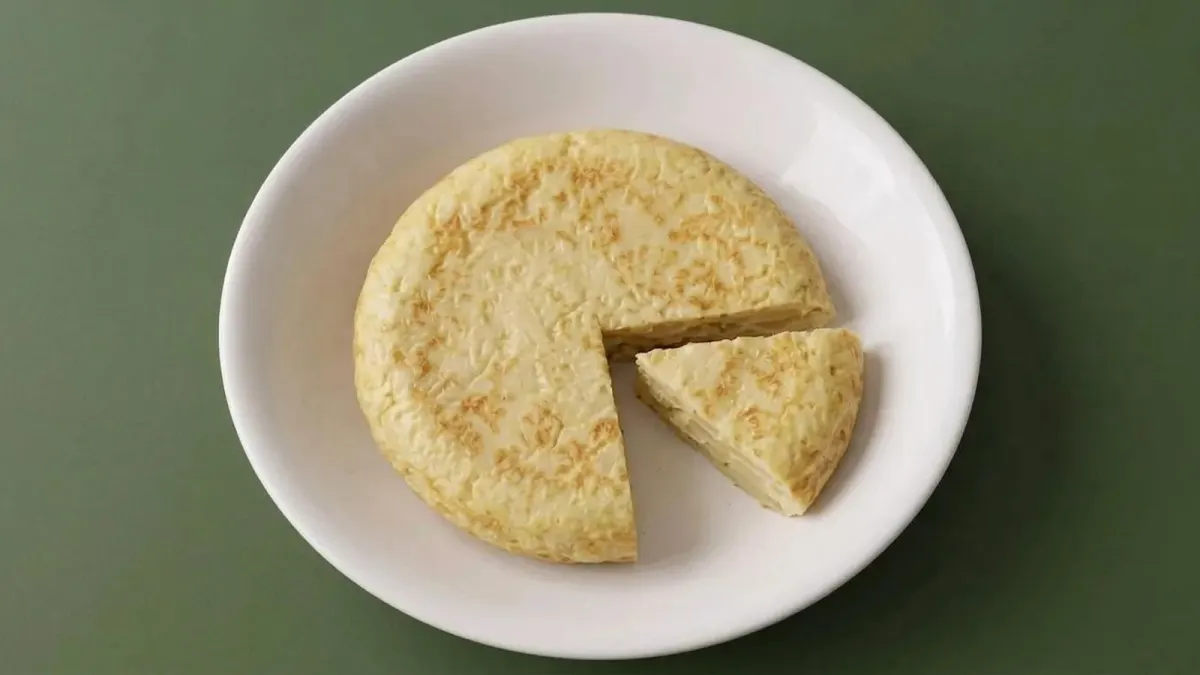
Ingredients
- Potatoes700 g
- Eggs6
- Onion2.5
- Extra-virgin olive oil400 g
- Saltto taste
The plan
- 01Slice the potatoesminutes 0–7
- 02Cut the onionminutes 7–10
- 03Confit potatoes and onionminutes 10–35
- 04Beat the eggsminutes 10–12
- 05Drain and add to the eggminutes 35–38
- 06Rest the mixtureminutes 38–46
- 07Set the first sideminutes 46–49
- 08Flip it onto a plateminutes 49–50
- 09Set the second sideminutes 50–52
- 10Rest before cuttingminutes 52–57
hands busykeep an eyewaiting
The plan is for one cook, with one pan and two pots: PREP lines the steps up side by side.
The steps
-
01 Slice the potatoes hands-on · 7min · minutes 0–7
Thin, even slices, edges left however they come.
- Varieties that hold their shape in the pan: Kennebec and Agria are the two the Spanish sources name outright, and they're the ones that don't fall apart in the oil.
- Slices, not cubes: a slice works itself into the egg, a cube stays a foreign body. Canal Cocina cuts small squares, and it's a legitimate school, but it binds less.
- Even, above all. Directo al Paladar insists on a uniform cut, and the reason is that in a single pan you have no way to fix slices cooking at different speeds.
- Soaking in cold water splits the sources: Directo al Paladar keeps the potatoes in water before frying, Canal Cocina just rinses them. Here they don't get soaked, because the starch you'd wash away is what holds the slice together when you cut it. It's a choice, not a rule.
Cue. The slices bend without snapping and stay tacky between your fingers.
-
02 Cut the onion hands-on · 3min · minutes 7–10
Finely sliced: it has to vanish inside, never show itself.
- This is where the Spanish holy war is fought. Cebollistas against sincebollistas: seven Spaniards out of ten side with the first camp, and this recipe follows them.
- Without onion the sources split, and not in the direction you'd expect: Dani García goes below the one-egg-per-100-grams-of-potato rule, Betanzos sits well above it. It's a choice about texture, not compensation for the water that isn't there.
- Sliced, not diced, because it has to blend into the potato. If you can feel it under your teeth, you've cut it too thick.
- Sweet onion if you can find it: Hogarmanía calls for it explicitly, and it stands up to a long cook better without turning sharp.
Cue. Thin, even strips that pull apart from one another without tearing.
-
03 Confit potatoes and onion keep an eye · 25min · minutes 10–35
Oil still cold, low heat: they cook, they don't fry.
- Potatoes and onion go in together and come up to temperature with the oil. Directo al Paladar puts it most bluntly: you start from oil that's almost cold, and that's how they confit instead of browning.
- The sources don't agree on how to share the pan: Hogarmanía puts them in together as here, Canal Cocina does the onion first and then the potatoes in the same oil, Directo al Paladar caramelises the onion separately. Together is the shortest route, and this card counts on that.
- The oil has to cover them. It looks like a lot because it is, but what doesn't get absorbed gets strained and goes back in the bottle.
- Stir now and then and scrape the bottom, but don't be rough with them: the slices need to reach the colander whole.
- If you hear it sizzling loudly, the heat is too high. A confit is silent, frying isn't.
- For a sweeter base, turn up the heat towards the end to catch a few amber edges: Directo al Paladar puts it in the recipe and calls it contrast in the finished dish.
- A third school, out of the pan: Senén González cooks the potato in the oven to drive off water, stirring it so it doesn't scorch. It's there to control the temperature better than you can on the hob.
Cue. The edge of the spatula cuts through a slice with no resistance, and the colour is still pale gold.
-
04 Beat the eggs hands-on · 2min · minutes 10–12
Fork, not whisk: mix them, don't whip them.
- The ratio two sources state almost identically is one egg per hundred grams of potato. Under it, the tortilla splits when you cut it; over it, it tastes like a frittata.
- Don't whip. Excess air puffs up in the pan and then collapses, and leaves you a hollow centre.
- In Betanzos the eggs aren't beaten at all: they're cracked into the bowl and stirred through the potato unbeaten, so visible yellow streaks stay and the tortilla runs. It's the far end of the jugosa school.
- Fresh eggs, still in date, kept cold the whole way: here they'll end up barely cooked, and there's no margin for error.
Cue. Even colour, no pale streak floating on top, almost no foam on the surface.
-
05 Drain and add to the egg hands-on · 3min · minutes 35–38
Drain well, tip into the egg, salt now.
- Drain in a colander set over a bowl, without pressing. Canal Cocina puts it well: you let them drip so they give up the oil still clinging to them. What you recover gets strained and used again.
- Warm potatoes into the egg, not scalding hot. The residual heat should just set the egg on contact: if they're piping hot you cook it in the bowl and end up with curds.
- Salt goes in here and not before. In the egg it spreads evenly; on the potato in the pan it pulls out water and wrecks the confit.
- Fold from the bottom up. A few slices break, and that's fine: the starch they release is what binds the dish.
Cue. Every slice is coated in a film of egg and no loose liquid is left in the bottom of the bowl.
-
06 Rest the mixture waiting · 8min · minutes 38–46
Leave it alone: the potato drinks the egg.
- Four sources out of fourteen call for it, and it's the step that goes first when a recipe is in a hurry. The egg works into the cavities of the potato and binds it from the inside, instead of just wetting the outside.
- Bon Viveur puts it down to the flavours coming together, El Ingeniero Cocinero to creaminess: the same thing seen from two sides.
- Without the rest the tortilla falls apart when you cut it. With the rest it stands up even when jugosa.
- If the kitchen is warm, keep it in the fridge. A raw egg mixture sitting at room temperature is the one real safety mistake in this recipe.
Cue. Tilt the bowl and the mixture slides as one mass, not in waves: there's no loose egg left.
-
07 Set the first side hands-on · 3min · minutes 46–49
Dry pan, a film of oil, medium-high heat.
- Empty and wipe out the pan before you start again: the confit oil is too much, here you need barely a film.
- The tortilla should come out tall and not wide, because tall means set edges and a centre still soft. Pour it all in at once, give the pan a few sharp shakes for the first few moments, then stop and gather the edges towards the centre with the spatula to give it its curve.
- This is where doneness is decided, and it's decided by shortening or stretching this step. At the low end the centre stays runny like in Betanzos, where they count in seconds; the time on this card is the compromise the sources call el punto; if you want it cuajada, go on until the centre stops trembling.
- Undercooked egg: killing salmonella takes a temperature that a tortilla cooked to the Spanish punto never reaches. The Spanish catering decree, whose exact thresholds Maldita.es reports, prescribes immediate consumption in that case. Fresh eggs, tortilla eaten right away, never left out of the fridge for hours.
Cue. The edges are opaque and pulled away from the side of the pan, the centre still trembles when you shake it.
-
08 Flip it onto a plate hands-on · 1min · minutes 49–50
Plate wider than the pan, one move, committed.
- A flat plate wider than the rim of the pan, otherwise the mixture escapes at the sides while you turn.
- Before you flip, tilt the pan and pour off the excess oil: that's what runs down your wrist.
- Plate on top, open hand at the centre of the plate, pan and plate turn together in one stroke. Slowing down halfway is the only known way to break it.
- Then put the pan back on the heat and slide the tortilla in off the plate, without lifting it.
- A flat lid with a handle does the same job and is easier to hold: Canal Cocina flips with the lid exactly this way.
Cue. The tortilla lands on the plate whole, browned face up and nothing spilled around it.
-
09 Set the second side hands-on · 2min · minutes 50–52
Shorter than the first side: the centre is already hot.
- The second side starts with the inside already up to temperature. Keeping it on as long as the first means drying out the centre, and Bon Viveur writes it as a rule: a little less than the first.
- Keep gathering the edge inwards with the spatula as you turn the pan: that's how it takes on its cushion shape.
- If you want it very jugosa, do several very short turns counted in seconds instead of one long side. It's the method of the tortilleros of Betanzos, who give it the second turn before the first has dried.
- Off the heat it carries on cooking on residual heat: take it off when it still seems a shade underdone.
Cue. Press the centre with the back of the fish slice and it springs back softly without sinking: inside it's creamy, not liquid.
-
10 Rest before cutting waiting · 5min · minutes 52–57
On the plate, uncovered, the time it takes to set the table.
- The inside settles and stops running when you cut, and the temperature evens out from edge to centre.
- Uncovered: under a lid the steam softens the crust you've just made.
- Three sources call for it and none of the three puts a clock on it: they all say let it rest a few minutes before serving, and stop there.
- Warm, you taste the potato; piping hot, you taste only the egg.
- If there's any left: into the fridge as soon as it's cool enough to handle, and finished the next day. Barely cooked, it won't keep any longer than that. None of the sources listed gives a storage rule, so this is my own caution and not a prescription.
Cue. The cut stays clean and the wedge stands up, with the centre glossy but not running.
Allergens
- Eggs
They come from the recipe's list. The label on what you buy is what counts.
Where the numbers come from
This recipe compares 14 sources. The quantities are the median of the versions, not one person’s opinion: where the sources disagree, the majority wins. Here they all are.
- Bon Viveur — La receta de la mejor tortilla de patatas española
- Directo al Paladar — Receta de tortilla de patatas con cebolla
- Directo al Paladar — Cuántos huevos hay que echar a la tortilla de patatas
- Hogarmanía — Tortilla de patatas o tortilla española por Joseba Arguiñano
- Gastronomía & Cía — Cuántos huevos por patata para la tortilla española
- Canal Cocina — Tortilla de patatas y cebolla
- Canal Cocina — Tortilla de patatas y trucos
- Hule y Mantel — Cómo se hace la tortilla de Betanzos según el Mesón O Pote
- Con Mucha Gula — Senén González, de Sagartoki, cocina la mejor tortilla de patata
- Wikipedia en español — Tortilla de patatas (Semanario de Agricultura 1798, barómetro CIS 2023)
- Maldita.es — Cómo reducir el riesgo de salmonelosis por tortilla poco cuajada (Real Decreto 1021/2022)
- El Ingeniero Cocinero — Cómo hacer la tortilla de patatas cremosa y perfecta
- PequeRecetas — Tortilla de patatas española, jugosa, alta y esponjosa
- Recetas Comidas — Tortilla de patatas con patatas confitadas
For 36min of this recipe’s 57min your hands are free: PREP fills them with a second dish or a side, and tells you what to do and when.
Leave your email: we’ll write once, when it’s out.
More recipes
- Paella valenciana 1h30min
- Tacos al pastor 4h37min
- Guacamole 12min