Tzatziki
Fifteen minutes of waiting separate the sauce from the soup
- In all
- 59min
- Hands-on
- 19min
- Waiting
- 40min
- You save With the steps in parallel, instead of one at a time.
- −5min
Difficulty: 1 of 5. 245 kcal each With the steps in parallel, instead of one at a time.
The median
The quantities are the median of the versions that give them, not one person’s opinion.
The time
The sources 25min
The plan 59min
7 of 17 sources state a time: 10min to 1h20min, median 25min.
Ingredients · 4 people
- Strained Greek yogurt 500 g
- Cucumber 2
- Garlic 3 cloves
- Wine vinegar 2 tablespoons
- Extra-virgin olive oil 3 tablespoons
- Fresh dill half a handful
- Salt to taste
- Black pepper to taste
The plan
59min, 19min of it hands-on.
for 4 · one cook · one pan and two pots
- 01 Grate the cucumber hands-on, minutes 0–5
- 02 Salt, then fifteen minutes waiting, minutes 5–20
- 03 Pound the garlic in a mortar hands-on, minutes 5–8
- 04 Chop the dill hands-on, minutes 8–10
- 05 Wring out the cucumber hands-on, minutes 20–24
- 06 Build the tzatziki hands-on, minutes 24–29
- 07 Chill before serving waiting, minutes 29–59
- hands-on
- watching
- waiting
The plan is for one cook, with one pan and two pots: PREP lines the steps up side by side.
In the app this plan guides you step by step, and rings when a pot is ready. Notify me
The steps
-
01 Grate the cucumber
Peel it, cut out the seed core, coarse holes.
- Pick a firm, slender one. The soft, seedy kind is already half liquid: it gives you volume and no flavour. Sia is Cooking asks for exactly that, firm and not too seedy.
- The seed core gets thrown out. It's the part that gives off the most water and adds nothing: keep it and you'll find the sauce gone watery by the next day.
- Coarse holes and vertical strokes, no scrubbing back and forth. You want shreds you can feel under your teeth, not a purée.
- Argiro Barbarigou grates almost straight down the grater, so she takes only the firm outer part and the watery core stays in her hand: it's the same result you get by scooping out the seeds, only in one move.
IT’S READY WHEN Short, distinct shreds that stay separate, not a mush running off the grater.
-
02 Salt, then fifteen minutes
Salt it in a strainer and let it drain.
- This is the step that separates tzatziki from soup. Salt pulls the liquid out by osmosis, and that liquid belongs in the sink, not in the yogurt.
- Fifteen minutes is the median across the Greek sources. The lowest figure is ten minutes, the highest is Diane Kochilas's full hour: the longer you wait the thicker it gets, but nobody goes below ten minutes.
- Light hand with the salt: some of it stays on the cucumber and you'll taste it again in the finished dish. The final seasoning happens later, not now.
- Set a bowl under the strainer. Seeing how much liquid came out is the only proof the step was worth doing.
- Turkish cacık, which the name comes from, is thinned with water until it's a cold soup you drink. Tzatziki is the same dish with the liquid taken out: skipping these minutes isn't a shortcut, it's making a different dish.
IT’S READY WHEN The dripping slows to a stop and the cucumber in the strainer has visibly collapsed in on itself.
-
03 Pound the garlic in a mortar
Mortar, a pinch of salt, work it to a paste.
- The salt works as an abrasive and breaks the fibres: in the mortar the garlic turns to paste and spreads everywhere. Chopped with a knife it stays in bits, and the first person who bites into one stops eating.
- Here the Greek sources genuinely disagree: some use a single clove for the whole bowl, others go to five or six times that. The ingredient list here takes the median, and that's already a tzatziki you notice.
- Sia is Cooking puts it to soak in water the night before: it loses its bite and you're not tasting it all afternoon. If you do it, the soak goes in the fridge and not on the worktop — peeled garlic in water at room temperature overnight is the one point in this recipe with a real risk, and the dish is then eaten raw and keeps for days. The source doesn't give it: it's a food-safety precaution.
- It's the raw garlic that sets how long the dish keeps, not the yogurt.
IT’S READY WHEN A white, even paste in the bottom of the mortar, no slivers escaping from under the pestle.
-
04 Chop the dill
Fronds only, sharp knife, a few strokes.
- The stems get thrown out: they're woody and leave fibre in your mouth.
- Short passes with a knife that actually cuts. Bruise it and it bleeds its liquid, turns dark green and bitter.
- Most Greek sources use it, Alfavita calls it optional, Madame Ginger and Tasty Cooking don't have it at all — and Tasty Cooking goes so far as to claim that dill and mint are almost never used in the traditional version. Here the dill stays and the mint doesn't, even though Argiro and Pandespani put it in: mint pulls the dish towards cacık.
IT’S READY WHEN Fronds in distinct little pieces and a smell of aniseed coming up straight away. If the chopping board stains green, you crushed instead of cutting.
-
05 Wring out the cucumber
In a tea towel, twist until not another drop comes out.
- The strainer takes out the free liquid, the towel takes out what's held in the flesh. Two different things, and you need both: skipping the second is the mistake you see at the table.
- Gather the corners and twist the way you'd wring out a rag. Then open it up, shift the pulp around and twist again: the first turn comes easy, the last one is the one that counts.
- It loses a lot of weight, and that's as it should be. What's left in your hand is flesh.
- Tasty Cooking puts it in a tea towel and squeezes hard until all the juice is out; Viologika, after the fifteen minutes in the strainer, wrings it well. Neither one says for how long, and that's consistent: it's a move that ends when nothing more comes out, not when a timer runs down.
IT’S READY WHEN You twist hard and not another drop falls. The mass holds together on its own when you open the towel.
-
06 Build the tzatziki
Liquids into the yogurt first, then the cucumber.
- Put the garlic, vinegar and oil into the yogurt first and stir until it's smooth again, and only then add the cucumber, dill, salt and pepper: that way the oil binds instead of sitting in patches. It's not a Greek rule — the sources don't insist on the order and Βαρθαλίτης starts with the cucumber itself, then garlic, yogurt and vinegar.
- Vinegar isn't a finishing touch, it's structure: it cuts the fat and holds the flavour up when the sauce is cold. But the sources aren't unanimous. Most of them use it, Alfavita offers it as an alternative to lemon juice, Viologika marks it optional, and Cookout and Pandespani use none at all: Pandespani says outright that her recipe has neither vinegar nor lemon. Lemon is the signature of Cypriot talattouri, but one Greek source out of eleven allows it, and that has to be said.
- The yogurt has to be genuinely strained. Below 5.6 per cent protein the Greek food code won't even call it strained, and in the bowl the difference shows immediately.
- Spatula or spoon, not a whisk. The sources only say to stir and forbid nothing: that a whisk breaks the yogurt's structure and leaves it runny within half an hour is a kitchen observation, not something the sources say.
- Hold back a drizzle of the oil for the top. It goes on at serving time: put it in now and it gets absorbed and you never see it again.
- Taste for salt only here. Between the salt on the cucumber and the salt in the mortar there's already plenty in there, and there's no taking it back out.
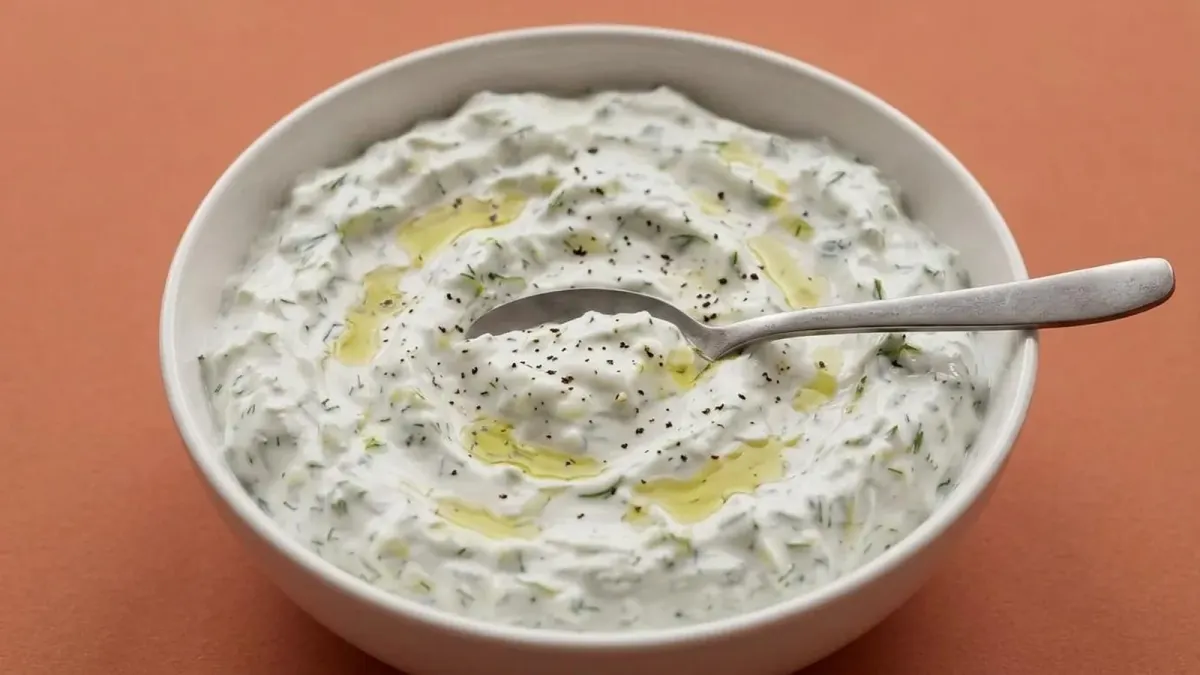
IT’S READY WHEN One single colour, white just veined with green, and the sauce mounding on the spoon without running off the sides.
-
07 Chill before serving
Covered tight, into the fridge, a good half hour.
- This rest isn't for your convenience. The garlic has to spread out and the yogurt has to firm up in the cold: just mixed, it tastes of garlic in layers, after half an hour it tastes of tzatziki.
- Half an hour is the median. Paxxi and Sia is Cooking ask for at least an hour, Kochilas settles for fifteen minutes, and Argiro says that after the first day it's better still and more fragrant: she's right.
- Covered tight: yogurt takes on the smells of the fridge, and the garlic hands them back to everything else on the shelf.
- Two days, no more: Kochilas warns that past that point raw garlic starts turning unpleasantly bitter. If a film of whey separates on the surface, stir it back in and keep going — there's nothing wrong with that.
IT’S READY WHEN Cold to the touch through the bowl, and a spoon planted in it stands up before it leans over.
Where the sources disagree
- 1
How long to salt
Ten recipes out of eleven salt the cucumber and let it drain before squeezing, for anything from Tasty Cooking's ten minutes to Diane Kochilas's hour; Paxxi squeezes it straight away, without salt. Here it's a quarter of an hour, the median: by then the free liquid has gone, and the tea towel takes the rest. For a thicker tzatziki, go towards Kochilas's hour; just squeezing is quicker, but the water left behind seeps out later, into the yoghurt.
- 2
Vinegar, lemon or neither
Nine recipes out of eleven use vinegar, Alfavita as an alternative to lemon and Viologika as optional; Cookout and Pandespani use no acid at all. Here it's wine vinegar, like the majority: it cuts the richness of the yoghurt and holds the flavour even when cold. If you want it the Cypriot way, like the talattouri Tasty Cooking and Pandespani mention, use lemon; with no acid it stays mellower and the yoghurt comes through more.
- 3
Dill or no dill
Eight recipes out of eleven use dill, Alfavita leaves it optional, Madame Ginger and Tasty Cooking go without, and the latter writes that dill and mint are almost never used in the traditional recipe. Here there's dill, like the majority, and no mint: that's the scent of the Turkish and Cypriot versions. If that's what you're after, add mint as Argiro and Pandespani do; without herbs you taste only yoghurt, cucumber and garlic.
Where the numbers come from
This recipe compares 17 sources. The quantities are the median of the versions, not one person’s opinion: where the sources disagree, the majority wins. Here they all are.
- Αργυρώ Μπαρμπαρίγου — Συνταγή για τζατζίκι 15min
- Diane Kochilas — Tzatziki, Greek Yogurt Dip —
- Σταύρος Βαρθαλίτης — Τζατζίκι 1h20min
- LiFO — Το τέλειο τζατζίκι και πώς να το πετύχετε —
- Cookout ΣΚΑΪ — Τζατζίκι 15min
- Pandespani — Τζατζίκι 40min
- Alfavita — Συνταγή για το τέλειο τζατζίκι —
- Paxxi — Τζατζίκι 10min
- Madame Ginger (Ντίνα Νικολάου) — Το τέλειο τζατζίκι και 3 παραλλαγές του 25min
- Sia is Cooking — Τζατζίκι Παραδοσιακό —
- Viologika — Τζατζίκι σπιτικό 25min
- Tasty Cooking — Τζατζίκι συνταγή —
- Κώδικας Τροφίμων και Ποτών (via Cantina / Πρώτο Θέμα) —
- Βικιπαίδεια — Τζατζίκι —
- Wikipedia — Tzatziki —
- Wiktionary — tzatziki —
- Ιατροπαίδεια — Στραγγιστό γιαούρτι, 6 οφέλη στην υγεία —
- With PREP’s plan 59min
Published .
Allergens
- Milk
- Sulphur dioxide and sulphites
They come from the recipe's list. The label on what you buy is what counts.
More recipes
- Moussaka 2h29min
- Pork souvlaki 3h04min
- Aubergine parmigiana 2h37min
Coming to the App Store.
For 40min of this recipe’s 59min your hands are free: PREP tells you what to do meanwhile, and when to go back to the stove.
Leave your email: we’ll write once, when it’s out.
We count visits to the website without cookies and without knowing who you are.
One step left.