Paella valenciana
No onion, one layer of rice, and nobody stirring it
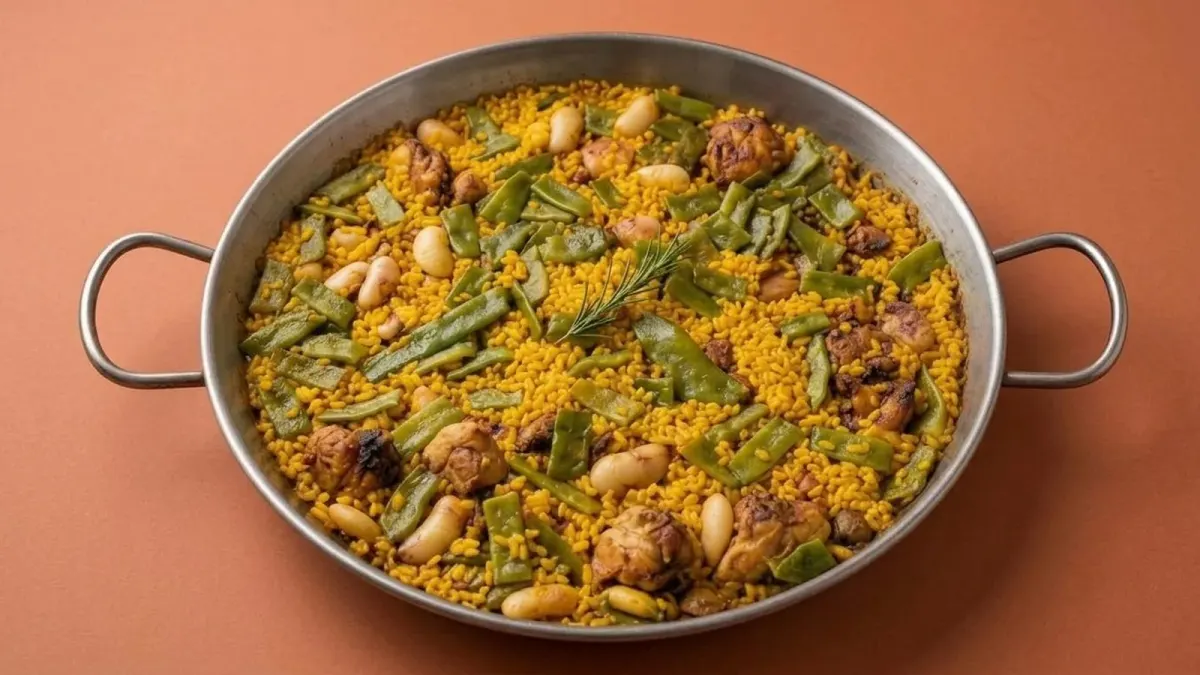
- In all
- 1h30min
- Hands-on
- 23min
- Waiting
- 1h07min
- You saveWith the steps in parallel, instead of one at a time.
- −12min
Difficulty : 4 of 5680 kcal eachWith the steps in parallel, instead of one at a time.
The median
The quantities are the median of the versions that give them, not one person’s opinion.
The time
The sources1h30min
The plan1h30min
4 of 14 sources state a time: 1h25min to 2h, median 1h30min.
Ingredients · 4 people
- Bomba rice320 g
- Chicken thighs350 g
- Rabbit, in pieces250 g
- Flat green beans150 g
- Garrofón beans110 g
- Ripe tomatoes1.5
- Extra-virgin olive oil3.5 tablespoons
- Saffron1 packet
- Sweet pimentón1 tablespoon
- Rosemaryto taste
- Saltto taste
The plan
1h30min, 23min of it hands-on.
for 4 · one cook · one pan and two pots
- 01Cut up chicken and rabbit hands-on, minutes 0–10
- 02Heat oil in the paellera watching, minutes 6–10
- 03Snap the bajoqueta hands-on, minutes 10–15
- 04Brown chicken and rabbit watching, minutes 10–15
- 05Grate the tomatoes hands-on, minutes 15–18
- 06Add bajoqueta and garrofón watching, minutes 15–20
- 07Fry down the tomato watching, minutes 20–30
- 08Pimentón and saffron hands-on, minutes 30–31
- 09Pour in the water waiting, minutes 31–37
- 10Cook the broth waiting, minutes 37–63
- 11Taste and adjust the salt hands-on, minutes 63–65
- 12Pour the rice a caballete hands-on, minutes 65–67
- 13High flame watching, minutes 67–72
- 14Lower heat, add rosemary watching, minutes 72–84
- 15Make the socarrat watching, minutes 84–85
- 16Rest it covered waiting, minutes 85–90
- hands-on
- watching
- waiting
The plan is for one cook, with one pan and two pots: PREP lines the steps up side by side.
In the app this plan guides you step by step, and rings when a pot is ready. Notify me
The steps
-
01Cut up chicken and rabbit
Small pieces, bone in, all the same size.
- Bite-size pieces or a little bigger: they have to brown fast and go in your mouth without a knife. Get the butcher to cut them up and you've taken out the most tedious step in the recipe.
- Bone and skin stay on: they're half the flavour of the liquid, which here is built inside the paellera and not in a separate pot.
- Break the rabbit at the joints, don't saw it: bone splinters end up in the rice and you find them while eating.
- Vegetables never touch the raw-chicken board: either a second board, or wash it in hot soapy water before using it again. That holds whichever order you do the two in.
IT’S READY WHEN Even pieces: if one is twice the size, by the time it's done the rest are stringy.
-
02Heat oil in the paellera
Paellera level, oil in the centre, medium flame.
- Level the paellera before you light the ring: if it tilts, the liquid pools on one side and the rice cooks at two speeds. Oil that sits still in the centre is the level that tells you it's flat.
- Wide and shallow: the right size is the one that leaves a layer of rice less than a finger deep for four portions. A small paellera makes deep rice, and deep rice is a different thing.
- On a home hob you need the widest ring, or better a dedicated paella gas ring. The whole base has to heat, not just the middle. Stay there and watch it: a thin film of oil in a wide pan goes from hot to smoking without warning.
IT’S READY WHEN The oil runs loose and makes a small wave when you tip the paellera slightly. No smoke: past that you've gone too far.
-
03Snap the bajoqueta
By hand, into finger-length pieces.
- It's the judía ferradura: the wide flat green bean that València's tourist board lists among the dish's main ingredients alongside chicken, rabbit, garrofón and tomato.
- Snap it with your fingers instead of cutting it: the ragged break makes more surface and picks up more sofrito.
- Pull the side string if there is one. You really notice an old stringy pod here, because it stays whole to the end.
- Where you can't find it, any flat green bean holds up. The thin round kind doesn't: it falls apart over the half hour in the liquid.
IT’S READY WHEN The pod breaks with a clean snap and the break is pale green and wet. If it bends without breaking it's old.
-
04Brown chicken and rabbit
Meat in a single layer, lively flame, turned when it releases.
- Salt goes into the oil and onto the meat now, not onto the rice at the end.
- Don't pile it up: lay the pieces out in a single layer, the rabbit towards the outer rim where the paellera runs cooler, the chicken where the flame runs hottest. Stacked, the meat steams in its own juices and never browns.
- Turn them when they release on their own. If they resist they're not ready: the crust forms before you lift it, not after.
- The sources split on the how, not on the result: over a high flame the meat browns fast, over a medium one it takes three times as long and lands in the same place. Here it's high flame. Whatever sticks to the bottom is the whole base of the liquid to come.
IT’S READY WHEN Brown edges and the base of the paellera filmed with pale crusty bits. The meat lifts without tearing.
-
05Grate the tomatoes
Coarse grater, skin in your hand, pulp in the bowl.
- Halve them and grate from the cut side holding the skin between your fingers: the skin stays in your hand and doesn't end up in the sofrito.
- Fresh grated tomato, never passata and never tomato purée. You need the tomato's water itself, which has to evaporate in the paellera and leave its sugar behind.
- Do it now, not later: when its turn comes, the sofrito won't wait.
IT’S READY WHEN Fine watery pulp, no chunks. If cubes are left the grater is too coarse.
-
06Add bajoqueta and garrofón
Vegetables into the meat fat, turned until they take colour.
- They go into the fat that's already flavoured, pushed towards the centre where it's hottest. The meat moves out to the rim meanwhile.
- Fresh, frozen or jarred garrofón goes in as it is. Dried needs an overnight soak, the soaking water thrown out, and a separate pot at a full rolling boil until it gives under your finger — then drain it and bring it here. A simmer isn't enough: it's a butter bean, and raw it isn't food.
- They aren't really cooking now: they'll finish over the half hour in the liquid. Here they only take colour and a little fat.
- Nothing else goes in. No onion, which releases water and gums up the rice; no peas; no chorizo. None of the Valencian recipes read for this card use any of them.
IT’S READY WHEN The bajoqueta goes from bright green to dull green, with a few golden patches on the flat faces.
-
07Fry down the tomato
Clear the centre, tomato in, until no water is left.
- Move meat and vegetables out to the rim and work the tomato in the centre, where the flame is direct.
- The sofrito is done when the tomato stops being sauce and turns into a dark oily paste. If it stays watery, that water carries through into the liquid and the colour never arrives.
- A real split between the sources, and a wide one: some finish it in a few minutes over a medium heat, others draw it out for a quarter of an hour over a low heat, down to the last drop of the tomato's water. The time in the table sits in between. Longer is fine, shorter isn't: here the eye rules, not the number.
IT’S READY WHEN The oil separates and comes back up around the mound, and the red turns brick.
-
08Pimentón and saffron
Flame down, stir fast, and count the seconds.
- Pimentón burns in seconds and turns the whole dish bitter. Drop the flame or lift the paellera, stir it into the sofrito and go straight to the water: there isn't a second of margin.
- Saffron threads get a moment's toasting on a hot edge of the paellera, then crumble between your fingers. Toasted it gives up its colour, raw it keeps it. If the sachet is powder, don't toast it: it goes into the water as it is.
- No colouring in place of saffron: it gives the colour and not the scent, and you catch the difference on the first spoonful.
- It's the one step in the recipe where you can't turn away.
IT’S READY WHEN The red darkens a shade and a sweet pepper smell comes up. Acrid or sharp smell: it's burnt, and the sofrito has to be made again.
-
09Pour in the water
Water up to the handle rivets, flame all the way up.
- In paella the liquid is built inside the pan, not made separately: cold water covers meat and vegetables and takes from them everything it will ever have.
- The reference isn't a weight but a mark on the metal: you fill to the handle rivets. The mark moves with the paellera: if yours is wider, more goes in, and the rivets always rule.
- Ratio rule: three volumes of liquid to one volume of rice at the moment the rice goes in. At the rivets there's more on purpose, because the uncovered boil sends part of it off before you get there.
- Senia in place of bomba absorbs far more and stays creamier: same ratio, but it has to come off the heat sooner.
IT’S READY WHEN A rolling boil that moves the whole surface, not little bubbles at the edges.
-
10Cook the broth
Boiling uncovered, no lid, the meat finishes cooking here.
- Uncovered and lively: it has to reduce. The level drops from the rivets to just above the pieces of meat, and that reduction is what decides how concentrated the dish will be.
- The rabbit tells you when it's over: the meat comes off the bone when you push it with the spoon.
- If the level drops too fast, top up with boiling water and never cold. Cold water kills the boil and stretches everything out.
- Just under half an hour where all you do is keep an eye on the level.
IT’S READY WHEN Red-amber broth, barely thickened, down a good finger from the rivets.
-
11Taste and adjust the salt
The liquid should taste a little saltier than seems right.
- The rice never gets salted: it absorbs the liquid and the salt with it. A liquid that tastes right to you now is bland by the time the dish is done.
- Taste with the spoon dipping in the centre, not at the rim: the rim is always more concentrated and it fools you.
- Check the level too, because from here on nothing else gets added. If liquid is short, top up now with boiling water and wait for it to come back to the boil.
IT’S READY WHEN The liquid tastes assertive, almost too salty, and still tastes full once it has cooled on the spoon.
-
12Pour the rice a caballete
A ridge from handle to handle, then level it and don't touch it again.
- You pour it a caballete: a diagonal ridge running across the paellera from one handle to the other. It lets you read by eye whether the liquid level is right against the rice.
- Level it with the skimmer in one pass. From this moment the paella is never stirred again: stirring releases starch, and starch makes risotto.
- Where the rice sits higher it stays raw, where it sits lower it dries out. Even distribution is worth more than any timer.
IT’S READY WHEN A thin even layer, with the liquid just rising above the rice across the whole surface.
-
13High flame
A hard even boil across the whole base, hands in your pockets.
- Flame at full across the whole ring, not just the centre. If it only boils in the middle, the rice at the rim stays raw: on a home ring turn the paellera a quarter turn now and then.
- No lid and no spoon. You're here to watch the boil, not to step in.
- This is the phase that decides whether the grains stay separate: it starts hard, opens the surface and lets the liquid in all at once.
IT’S READY WHEN A vigorous boil over the whole surface, with the grains visibly moving. If a patch is still, the flame isn't reaching it.
-
14Lower heat, add rosemary
Gentle flame, sprig laid on top, the liquid dropping as you watch.
- From a hard boil to a bare simmer. This is when the grain finishes drinking and stays separate: a high flame all the way through dries it on top and leaves it raw inside.
- The rosemary is laid whole on the surface and comes off before the liquid is gone. You want the scent, not an infusion: left to the end it gives a resinous bitterness. Some put it in earlier, already in the liquid, and that's another school of thought.
- The rice stays below the level of the liquid almost to the end. When it surfaces dry across the whole paellera, all that's left are the few seconds of the socarrat.
IT’S READY WHEN The boil turns into a slow gurgle and the liquid no longer covers the rice, it only glints between the grains.
-
15Make the socarrat
Flame up for a moment, and listen to the bottom.
- When the liquid is gone, raise the flame. Socarrat isn't burnt rice: it's the sugar in the liquid caramelising against the base, and it happens in a moment, not over five minutes of flame thrown at it any old how.
- Go by ear and by nose, never by the clock. The bottom goes from a wet mutter to a fine dry crackle, like a sofrito in oil.
- At the first bitter note you're past the line: that's charcoal and there's no going back. Better to take it off a moment early than a moment late — early you can fix by turning the flame back up, late you can't.
- Check with the spoon in one spot only: if the rice gives way along with a solid crust, you're there.
IT’S READY WHEN A fine crackle slowing and dropping in pitch, and a sweet toasted smell, hazelnut and bread. Acrid smell: off the heat immediately.
-
16Rest it covered
Off the heat, a tea towel over it, and no peeking.
- The rice comes off the heat just al dente. The rest is there so the moisture redistributes and the grain finishes on its own, and it's part of the cooking, not a courtesy wait.
- A clean tea towel or kitchen paper, never a lid: a lid collects the condensation and sends it back onto the rice, and the socarrat goes soft. Not all sources agree, and some do cover it.
- It goes to the table in the paellera and everyone eats from their own wedge inwards. No lemon on top: in Valencia lemon goes on when the paella is short on flavour.
- Leftovers go in the fridge within the hour, spread out in a shallow layer in an open container so they cool fast: cooked rice held warm for any length of time is a breeding ground for Bacillus cereus, whose spores survive cooking, and reheating it later doesn't undo what they've produced. Reheat once only, steaming through to the centre.
IT’S READY WHEN Lift the towel and the steam is barely warm, and the grains on the surface are dry and separate.
Where the sources disagree
- 1
Snails, artichokes, duck
Chicken, rabbit, bajoqueta, garrofón and tomato are the common base; snails, artichokes and duck aren't: Visit València, Directo al Paladar and Toni Montoliu add snails, artichokes or duck, and the Visit València blog ties them to the area, duck and snails around the Albufera, artichokes in Castellón. This recipe sticks to the base; seasonal snails or artichokes are the way to go if you cook the paella of your own area.
- 2
How long the sofrito cooks
The two sources that time the tomato are a factor of three apart: Canal Cocina is done in a few minutes, Factor Gastronòmic draws it out over a low heat until its water has gone. This recipe sits in between and lets your eye decide: longer is fine, shorter isn't, because the water left behind takes the colour out of the liquid.
- 3
When the rosemary goes in
Visit València lays the rosemary on the rice in the last few minutes and takes it out soon after; PequeRecetas puts it in the liquid as soon as it boils and takes it out before the rice goes in. This recipe does it Visit València's way, on the rice and out before the end, for the scent without the resinous bitterness; if you want it in the liquid, follow PequeRecetas.
Where the numbers come from
This recipe compares 14 sources. The quantities are the median of the versions, not one person’s opinion: where the sources disagree, the majority wins. Here they all are.
- Visit València — Receta paella valenciana—
- Blog Visit València — «Conoce la auténtica paella valenciana en detalle»—
- Valencia Bonita — «La receta de la auténtica Paella Valenciana»—
- PequeRecetas — «Cómo hacer paella valenciana, la auténtica receta hecha por un valenciano»1h25min
- Factor Gastronòmic — «Recepta paella valenciana»1h30min
- Directo al Paladar — «Paella valenciana tradicional, receta de cocina»1h30min
- Gastraval — «Cómo hacer una paella valenciana tradicional paso a paso»—
- ElNacional / La Gourmeteria — «El socarrat en una paella no sale por casualidad: hay un gesto que mucha gente hace demasiado tarde y mal»—
- Toni Montoliu (Barraca Toni Montoliu) — ¡HOLA! Cocina1h30min–
2h - Canal Cocina — «Paella valenciana»—
- La Fallera — «Tiempo de cocción del arroz para paella»—
- Casa Isabel — «Senia, Bomba y Albufera: conoce estos tres tipos de arroz valenciano»—
- Tu Arrocero — «El reloj del arroz: los 7 minutos que deciden si una paella es gloria»—
- Eroski Consumer — «Paella valenciana»—
- With PREP’s plan1h30min
Allergens
None of the 14 named allergens.
They come from the recipe's list. The label on what you buy is what counts.
More recipes
- Tortilla de patatas57min
- Tacos al pastor4h29min
- Guacamole12min
Coming to the App Store.
For 1h07min of this recipe’s 1h30min your hands are free: PREP tells you what to do meanwhile, and when to go back to the stove.
Leave your email: we’ll write once, when it’s out.
We count visits to the website without cookies and without knowing who you are.
One step left.