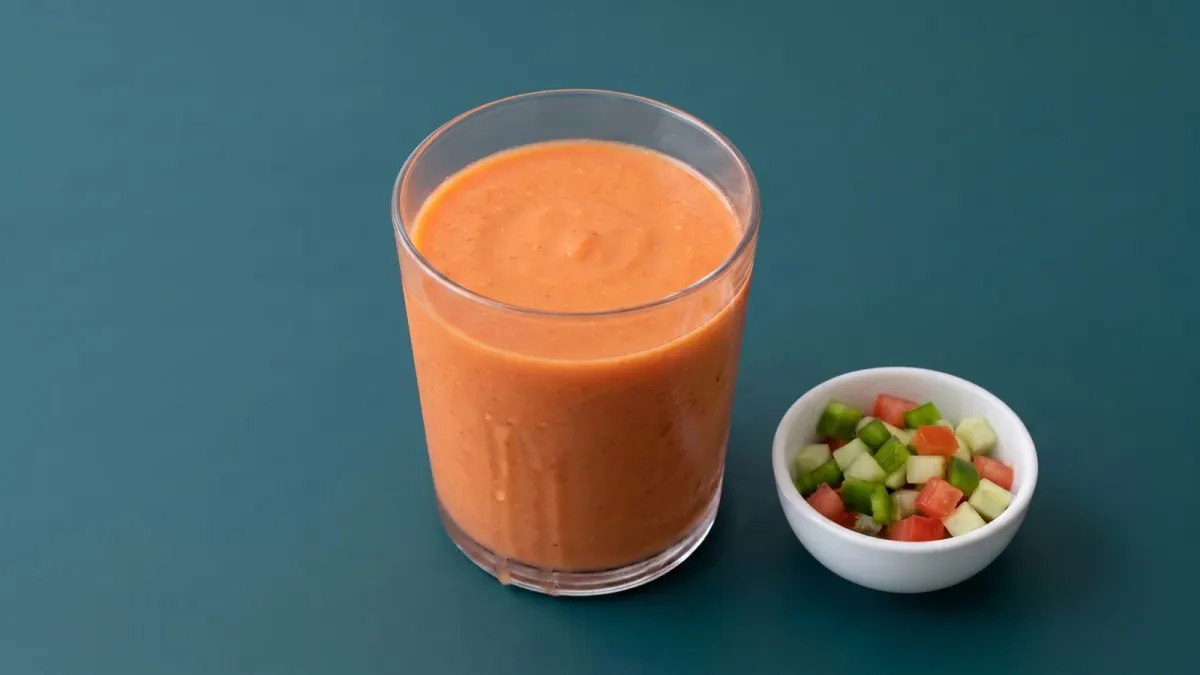
Gazpacho andaluz
No heat. The only cooking is the cold, and it wants its full two hours.
- In all
- 2h25min
- Hands-on
- 25min
- Waiting
- 2h
- You save With the steps in parallel, instead of one at a time.
- −10min
Difficulty: 2 of 5. 265 kcal each With the steps in parallel, instead of one at a time.
The median
The quantities are the median of the versions that give them, not one person’s opinion.
The time
The sources 15min
The plan 2h25min
3 of 15 sources state a time: 15min to 1h15min, median 15min.
Ingredients · 4 people
- Ripe tomatoes 8
- Green pepper 1.5
- Cucumber 1
- Garlic 1 clove
- Onion to taste
- Stale bread 1.5 slices
- Extra-virgin olive oil 6 tablespoons
- Wine vinegar 2 tablespoons
- Salt 5 g
The plan
2h25min, 25min of it hands-on.
for 4 · one cook · one pan and two pots
- 01 Cut the tomatoes into wedges hands-on, minutes 0–6
- 02 Soak the bread waiting, minutes 1–11
- 03 Prep the other vegetables hands-on, minutes 6–11
- 04 Blend veg, bread, salt and vinegar hands-on, minutes 11–13
- 05 Stream in the oil hands-on, minutes 13–15
- 06 Pass through a fine sieve hands-on, minutes 15–21
- 07 Rest in the fridge waiting, minutes 21–141
- 08 Garnish and serve hands-on, minutes 141–145
- hands-on
- watching
- waiting
The plan is for one cook, with one pan and two pots: PREP lines the steps up side by side.
In the app this plan guides you step by step, and rings when a pot is ready. Notify me
The steps
-
01 Cut the tomatoes into wedges
Wash them, big wedges, skin and seeds stay in.
- Ripe, the kind that give under your thumb. The sweetness of a gazpacho comes from there and nowhere else, not from sugar: with unripe tomatoes no amount of vinegar will save it.
- Don't peel them and don't deseed them. The strainer handles that at the end, and in the meantime the blender pulls colour and flavour out of the skins.
- Cut out the stalk core: it's tough, it won't blend, and you'll still feel it in your mouth after the strainer.
- The board is left wet with juice: that liquid goes in the blender, not down the sink.
- Tomato outweighs all the other vegetables put together, and it's the one proportion every source agrees on. It came late to the dish, though, in the nineteenth century: before that, gazpacho was bread, oil, vinegar and garlic pounded in a wooden mortar.
IT’S READY WHEN Wedges all the same size and no white stalk core left attached.
-
02 Soak the bread
Stale bread in a bowl, cold water just to cover.
- Day-old white bread, tight crumb. Fresh bread turns to glue and makes the gazpacho gummy instead of creamy.
- Not much: bread here is support, not the base. When it becomes the base the dish changes name and turns into something else, thick enough for a spoon.
- Squeeze it out before it goes in the blender, or the soaking water counts twice and the gazpacho comes out watered down. Some soak it in a ladleful of the gazpacho itself instead of water: that way the liquid count doesn't move at all.
- Plenty of modern Andalusian versions drop the bread entirely and trust the tomato alone. Most written sources keep it, though, and keep it to a minimum.
- With a powerful blender, some skip the soak and throw the hard crusts straight in. It works, but the texture stays grainier.
IT’S READY WHEN It gives under your finger without crumbling and there's no hard core left in the middle.
-
03 Prep the other vegetables
Pepper deseeded, cucumber peeled, garlic and onion peeled.
- Green pepper, thin-walled, the Italian type. Not red: it's sweeter and pushes the dish towards a different recipe.
- The cucumber always gets peeled. The skin brings bitterness and an aftertaste the cold doesn't cover — if anything, it stretches it out.
- Go light on the garlic: raw and cold it grows in the glass, and by the next day it covers everything. The sources sit at one clove per kilo of tomato, and the ones that double it say so.
- Onion is where the sources split, and the half that leaves it out is the bigger half. If you use it, make it a sweet one and go easy: too much of it and it's the one vegetable that buries the tomato for days.
- Set aside a small piece of pepper, one of cucumber and one of onion, and cover them in the fridge along with everything else: left out they dry and oxidise the whole time the gazpacho is resting. They're the garnish: the ingredient list already counts the pepper and cucumber as extra (the onion is to taste) — don't take them from the pile you're blending, or it drops below the median.
IT’S READY WHEN Pieces the size of walnuts: the blender does the rest, and chopping them fine now is wasted time.
-
04 Blend veg, bread, salt and vinegar
Everything in the blender at full speed, water after, oil last.
- The oil doesn't go in now. Blended for a long time with the vegetables it oxidises and turns bitter: it goes in later, in a thin stream, at low speed.
- Salt and vinegar go in right away. Salt works by osmosis and pulls the water out of the tomato, and that's flavoured liquid, not tap water.
- Water is the variable: add it at the end, a little at a time, until the gazpacho runs but still coats the spoon. Start from very ripe tomatoes and you add none at all.
- No ice in the blender, ever. It chills fast but it dilutes, and the tomato disappears. If you want it ice-cold, serve the ice on the side.
- There's a school — Dani García, Carme Ruscalleda — that seasons the cut vegetables and lets them macerate in the fridge before blending, to draw the water out of the tomato instead of adding any. It comes out more intense and asks for no water, but it costs a wait as long as the final rest, before you've even started.
IT’S READY WHEN No specks of skin visible, and the red turning orange: that's the air worked in, and it's normal.
-
05 Stream in the oil
Blender at its lowest, oil down slow and steady.
- You want an emulsion, not a slick of dressing floating on top. Oil and tomato water bind only if the oil goes in slowly and the blades turn slowly.
- The garlic is there for flavour: without it gazpacho tastes like vegetable juice — and in the old gazpacho, the one without tomato, garlic was already there.
- Extra virgin and good: it's the only fat in the dish and you taste all of it. Andalusia uses green, bitter oils, the kind that stand up to the vinegar instead of vanishing under it.
- The most common ratio in the sources is five parts oil to three of vinegar: three sources out of six sit exactly there. Two more climb towards three to one, one drops to one to one. Here the ratio comes out at two and a half to one, mid-range, a little less sharp than the most common one. Taste before it goes in the fridge and move the vinegar, not the oil.
IT’S READY WHEN The colour lightens towards salmon pink and the cream holds together when you stop the blades.
-
06 Pass through a fine sieve
Fine sieve, a ladle to press, skins in the bin.
- This is the step that separates a gazpacho from a vegetable smoothie: skins, seeds and fibres stay behind, only the cream goes through.
- Press with the back of a ladle and scrape the underside of the strainer: the densest part clings there, and it's the best part.
- The sources split, and neither side hides why. Arguiñano prescribes it in the body of the recipe — «Tritura todos los ingredientes con la batidora eléctrica, cuela y pásala a una sopera» — Canal Cocina calls it advisable but not necessary, «aunque no es necesario, es aconsejable», and Directo al Paladar brings it up as a fix, «si quedara algún pellejo». Skip it and the gazpacho is still drinkable but rough, and you feel the seeds.
- What stays in the strainer looks like a lot and is almost all skin: it's exactly the part you wouldn't drink.
IT’S READY WHEN A dry, pale paste left in the strainer; below it, a smooth cream that runs off the ladle in one unbroken stream.
-
07 Rest in the fridge
Covered, on a cold shelf, never in the door.
- This isn't optional. Straight out of the blender the gazpacho is loose and tastes of raw vegetables: the cold pulls it together and the flavours settle. It's the only cooking this dish gets.
- Sealed glass container, low shelf. In the door the temperature swings every time the fridge opens, and the gazpacho doesn't keep as well.
- Overnight is better still, and every source that takes a position agrees on that. No more than four days, say the food-safety people, and the reason is that «hay microorganismos patógenos que no producen alteraciones»: they change neither colour nor smell. When in doubt, throw it out.
- A Spanish university study found that the processing itself costs vitamin C compared with the raw vegetables you started from, and recommends making gazpacho shortly before you serve it, or storing it properly. One more reason not to leave it sitting out of the fridge.
- Chilled, not freezing. Below a certain point the tongue stops registering and all that's left is cold red liquid: «las papilas gustativas disminuyen su sensibilidad con las bajas temperaturas».
IT’S READY WHEN The glass mists up and the gazpacho stays together. If it has split into two layers, a turn with the whisk brings it back.
-
08 Garnish and serve
Small dice of what you set aside, in separate bowls.
- Taste again now, cold. Cold mutes salt and vinegar: what was right at room temperature comes out of the fridge flat.
- The garnish goes to the table separately and everyone helps themselves: sitting in the gazpacho it softens right away and loses the crunch, which is the whole point of it.
- In Arguiñano's version the garnish includes slices of bread as well. Not here: the bread on the list is the bread that goes in the blender, and adding more weighs down a dish that starts out light.
- You drink it from a glass or eat it with a spoon: the difference is how much water you added, not the recipe.
IT’S READY WHEN An even, opaque film on the sides of the glass, no sediment at the bottom.
Where the sources disagree
- 1
Bread or no bread
Directo al Paladar, Arguiñano, Canal Cocina, Miriam García and Javi Recetas use bread; Cocinando entre Olivos and Dani García don't, and for him bread only goes in because water does. Here there's bread, but not much, as in most versions: it binds and gives body without making it so thick you need a spoon. Without it the gazpacho is lighter, the way Javi Recetas likes it, and it's the one to make if you avoid gluten.
- 2
Sieved or not
Directo al Paladar, Arguiñano and Dani García push the gazpacho through a sieve, and Canal Cocina through a mouli, advisable but not essential; Miriam García, Cocinando entre Olivos and Javi Recetas don't, and Javi only sieves the tomato, for anyone who doesn't want the seeds. Here it's sieved, as most do: the skins and seeds stay behind. With a very powerful blender you can skip it; otherwise it stays coarse and you can feel the seeds.
- 3
Macerate first or not
Dani García and Carme Ruscalleda dress the chopped vegetables with oil, salt and vinegar and leave them to stand before blending: he gives them at least two hours in the fridge, often overnight, she at least half an hour. The other recipes blend straight away, and so does this one, because macerating adds a wait before you've even begun. It makes a more intense gazpacho that needs no water: it's for anyone who can start well ahead.
Where the numbers come from
This recipe compares 15 sources. The quantities are the median of the versions, not one person’s opinion: where the sources disagree, the majority wins. Here they all are.
- Directo al Paladar — Gazpacho andaluz casero, la receta tradicional más fácil 1h15min
- Karlos Arguiñano / Hogarmania — Gazpacho andaluz, receta tradicional 15min
- Canal Cocina — Gazpacho andaluz —
- Miriam García, El invitado de invierno — Gazpacho andaluz 15min
- Cocinando entre Olivos (Jaén) — Gazpacho andaluz tradicional —
- Javi Recetas — Gazpacho andaluz tradicional —
- Recetas y Gustos — Receta gazpacho andaluz tradicional: cómo hacerlo en 15 minutos —
- Directo al Paladar — Gazpacho: nuestra nueva receta favorita (y siete trucos para que salga perfecto) —
- Infobae — Dani García: los trucos para el mejor gazpacho tradicional —
- El Español (Málaga) — Dani García y Carme Ruscalleda sobre la maceración previa —
- ArqueoTimes — Recetas a través de la Historia: el gazpacho andaluz —
- Wikipedia ES — Gazpacho —
- Universidad de La Laguna / Universidad Complutense — La elaboración del gazpacho hace perder vitamina C a sus ingredientes —
- Directo al Paladar — Cuántos días aguanta el gazpacho en la nevera (Beatriz Robles) —
- eldiario.es Consumo Claro — Receta tradicional del auténtico gazpacho andaluz —
- With PREP’s plan 2h25min
Published .
Allergens
- Gluten
- Sulphur dioxide and sulphites
They come from the recipe's list. The label on what you buy is what counts.
More recipes
- Pulpo a la gallega 1h31min
- Crema catalana 4h17min
- Churros with hot chocolate 1h
Coming to the App Store.
For 2h of this recipe’s 2h25min your hands are free: PREP tells you what to do meanwhile, and when to go back to the stove.
Leave your email: we’ll write once, when it’s out.
We count visits to the website without cookies and without knowing who you are.
One step left.